- Heat Soaked Glass
- Laminated Glass
- Tempered Glass
Heat Soaked Glass

The HT Glass Pte Ltd (HTG) is one of Singapore's leading manufacturers that specialised in the production of tempered and laminated glass for the architectural glass market. We operate a highly automated domestic plant for high-tech, value-added production.
We are incorporated on 11th January 2007as a limited exempt private company with an initial paid up capital of S$300,000. We conduct our operation at 5 Sungei Kadut Street 4, which was previously rented from Wah Guan Hup Kee Pte Ltd.
Moving ahead with confidence and commitment, HTG has completed the transfer of the lease and is the legal lessee of the plot of land where we operate as of 21st August 2009.
Laminated Glass
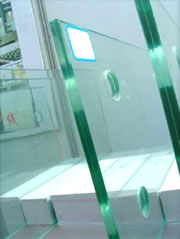
Laminated Glass In order to make glass safer, a thin layer of adhesive permanently bonds together two or more sheets of annealed, heat-strengthened, or fully-tempered glass. When the sheets are joined under 250 degrees heat and compression, they create a single panel that has significantly greater strength and ductility than its single laminate counterpart.
A common adhesive, polyvinyl butyral (PVB) is invisible if applied evenly. If one layer of glass is shattered, the fragments adhere to the interlayer, which protects people from dangerous shards of falling glass as long as the remaining lites of glass are strong enough to support the total dead weight of the glass assembly.
Subsequently, the internal layers of glass are protected from damage by the exterior lites of glass, which are often referred to as the "sacrificial" panels. Laminated glass often consists of only two lites, however over 25 layers have been successfully bonded in an assembly over 100 mm thick.
Main Feature of Laminated Glass The advantages of laminated glass are numerous and extend beyond the obvious safety benefits that multiple lites of bonded glass provide. Laminated glass resists penetration and impact, which is beneficial in security applications.
The additional environmental benefits make its use as an architectural and engineering structural material extremely desirable. Tinted and translucent interlayer can absorb and refract light so as to minimize solar gains within the interior of a building which translate into energy and financial savings.
In addition, the interlayer provides a damping effect that minimizes unwanted external noise, a truly a boon to high-density urban areas where noise reduction can lower stress and increase productivity.
Tempered Glass
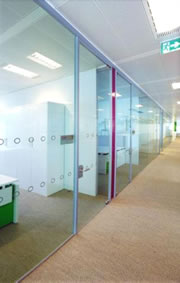
Tempered Glass One method of strengthening glass is to enforce compression in the outside "skin" of a glass panel. This compression serves to close small existing cracks inevitably present from the manufacturing process, and to compensate tensile forces. The glass is then more resistant to impact loads since the induced peak tensile stress at the point of impact is compensated by the compression of the skin.
A sheet of annealed float glass, complete with all mounting holes and polished edges is heated to roughly 650 degrees in a furnace. The panel is removed from the heat, and then the outside of the glass is quenched with air jets so that the surfaces are cooled quickly and the core more slowly. At ambient temperature the core continues to cool and compression stresses develop in the surfaces, balanced by tension in the core.
Main Feature of Tempered Glass Tempered Glass is about four to five times stronger than annealed glass of the same thickness. This is due to contraction of the inner layer during the process of tempering hence inducing compressive stress on the surface of the glass.
When annealed glass breaks, the glass fractures into large, sharp shards. However, when tempered glass breaks, the tensile stress layer inside collapses, resulting in broken glass fragments to be small and relatively harmless compared to breaking of annealed glass.