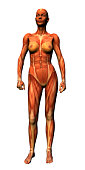
The knee joint is the mating and movement of three bones; the femur or thigh bone, the tibia or shin bone and the patella or knee-cap. The bones are joined together by ligaments and tendons. The tendons attach the muscles to the bones and the ligaments attach the bones to one another .
THE KNEE JOINT - WHAT GOES WRONG
If the surfaces of the knee bones become worn (arthritis), pain and limited mobility may result. Often, the surfaces of the bone will wear unevenly causing a bow-legged (varus) or knock-kneed (valgus) deformity. If the pain and deformity become severe enough, Total Knee Replacement may be indicated.
KNEE REPLACEMENT SURGERY OVERVIEW
In general, Total Knee Replacement is a very safe and effective procedure. However, it is a major operation that is quite invasive.
The outline below is indicative of the standard approach. A minimally invasive technique is similar, but the incision and disruption to surrounding soft-tissue is reduced.
An incision is made a few inches above the knee cap and extends just below the knee into the shin. The outer capsule of the joint is opened and the bones of the knee are inspected. In one type of procedure, both the ACL and PCL are removed (if present). The ACL (anterior cruciate ligament) and the PCL (posterior cruciate ligament) are the primary front-to-back stabilizers of the knee joint. In patients with advanced disease, these ligaments are compromised or absent.
Femoral Preparation in Total Knee Replacement
A small hole is drilled in the end of the femur (at about the center of the knee joint.)
A long rod is placed in the intramedullary canal of the femur (the hollow portion of the bone where the marrow is).
A cutting guide is placed on the rod and rotated so that it sets up a slot to make the femoral distal cut. This is a cut that created a plane that is roughly parallel to the floor if you were in a standing position. This cut is made such that it is perpendicular to a line connecting the center of the hip and the center of the ankle. This line is the mechanical axis of the lower extremity and it is important that the implant is aligned properly with respect to this. In doing so, the load distribution across the implant is optimized and the longevity of the implant maximized.
Next, a cutting guide is placed on the plane of the distal cut, it is aligned in rotation and 4 more cuts are made. The rotational alignment here (which is called internal/external rotation) is important in balancing the soft tissue and aligning the patella track of the implant. The patella track is literally a track or groove in the implant in which the patella moves during knee motion. Incorrect alignment of this track can lead to pain and/or accelerated wear of the patella component.
Once these cuts are made, the preparation is basically finished. Some implants have small fixation pegs on the distal surface so two holes are sometimes drilled for these. In the case of a PS implant (see PS implant post), a box is cut out from roughly the center of the prepared femur to make space for the cam/post mechanism of the PS implant. The outline below is indicative of the standard approach. A minimally invasive technique is similar, but the incision and disruption to surrounding soft-tissue is reduced.
Tibial Preparation in Total Knee Replacement
Typically, the top surface of the tibia is resected creating a planar surface that is perpendicular to the shaft of the tibia. In a PCL retaining procedure, a bony island is preserved around the insertion site of the Posterior Cruciate Ligament in the tibia. In a PCL sacrificing procedure, the PCL and the insertion area are removed.
About 8mm of bone is removed as measured off of the good side of the joint surface of the tibia known as the tibial plateau. In the arthritic knee, there is usually uneven wear of the joint surface. The joint basically collapses on the diseased side. The resection level is typically a couple of millimeters below the surface of the worn side of the joint, or 8mm off of the good side. Creating a flat tibial surface therefore requires a wedge shaped piece of bone to be removed.
Once the resection is made, trial components are placed in the joint. With the femoral and tibial prep complete (and often the patella prep as well), and a trial femur and tibia implant in place, the surgeon basically moves and tenses the joint through a range of motion. The surgeon can use tibial insert trials (also called tibial bearings or tibial spacers) of various thicknesses until the correct stability is achieved. The tibial insert trial corresponds to the tibial insert implant that will eventually sit in between the metal femoral and tibial implant components.
Often, the surgeon must make surgical corrections of certain soft-tissue structures to help align and stabilize the knee.
Once trialing is complete, the appropriate keel preparation is made. The keel is a fin or cross shaped protrusion on the implant that helps it stay fixed and in the bone. This can be punched, chiseled, broached or cut into the tibia and a set of instruments is used so that the resulting shape matches the implant. Here, the surgeon must take care in aligning the keel preparation so that the correct rotation of the implant about the axis of the tibia is achieved. Correct rotational alignment of the implant promotes better distribution of load across the implant and better motion of the knee joint.
Next, the tibial baseplate portion of the implant is simply pressed or cemented in place.
A plastic tibial insert is then snapped into the tibial baseplate (see the Implant section for more details). The insert comes in the various thicknesses that correspond to the trial used previously.
After Total Knee Replacement
The key difference is the relative size of the end of the femur or thigh bone. For a given front-to-back or anterior-posterior (AP) width, the femurs of females tend to be narrower in the medial-lateral (ML) or side-to-side direction compared to males. An implant which is proportioned based on male anatomy would, therefore, be too wide on a similarly sized female. The result is that when a surgeon sizes the implant based on the AP width of the femur, the implant could "overhang" the narrower female bone and cause irritation of the surrounding soft-tissue. Faced with this situation, orthopaedic surgeons are sometimes forced to "downsize" the femoral component during total knee replacement surgery. In downsizing the femoral component, the doctor chooses a smaller implant, so that the implant does not overhang the sides of the bone.
There are, however, some potential disadvantages to downsizing depending upon the type of instrumentation system the surgeon is using during the knee replacement procedure. If the surgeon is using an implant system where the femoral component is placed at a particular distance relative to the anterior surface of the femur (anterior referencing), excessive laxity in flexion can occur with downsizing. Alternatively, if the doctor is using a system which references the posterior aspect of the femur, the resulting femoral preparation could "notch" or undercut the anterior aspect of the femur. This could, in turn, lead to fracture of the femur.
Recognizing that neither of the above scenarios is desirable, the makers of implants specifically designed for females have sought to remedy this by making the implants more narrow in the ML direction. On a male knee, the implant could "underhang" leaving some distal femoral bone exposed, but this is generally not a problem.
In the company announcements, both manufacturers noted that their new "Female" knee replacements are designed to address the more narrow female femur. Zimmer also noted that differences extend beyond femur width to things such as the angle of the femur in relation to the tibia. It will be interesting to see how these new implants fair clinically and whether the potential advantages are realized.
Both Ralph Serpe & Lou Serpe are contributors for EditorialToday. The above articles have been edited for relevancy and timeliness. All write-ups, reviews, tips and guides published by EditorialToday.com and its partners or affiliates are for informational purposes only. They should not be used for any legal or any other type of advice. We do not endorse any author, contributor, writer or article posted by our team.
Ralph Serpe has sinced written about articles on various topics from Guide Guitar, Painting and Health. For more detailed information and resources on , visit
Cost Health Insurance Premiums And it goes on and on. If we really want to solve the affordable health insurance crisis here in America we must first make healthcare in general more affordable.