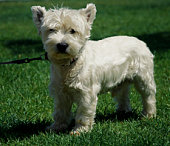
The Bouvier des Flandres makes a great family pet for those who would like to have a watch dog and guard dog combination. She can be relatively inactive indoors and can be exercised via many walks. A better situation for her is a properly fenced in exercise area. She is good with other dogs and pets, especially if she has been socialized with them early on. She is generally good with children but may have a problem with their friends. Just as a reminder, never leave young children alone with any puppy or dog.
*Approximate Adult Size. The approximate adult size (two years old or older) of the male Bouvier des Flandres ranges from 24 to 28 inches to the withers (highest point of the shoulder) and 75 to 90 pounds and the females run from 22 to 27 inches to the withers and 60 to 80 pounds.
*Special Health Considerations. Most dog breeds have certain inherited health problems associated with that specific breed and the Bouvier des Flandres is no exception. Be on the look out for bloat (Gastric Dilation-Volvulus, the second leading killer of dogs, can kill within the hour, this space is too limited for a complete explanation but you should read up on this). Feeding more then once a day and avoiding exercise right after meals may help guard against bloat.
Also be aware of canine hip dysplasia (genetic based looseness in the hip that can lead to arthritis pain and lameness), Laryngeal Paralysis (muscular narrowing of the airway especially during exercise) and eye problems. This disease list is an informative guideline only. Other diseases may also be significant threats, please contact your veterinarian for a complete list.
She should visit the veterinarian several times in the first year for shots, boosters and check up. Then, as an adult, she should visit the veterinarian yearly for shots and check up. As she gets older, six years and on, she should visit the veterinarian twice a year for check ups and shots. Remember; avoid feeding your dog sweets.
*Grooming. The Bouvier des Flandres has a rough coat with a dense undercoat that requires plenty of attention. She needs to be brushed regularly, bathed infrequently and trimmed professionally several times a year. The pads of her feel will need to be trimmed also.
Her teeth should be brushed at least twice a week with toothpaste and toothbrush designed for dogs. Brushing removes the accumulation of plaque and tartar which can cause cavities (rarely) and periodontal disease. Dog periodontal disease can lead to pain, loss of teeth, bad breath and other serious disease.
Her toenails may need to be examined for growth and clipped regularly. The toenails of the rear feet grow slower than the toenails of the front feet. Generally a guillotine type trimmer is the best for this chore and competent instructions to accomplish this can be found on the net.
Her ears should be checked once a week and be kept clean. When you have her professionally groomed, make sure ear cleaning and inspection is part of the package. No water or excess fluid should get in the dogs ears, and do not try to irrigate the ears. Ear cleaning is too complicated and critical to instruct here. Look for hair growing in the ear canal, excess wax, or moisture. If her ears have a discharge, foul odor or she seems to be in distress and you suspect an infection, or tumor, consult your veterinarian.
*Life Span. The Bouvier des Flandres can live between 10 and 12 years with proper nutrition, medical care and excellent living conditions.
*History. The Bouvier des Flandres originated from Flanders, Belgium around the sixteenth century. They were bred to drive cattle and pull carts. The name Bouvier means driver of oxen. They were almost lost during World War I. They came to the United States around 1930. They were first registered by the American Kennel Association in 1931.
Some Registries:
*American Bouvier des Flandres Club.
*UKC United Kennel Club
*NKC National Kennel Club
*CKC Continental Kennel Club
*APRI Americas Pet Registry Inc.
*AKC American Kennel Club
*FCI Federation Cynologique Internationale
*NZKC New Zealand Kennel Club
*KCGB = Kennel Club of Great Britain
*ANKC = Australian National Kennel Club
*ACR = American Canine Registry
Litter Size: 5 to 10 Bouvier des Flandres puppies
Category: Herding.
Terms To Describe: Intelligent, trainable, powerful, agile, bold, spirited, fearless, alert, brilliant, well behaved, serene, calm, gentle
*SPECIAL GOOD POINTS
Very good watch dog.
Very good guard dog.
Generally will stay home, not roam.
Good with children but maybe not their friends.
Can tolerate cold.
*SPECIAL BAD POINTS
May be aggressive to other dogs.
High pain threshold. Hard too tell if they are hurting.
She needs an experienced owner.
Slow to mature.
May be suspicious of strangers.
*Other Names Known By: Belgian Cattle Dog
*Every dog is an individual so not everything in this information may be correct for your dog. This information is meant as a good faith guideline only.
Bouvier Des Flandres Puppies
During World War I the breed suffered almost to the point of extinction and the Bouvier of today descends from the limited gene pool of the few who survived. This dog has become gradually more numerous in the United Sates. It was placed into the Herding Group in the American Kennel club registry, but its general purpose is that of a Working Dog and the characteristics of this dog's temperament resemble more closely the working dog temperament than the characteristic temperament associated with the herding dogs.
The breed exhibits a dependable disposition, loving the company of people and being very gentle with children. This is a dog that does well in a household despite his size, being serene and steady and also performs many jobs reliably and without any sign of poor temperament. The Bouvier Des Flandres is well suited to country life. It has a desire to work and does well as a general farm dog. This is a dog with high intelligence and can become bored and overly obese without activity and some sort of job to do.
The Bouvier's large size has made him useful as a watch dog, a Guide Dog for the Blind, an Assistance Dog, a Messenger Dog and general Police work. The breed of course still retains some of the drovers tendencies and he has been used successfully as a draft dog and a herding dog. His appearance is more forbidding to strangers than his temperament and he makes a generally good watch dog.
He should be 25 to 27 inches at the withers, with a harsh double coat which should appear "tousled" according to the standards of the A.K.C. The coat should be weather resistant and the muzzle should be bearded. There should be "eyebrows" similar to the Schnauzer in appearance but these should not be shaped or trimmed excessively as is done with the Schnauzer. Color can be anything from fawn to black with varying qualities of salt and pepper or brindle. There can be no markings of white except for a small star on the chest, which is the only acceptable amount of white.
This breed carries both of the inherited tendencies of hip dysplasia and gastric torsion which are common in large breeds. Buyers of Bouvier puppies should be sure that they purchase from a reputable breeder who has x-rayed for dysplasia. Gastric torsion may be avoided if the dog is fed separate meals morning and night or three times a day rather than allowing the food to be freely dispensed from a feeder. There are few other health problems.
Both Mitch Endick & are contributors for EditorialToday. The above articles have been edited for relevancy and timeliness. All write-ups, reviews, tips and guides published by EditorialToday.com and its partners or affiliates are for informational purposes only. They should not be used for any legal or any other type of advice. We do not endorse any author, contributor, writer or article posted by our team.
Mitch Endick has sinced written about articles on various topics from Home, Puppies Dogs and Education. Mitch Endick is a short article writer, editor and website developer for the popular pet site petpages.com.
Calories Intake For Women Therefore, female bodybuilders who have gone through this phase of their life must focus on taking calcium rich diets like beans, cabbage, tofu, green leafy vegetables and most importantly, one large...