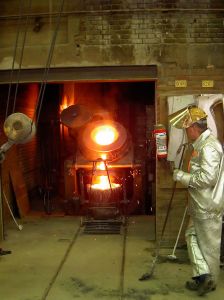
Bronze Casting has been practiced for centuries. Many civilizations have used this alloy for weapons, sculptures, and general pieces of hardware. The popular way to cast bronze is the Lost Wax Casting process which was first used sometime in the 3000 BC near ancient Sumeria. The Lost Wax process is still used to this day and its modern equivalent Investment Casting is very popular with jewelry makers.
Bronze is the preferred alloy for metal working artists as it's relatively easy to work with and resistant to corrosion. The properties of bronze tend to be stronger than most other alloys, except of course for steel, and lends itself easily to the molding and casting process. Many small foundries like the kind that can be found in a backyard or workshop find that bronze is a great material to work with and with a melting point of 1,700 Fahrenheit or about 925 Celsius many homemade furnaces are able to melt down the bronze quickly and efficiently.
Many modern day artists create their own furnaces with the metal casting in mind. These metal casters employ the Lost Wax Casting method which proves to be the best when dealing with the alloy. The Lost Wax Casting is making an original of the sculpture from wax and then creating a mold using this original. Often times the original is lost during the mold making process so keep that in mind if you want to hang on to the original for whatever reason. Molten wax is poured into the mold which is chased or smoothed of imperfections. During this point, any other pieces are attached and small wax tubes are placed into the piece. These tubes will be how the molten bronze is going to travel into the piece replacing wax with the alloy. When this is complete the artist will create a ceramic shell around the wax model. This shell will help form the molten bronze which will melt the wax. When the molten bronze is poured the bronze takes place of the wax. Afterwards, the artist will crack the shell and reveal the bronze piece. This method allows the transfer of very exact detail from the wax to the bronze.
Patina is added to the figure at the artist's discretion. The Patina is a chemical that when applied to bronze creates colors and makes the bronze take an aged look. The Patrina compounds used depends on the type of color desired. Ferric Nitrate will make the bronze take on a red or brown color while Sulphurated Potash will make black and Cupric Nitrate will create blue and green. Modern day artists choose to go with a very high polished bronze instead of using these compounds. This step depends solely on the artist's taste and the look they are going for.
Bronze casting will remain a popular medium until another alloy is developed that exhibits properties that are easier to manage and are more resistant to corrosion. Casting the alloy is easily done so metal casters that want to experiment are encouraged to do so. Making anything from small figurines, large sculptures, and even cabinet handles can be accomplished with the use of bronze. The only limitations in bronze casting are with the caster himself.
Brass And Bronze Casting
Bronze has been the most sought-after metal for cast metal sculptures in the bygone years. Bronze alloys have a desirable and unusual property to expand slightly prior to their setting. This helps a great deal in filling every corner of the mold. Their ductility and strength causes them to be molded into any form. However, bronze has a basic disadvantage of not being durable. Hence, there are hardly any traces of ancient bronze statues found. Bronze casting generally takes place by a process called lost-wax casting. Though, centrifugal and sand castings are also employed, around 90% of bronze casting takes place through lost-wax casting.
Lost-wax method: Lost-wax casting, in the industry, is better known as investment casting. It is costlier than die and sand casting, but outshines them in terms of accuracy. It is easily possible to make complicated structures through ‘lost-wax casting'. The process can be described as follows:
Sculpting: First, the original artwork is created by the artist from clay, wax, or some other material. Mostly, clay (oil-based) and wax are used due to their property of retention of softness.
Mold making: Majority of molds consist of 2 pieces, along with a shim placed between 2 halves at the time of construction in order to put back the mold accurately. Keys are kept in the shim. The small sculpture molds generally consist of plaster. Fiberglass can also be used. To have the minute details preserved on the surface of original artwork, there exists a mold inside. It is made up of vinyl, silicone, or latex supported by plaster part of mold. Generally, the destruction of original artwork takes place during making. This is due to the solid nature of the originals. The other reason is the rigidity of the originals at the time of removal of plaster mold. That's why; the original is cut off into thin, long pieces and separately molded. At times, a number of molds are required for recreating the original structure.
Wax: After the completion of latex-and-plaster mold, the pouring of molten wax takes place. Then, swishing is carried out till a uniform coating is obtained. The thickness of the coating is 1/8 inches. The mold's inner surface gets covered by it. This process is repeatedly executed till the preferred thickness is attained.
Wax removal: Artwork's ‘hallow wax copy' is detached from mold. This mold may be reused by the artist for making more copies of wax, but its use gets restricted due to frequent ‘wear & tear'. Around 25 copies can be made for tiny bronze artworks.
Chasing: The chasing of each copy starts. Rubbing of the marks is done by a hot metal tool. The marks showing ‘flashing' or ‘parting line' are rubbed out.
Spruing: The spruing of copy generates paths to flow (for molten bronze) and causes air to move out.
Slurry: The dipping of sprued copy into a liquid silica slurry, and then into sand-like ‘stucco' takes place. This process is repeatedly carried out till the coating attains thickness of at least ½ inch.
After these steps, the out-and-out processes like burnout, testing, pouring, releasing, metal chasing, and patinating are carried out.
Kent Klein has sinced written about articles on various topics from Room Furniture, Computers and The Internet and Computers and The Internet. Go to Metal Casting Zone to get your free ebook on Metal Casting at . Metal Casting Zone also has. Kent Klein's top article generates over 14800 views. to your Favourites.
Carbon Auto Theft Games If you really need or want to keep your vehicle safe from auto theft you can use all of the steps above as well as all of the security systems outlined above. You can make certain choices with your vehicle that can easily prevent auto theft