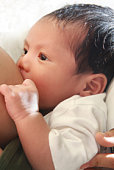
As soon as the infant is born, levels of estrogen, progesterone, and prolactin decline, and the level of oxytocin increases, which prompts delivery of a premilk liquid called colostrum. This thick, yellow substance is rich in antibodies that help fight off infections and allergies, prevent intestinal problems, and build up the infant's immune system.
Preparing to Breast-Feed
Most new mothers feel awkward and nervous the first few times they breast-feed. That's because it involves positions, movements, and feelings that are new. Although it is not within the scope of this book to address all of the issues surrounding breast-feeding, this book does give you a solid foundation on matters concerning breast health.
The Wonders of Breast-Feeding
When a baby begins to suckle, prolactin levels rise, prompting the production of milk. The nerves that surround the nipple and areola signal the hypothalamus, which then transmits a message to the pituitary gland to release oxytocin. The oxytocin stimulates the myoepithelial cells and the breast muscles to push I he breast milk toward the ampulla, where the milk collects before it is released through the nipple
The reflex that releases the milk from the breasts to the infant is called the let-down or the milk-ejection reflex. It operates automatically in the majority of women. It is often accompanied by the following signs:
Tingling or mild pain in the breasts
Uterine contractions
A feeling of fullness or warmth in the breasts
Negative emotions or events can have a corresponding negative effect on let-down. Women who are experiencing pain, embarrassment, anger, fatigue, illness, or fear may find it hard to get their milk flowing initially.
A trusted friend or a lactation expert from organizations such as La Leche League International and the International Childbirth Education Association can help in these matters.
The American Academy of Pediatrics recommends that mothers breast-feed their infants for at least 6 months, preferably 1 year or longer. If you must breast-feed for a shorter time, do so while slowly weaning your child to formula.
If you must return to work but also want to continue to breast-feed, use a breast pump and save your milk for your infant. Some mothers combine breast-feeding and formula feeding.
Discuss your options with your doctor, or contact La Leche League International or the International Childbirth Education Association for more information.
SELF CARE DURING BREAST-FEEDING
Remember that whatever you eat is transferred to your child. The best foods are fruits and vegetables, whole grains, and other natural foods. Avoid processed foods; the additives and chemicals are passed along in your breast milk.
Drink plenty of liquids, such as fruit and vegetable juices, pure water, and herbal teas (no caffeine). Contrary to popular opinion, nursing mothers do not need to drink milk in order to produce milk. Avoid caffeine and alcohol.
Take vitamins as recommended by your physician.
This article is not designed as a substitute for personal medical advice but as a supplement to advice for those wishes to understand more about her condition.
Try Free Sample from Anbes, Limited Period Only. Latest Nano technology Breast Enhancement Serum That Show Immediate Results In 5 Minutes ... While stock last! They also have other skin cream using only the best pueraria mirifica as the main ingredient Hurry Click Here Now.
Breast Feeding And Pregnancy
New mothers are many times faced with the question as to weather they would like to breastfeed. There are many things that may influence a mother's decision. If you decide to breast-feed, you are giving your baby the best nutrition possible regardless of whether you nurse for just a few weeks or for several months or more. Breast-feeding also provides a unique opportunity for mother and child to form a special bond. Breast-feeding benefits the mother in many ways:
? Helps your uterus return to its normal size more rapidly.
? Helps you lose weight faster.
? Helps reduce your risk of breast cancer by causing potentially protective changes in breast cells if you nurse for at least 3 months. The risk of breast cancer is further reduced each time you nurse another baby for at least 3 months.
? Eliminates the inconvenience and expense of preparing formula and washing bottles; breast milk is sterile, always available, and at just the right temperature.
? Each breast-feeding session gives you a much-needed chance to relax.
Breast-feeding is good for your baby because it:
? Provides a unique mixture of nutrients, hormones, and proteins essential for digestion, brain development, and growth.
? Provides infection-fighting proteins (antibodies) that reduce the risk of infections of the middle ear, digestive system, and respiratory tract.
? Reduces the risk of food allergies.
? Causes fewer digestive problems, such as constipation or diarrhea, than formula.
? Reduces the risk of some chronic diseases later in life.
Your breasts were made for nursing a baby-you don't need to do anything to prepare them. In fact, experts now say that the less a woman does, the better. Ask your obstetrician to examine your breasts during pregnancy for any anatomical features, such as inverted nipples, that might interfere with breastfeeding. If you have inverted nipples, your doctor or the lactation nurse (a specialist trained to help new mothers learn how to breast-feed) may recommend wearing a special nipple shield along with performing certain exercises in the last 3 months of pregnancy to draw out the nipple.
Women with some rare health conditions, such as infection with HIV the virus that causes AIDS, should not breast-feed (HIV can be passed to a nursing baby in breast milk). If you are concerned about any condition you have, ask your doctor about it. Medications taken by a nursing mother-for treating cancer, high blood pressure, or mental disorders-can harm a nursing baby. Inform your doctor if you are taking any medications regularly; he or she can tell you if it's OK for you to breast-feed or if you should take the medication just after a nursing session or before your baby goes to bed at night. If the doctor prescribes any new medication, be sure to tell him or her that you are breast-feeding. Some diseases, such as galactosemia or PKU prevent a baby from breast-feeding because the child cannot tolerate the nutrients in breast milk. In such cases, your child's doctor will prescribe special formula.
Both Annabel Cruz & Jesse Walters are contributors for EditorialToday. The above articles have been edited for relevancy and timeliness. All write-ups, reviews, tips and guides published by EditorialToday.com and its partners or affiliates are for informational purposes only. They should not be used for any legal or any other type of advice. We do not endorse any author, contributor, writer or article posted by our team.
Annabel Cruz has sinced written about articles on various topics from Women, Breastfeeding and Breast Enlargements. Annabel Cruz is a researcher that studies Natural healing by combining both Western and Eastern ways. Feel free to use this article on your website or ezine as long as the following information about author/website is included. And we provide best puer. Annabel Cruz's top article generates over 14800 views. to your Favourites.
Jesse Walters has sinced written about articles on various topics from Parental Care, Breastfeeding and Parenting. Spring Creek Toys offers ,. Jesse Walters's top article generates over 22200 views. to your Favourites.
Centers For Substance Abuse Remember You want your loved ones to have their freedom, but drug addicts have typically not build up the self-control thats necessary to quit cold turkey