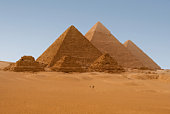
The pyramids were constructed as tombs for kings and queens, as parts of funerary complexes, where there would also be shrines and temples. The priests would summon the spirits of the deceased royalty and make offerings to ensure their immortality would be realized.
Many pyramids were built between 2700 and 1640 BC and there are still plenty surviving today, although many were reduced to rubble.
An architect with the name of Imhotep was the first master pyramid builder. He began by making a tomb in the shape of a mastaba, which is a long, flat, rectangular building, made of sun-baked mud bricks. The walls stood about 12 feet high.
Imhotep used stone to build with and kept adding to the tomb until he had made a six layered, stepped pyramid, which stood 200 feet high. This was the Step Pyramid and Saggara, the first Egyptian monument to be made completely from hewn stone.
Imhotep was greatly respected and worshipped, after his death, as a god. His incredible achievement is still standing today at Memphis, south of Cairo.
Between 2600 and 2500 BC, the time of the fourth dynasty, the Egyptians had honed their great architectural abilities to allow them to build the most famous and spectacular pyramids, the ones at Giza.
These pyramids, known as Mycerinus, Khufu and Khafre, were of a true pyramidal form and originally were built with smooth, white, limestone faces. They went on to become one of the Seven Wonders of the World because of the awe they inspired.
The biggest Egyptian pyramid at Giza, built for and named after the pharaoh Khufu, is 481 feet tall. It contains about two and a half million stone blocks and the average weight of the blocks is two and a half tons. Some weight up to fifteen tons.
Most of the stone used to build these monuments was quarried limestone. A much harder stone, granite, was also used for building the internal passages and burial chambers. This was brought a distance of over five hundred miles by river from the quarries in Aswan, in the south. Ramps were then used to drag the stones into place.
The later Egyptian pyramids of Mycerinus (204 feet high) and Khafre (471 feet) stand next to Khufu.
Within the Khafre funerary complex is also the famous limestone statue of the Sphinx, which is the biggest and oldest image of a man-headed lion.
The Sphinx is a lot smaller than the huge pyramids but is still large. It stands 66 feet high and is 240 feet long. The statue was meant to represent a divine guardian and its head is thought to be Khafre himself.
There is an inscribed granite slab between the paws of the Sphinx. This slab describes a dream which a prince called Tuthmosis had while resting in its shade during a hunt for gazelle.
He dreamt the Sphinx approached him and promised him the whole kingdom if he would clear the sand from his body which made breathing very hard. Tuthmosis did this to oblige the Sphinx and even ordered the construction of mud brick walls around the monument to discourage further encroachment.
That the Sphinx kept his word is demonstrated by the 3000 year old slab placed by Tuthmosis IV, who was the new pharaoh of the land.
Building The Egyptian Pyramids
In Egypt there are hundreds of pyramids. A few pyramids are grouped together and are situated south of the Nile Delta. The royal pyramid lies to the south of Egypt and is believed to be the last pyramid built by the emperor Ahmose. There are a few small pyramids built by the individuals in the Deir el-Medina. Some pyramids were established by the late period rulers called Nubians.
A lot of changes took place in the architecture when more pyramids were built. Royal pyramids included a courtyard to the surroundings. A portion of the pyramid was built for the king's soul and a mortuary temple was built next to it. It included an enclosure wall and a causeway to lead towards the temple. Some of the small pyramid complexes were built for the family members and were surrounded by some tombs.
The origin of pyramids is an unresolved mystery to many people still. As per ancient Egyptian mythology, the rulers particularly chose a tomb shape for the pyramid because they wanted to imitate the Bebans. It was a type of a stone found in the temples. They thought that it was the primitive mass from which life emerged. They associated it with sun and believed that it (the sun) provoked the mass to create life.
Even today all the pyramids have not yet been discovered and there are still a few pyramids, which are to be studied such as the Great Pyramid of Khufu.
Both Amar Mahallati & Paul are contributors for EditorialToday. The above articles have been edited for relevancy and timeliness. All write-ups, reviews, tips and guides published by EditorialToday.com and its partners or affiliates are for informational purposes only. They should not be used for any legal or any other type of advice. We do not endorse any author, contributor, writer or article posted by our team.
Amar Mahallati has sinced written about articles on various topics from Travel and Leisure, Family and Family Travel. Visit to find out more about this amazing country."Travel to Egypt" offers valuable information about. Amar Mahallati's top article generates over 110000 views. to your Favourites.
Paul has sinced written about articles on various topics from Chanel, Online Business and Finances. Paul has been providing answers to lots of queries through his website on a wide variety of subjects ranging from satellite phones to acne. To learn more visit. Paul's top article generates over 2240000 views. to your Favourites.
Corporate Coffee Gift Baskets All of these are available online for a many convenient shopping. Price ranges from 20 towards 300 or more