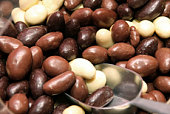
You can even learn to make fancy-dipped chocolates and bonbons that look as tempting as the ones you gazed at longingly as a child with your nose pressed against the confectioner's plate-glass window. And they'll live up to their looks, if you make them yourself.
Below you will find some general instructions for candy making. Familiarize yourself with this information, find the basic equipment and away you go!
Reading a Thermometer
With a candy thermometer you can be sure you have reached exactly the right degree of temperature for the particular candy you are making. But the thermometer must be read correctly, with your eye right on the level of the top of the mercury, not above or below.
Testing Your Thermometer
Test your thermometer by placing it in a pan of water and bringing it to the boiling point. It should now register 212 degrees at sea level. If it registers 214 degrees you can correct it by adding two degrees to those given in the recipe; if 210 degrees, by subtracting. If it is more than a few degrees off in either direction, you need a new thermometer.
Correcting the Thermometer for Altitude
For every thousand feet above sea level subtract roughly two degrees from the suggested thermometer readings. For example, if you are making fondant in the mountains and the altitude is 4000 feet, instead of cooking it up to 238 degrees you would remove it from the heat when the thermometer registers 230 degrees.
Correcting for Humid or Rainy Weather
When the barometric pressure is low or the weather is rainy or humid, cook most candies two degrees higher than you would normally.
Hard Water
If your water is unusually hard it may make the difference between success and failure in your candy-making. Boil one gallon of hard water with a teaspoon of soda for twenty minutes, to neutralize, before using water to make candy.
Storing Candy
All candy should be kept in a cool place and most should be packed in tin boxes for best keeping. Caramels should always be wrapped soon after cutting to prevent spreading.
Changing Recipes
Proportions in most recipes are carefully worked out for best results and usually should not be changed. Increasing the amount of liquid, for instance, will lengthen the cooking time and give a less tender result. Recipes can be doubled successfully in almost every instance but in that case a larger saucepan must be used or the candy will boil over or cook too slowly. Cutting recipes in half is not advisable because very small quantities are difficult to work with.
Equipment for the Candymaker
Candy thermometer
3-quart saucepan
Measuring cups and spoons
4-quart saucepan
1-quart saucepan
Heavy 12-inch skillet
Electric beater
Pans, 8 by 11 inch
7 by 7 inch Cookie sheets
Funnel and stick
Heavy, sharp knife
Waxed paper
Cellophane
Tin boxes for storing
Wooden spoons
Pastry brush or muslin-wrapped fork
Fondant paddle
Marble slab or large platter
Chocolate grater
Standard beaters, wire whisks
Follow the above instructions, and your candy will turn out right every time!
Chocolate For Candy Making
Sometimes, however, problems can come up that can affect even the most experienced candy maker. A good chocolate candy maker can end up with a bad batch of sweet things, however they will continue to try to produce the best candy that they are able to.
Ensure Dry Chocolate Mold
Some of the common problems that may occur in chocolate candy making has primarily to do with molded candy. One of the initial things you must do when you are using molds is to ensure that they are totally dry prior to adding the chocolate.
When molds are not completely dry, white markings may occur because water has become trapped inside. Some other issues are cracks within the chocolate when it gets too cold, or the chocolate candies end up being dulled when they get out of the mold. This is ordinarily caused because the chocolate is not properly tempered before pouring in the chocolate candy molds.
Effective Chocolate Tempering
One of the major issues when it comes to producing chocolate is tempering. Tempering is when the chocolate is heated so that it will melt. If a person making chocolate tempers at too high a temperature, the result would likely be the chocolate becoming crystallized causing hard sugar crystals to take form.
This will create chaos and then you will most likely throw the chocolate away which is now burned away. Other issues dealing with tempering are gray streaks and blooming. You can learn more about tempering and the best ways to keep the chocolate experience going as smoothly as possible by visiting the baking911 website can be helpful. Candy making 101 is a definite source for those who wish to avoid major errors when creating their unique, chocolate candies gifts, such as white chocolate candy or perhaps dark chocolate candy.
Chocolate candy making has been around for many generations. The people of ancient history created savory treats they believed were exclusively reserved for the gods. Good chocolate candies, can be difficult to do if you are a novice and unsure of how to cope with setbacks in the kitchen.
Nevertheless, by understanding the problems that might arise, an individual can make the best gourmet chocolate candy that they are able to on the first try, but as the saying goes, you must try and try again until you succeed.
Both Jimmy Cox & Corbin Newlyn are contributors for EditorialToday. The above articles have been edited for relevancy and timeliness. All write-ups, reviews, tips and guides published by EditorialToday.com and its partners or affiliates are for informational purposes only. They should not be used for any legal or any other type of advice. We do not endorse any author, contributor, writer or article posted by our team.
Jimmy Cox has sinced written about articles on various topics from Web Development, Horse Racing and Investments. Long-Lost Manuscript Resurfaces With The Secret Candy Recipe To Win Everyone Over!Click here for FREE online ebook!
Business Holiday E Cards Think this Christmas IMPACT.And there is nothing that has more impact then the human voice in MLM and Network Marketing