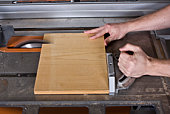
Circular saws and table saws have been around for about 200 years though not everyone can agree on exactly who invented the circular saw or even when it was invented. There are three generally accepted theories, two of which involve male inventors and one suggests the table saw was invented by a woman. All the theories essentially point to one need for a table saw: to cut the logs and lumber in saw mills.
Here are three different theories about the origin of the table saw:
Theory 1: A sail maker named Samuel Miller of England supposed invented the circular saw in 1777. He built his saw with a spinning blade that operated by wind. Larger versions of these blades were used in timber mills which means the timber industry created the first real table saw. This fixed table saw position allowed the logs to be pushed into the spinning blade much in the same way wood is pushed into a table saw today.
Theory 2: A gentleman named Walter Taylor built a saw mill in 1762 where he cut lumber for ship builders. Historical descriptions of the mill dating from 1790 describe circular type saws being used to rough cut the logs in his mill. Taylor has a couple other patents but the circular or table saw was not one of them.
Theory 3: This third theory takes place a little later. In 1813 there was a Shaker woman named Tabitha Babbit who worked at the spinning house of the Harvard Shaker community in Massachusetts. As a spinner she knew how to use a spinning wheel. The story goes that she was watching two men cut a shingle with a two-handed saw when she had the idea to mount a tin disk with notches along the circumference to her spinning wheel while pushing the wooden shingle into the spinning disk. The idea of using a spinning saw blade to cut wood was apparently a new one and her idea was later adopted and enlarged for use the local saw mill.
No matter which theory you agree with we know that the idea of a circular saw blade the operated by pushing the wood towards it probably emerged sometime in the late 1700s or early 1800s. Though technology has gone a long way it is interesting to note that the basic functionality of the table saw is essentially not that much different: a blade spins while material is fed towards it for cutting or ripping.
It is interesting to note that the concept of a table saw actually came before the use of electricity. Early circular table saws were operated in any number of more natural means including using a foot pedal like on a spinning wheel or even water powered. Many early saw mills were built along rivers to capture the motion of the water on a water wheel which was then attached to a shaft which turned a large saw blade.
Circular Saw Table Saw
Table saw is the frequent piece of large woodworking equipment. When there's only one tool that large woodworking machinery should have this would be the table saw because of its versatility. The table saw made up of circular saw blade, based on an arbor that is run by an electric motor either directly, by belt or by gears. Its blade is protrudes through the surface of the table, which provides support for the material usually wood that will be cut. A good table saw should be the centerpiece of the workshop because it is use to rip, square, miter, groove, shape and join pieces.
In latest kind of table saws, moving the blade up and down varies the depth of the cut; the higher the blade protrudes the table, the deeper the cut that is made on the material use. In early table saws, the blade and arbor are secured and table was move up and down to expose more or less of the blade and the angle of cut is controlled by adjusting the angle of blade. In earlier saws, it angles the table to control the cut angle. There are four general kinds of table saws; the Benchtop Table Saw, this kind of table saw is lightweight and designed to work while sitting on the table or other support.
It usually has direct drive or no v belt or pulleys from a general type of motor. It can be moved by one person and carried to the job location. This kind of saw often has parts that are made of steel, aluminum, and plastic that is designed to light and compact. The Benchtop Table Saw is the least expensive and least capable of the other types of saw but it can offer adequate precision and capacity for many tasks. Its universal motor is not as heavy duty or as silent as a brushless AC motor but it offers more capacity that is relative to its size and weight. The Contractor Table Saw is the other kind of saw; this is heavier, larger and has an attached stand or base, often with wheels.
The motor of this saw hinges off the rear of the saw and drives the blade via single belt using 1 or 2hp induction type motor. The Contractor table saw is often used by a hobbyist and homeowners because it only use standard electrical circuits that provide adequate power to run it and also due to its low cost.
The third general type of table saw is the Cabinet table Saw; this is heavy because it use large amounts of cast iron and steel to minimize vibration and increase accuracy. This saw is described by having a close cabinet base to collect dust and usually have induction motors in 3 to 5hp range. The Hybrid Table Saw is the last type of saw, which is designed to compete in the market with the high end Contractor table saw. It offers some of the advantages of the cabinet saw at a lower price. Hybrid table saw that is available in the market today offers an enclosed cabinet to help improve dust collection.
This kind of saw can either be similar to cabinet saw with a full enclosure from the table top to the floor or shorter cabinets on legs. This saw tend to be heavier than contractor saw and lighter than cabinet saw. It offers a sliding table as an option to improve cross cutting capability. The Hybrid Saw drive mechanisms can be a single v belt serpentine belt or multiple v belts.
Both Jt Miller & Sushmita Gupta are contributors for EditorialToday. The above articles have been edited for relevancy and timeliness. All write-ups, reviews, tips and guides published by EditorialToday.com and its partners or affiliates are for informational purposes only. They should not be used for any legal or any other type of advice. We do not endorse any author, contributor, writer or article posted by our team.
Jt Miller has sinced written about articles on various topics from Home Appliances, Home Improvement How to and Jewelry. Visit the TableSawSite.com for , reviews, information and accessories!. Jt Miller's top article generates over 60500 views. to your Favourites.
Cell Phone Electrical Outlet The money they save from shopping at the cell phone shopping outlets could allow them to purchase games, ringtones and accessories that they would normally not consider because of the cost associated...