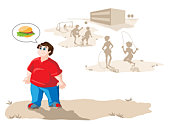
I have a (wholly unsurprising, considering my profession) confession to make, dear readers: I'm overweight. Not alarmingly so, like the rotund McDonalds victims we see on television or the huge guy creating his own Lake Mead of sweat next to you on an airplane, but I do have a belly on me. And unfortunately it's only getting bigger.
But hey, I'm not alone! A striking 67 percent of Americans are currently overweight, and of those people almost half are obese?that is, their Body Mass Index is over 30. We're all aware by now of the dangers inherent in obesity: high blood pressure, heart disease, depression, and other general nastiness; according to the U.S. Surgeon General, it kills 300,000 people per year. To put those numbers into perspective, cigarettes kill between 400-500,000 Americans per year. When our eating habits are killing us almost as much as tobacco, it's time to think about our lives.
And while other countries are having this problem, too, they're nowhere near as bad off as the US of A. Why? Why us? Of course names like ?McDonalds? and ?Burger King? immediately come to mind, but fast food is only one part of a much larger collection of problems; everything from our biological wiring to the size of our country itself factor in, creating one big overweight whole.
Biology.
This one isn't unique to America, but it is especially problematic in the industrial First World. Human beings just aren't wired to consume as few calories as possible; epochs of evolution have conspired to make us awesome at saving calories and lousy at losing them. It's much easier, after all, to eat 100 calories than it is to burn them off. It may be a curse now, but if you're a starving hunter-gatherer and there's no commercially-available food for another several thousand years, you want every bit of nutrition you can glean from your dinner. The human body can survive for 8 days without any food; imagine how long you can go on a little. And in America especially, a little is never enough.
Solution:
There isn't one, really. You can't change millions of years of evolution with willpower alone. What you can do is restrict your calorie intake and increase your calorie use, making this little biological stumbling block irrelevant.
Transportation.
The world's love affair with cars has plenty of detrimental environmental effects, but as it turns out there are some physical problems, too. Americans especially drive everywhere, foregoing bicycles or their legs in favor of shorter trips to the store or to work. The Surgeon General's office recommends 30 minutes of intensive exercise at least three times a week or 20 minutes of moderate exercise daily, and in the Information Age most of us rarely walk farther than the space between our parking spots and our chairs. It's not entirely our fault; while smaller European cities make walking everywhere easier, an American in, say, Phoenix may find geography working against him. Who has time to spend an hour walking to and from the grocery store these days?
Solution:
We all need to drive at some point, but take a long, hard look at your daily commute and determine when a car is truly necessary and when you're just being lazy. If the store's a couple miles away, ride a bike. If it's a mile or less away, walk?this goes double for folks in the warmer areas. A Minneapolis resident in winter has an excuse to drive that short hop to the store; a Boca Raton resident does not. And while you're at it?take a brisk walk a few times each week anyway!
Portion size.
Ideally, dinner should be the lightest meal of the day, as the human body stores calories more efficiently at night (energy burns faster earlier in the day). However, while most Americans eat minimal breakfasts and often small lunches, dinner is usually a smorgasboard, particularly when we dine out. And we're dining out a lot. Everywhere around the country, people are hitting up restaurants more than ever before. Increasing culinary sophistication and an ever-growing group of foodies are both factors, but as usual it all boils down to time. Americans are busier than ever; many families dine out or order in up to three times per week rather than slaving away in the kitchen for hours after work.
Solution:
For starters, follow your mom's advice and chew your food. We've all heard it a dozen times, but it bears repeating: your body doesn't automatically know when it's full. It takes the brain a good ten minutes to send the ?stop eating? signal, and you can scarf a lot more strip steak in ten minutes. On the same track, drink plenty of water. Good-old H20 takes up a lot of space in your belly, meaning the ?I'm full? response will hit you quicker.
And finally, if it applies: stop dining out so much. You'll feel less compelled to eat everything in sight when you didn't pay someone else to make it for you. On that note, here are some delicious, healthy, and quick recipes to ease the restaurant withdrawal!
Chicken Mediterranean Salad
Encrusted Walnut Chicken
Broiled Lemon Fish Fillets
Cream of Roasted Walnut Soup
Bean and Cheese Enchiladas
Barbecue Pork Skillet
Armed with these recipes and more from our Quick & Easy and Healthy sections, take a crack at our nation's obesity problem--whether you do it by shedding some pounds yourself, or helping out someone else you know. If you're concerned about your health, check your Body Mass Index. After that--maybe I'll see you at the gym!
Let's face it, we all want to be in shape and catch someone's eye. None of us like putting on our clothes and seeing our tummy hang over our jeans or our arms looking like a set of bat wings. With multi-joint exercises, you'll be able to blast away fat at record speed, as well as get your chest, abs, shoulders, back and arms into the best shape they've ever been in your life.
When you want to find a way to build strength and fire up your metabolism to burn away all that fat, it is best that you concentrate your exercise routine on including exercises that deal with many joints at the same time. With a perfect foundation, you'll be able to add lean muscle as well as burn fat. To do this, it is very important to know many single-joint and multi-joint exercises.
What exactly is the difference between single-joint and multi-joint exercises?
Single-joint exercises usually work and engage muscles that surround and focus on one moving joint. An example of this would be a bicep curl because it only moves the elbow joint. Multi-joint exercises are those that engage in rotation around many joints. Multi-joint exercises are said to stimulate how our body both works and plays. Many of our daily movements require multi-joint exercises.
This is precisely why we need to use multi-joint exercises, simply because they determine how our body works and moves. With daily activities, our bodies don't just use one muscle or one joint at a time. Something as simple as walking is a multi-joint activity. Though walking isn't complicated, it involves every joint and muscle in our lower extremities.
Why are multi-joint exercises important in a regular exercise routine?
1. Time efficiency. Multi-joint exercises are able to save you time that you have to spend in the gym working out. Because these exercises are able to allow you to engage in many muscles and joints all in the same exercise, you are able to work more of your body, decreasing the amount of time you have to spend.
2. High metabolic cost. That's right! Doctors have even been able to prove that multi-joint exercises get our metabolism working 30 to 40 percent higher. As you work more muscles at the same time, you are able to burn more calories while your metabolism rates are high and pumping.
3. Helps to train our neuromuscular system. Having a steady and healthy neuromuscular system is able to improve our balance. Whether you plan on walking across the tightrope in the circus or just walking down the street, balance is important. Because multi-joint exercises use many muscles and joints at the same time, your body learns how to work together with the many parts that makes it.
4. They're more fun. Who said working out couldn't be fun? With multi-joint exercises, you are able to tone and shape your body while having fun with it. You don't have to stick to the boring sit-ups or crunches. With multi-joint exercises, you can take pleasure in doing simple exercises while adding a little spice to them.
5. Variety, variety, variety. We all want to be able to have some sort of change in our lives. Start with your exercise program! If you incorporate multi-joint exercises into your routine, you are able to do many different types of exercises each day. Change and variety is good, especially if you want to have fun while getting into shape.
Here are some effective multi-joint exercises:
Squats: Squats, as dreaded and boring as they may be, help to build powerful and strong thighs and hips as well as toned a toned back, shoulders, arms, and chest.
Deadlifts: This exercise uses joints throughout the whole body. They are able to work both your lower and upper body muscles.
Leg Presses: These exercises are used to work the hamstrings, quads, and your glutes. With these, you'll be able to have toned legs and a firm butt!
Front, Side or Reverse Lunges and Stepups: These exercises are able to work each and every leg muscle. These can get quite boring, so try doing all three types of lunges. A lunge requires you to drop your knee 90 degrees to the ground.
Bench Presses, Dips and Pushups: All of these exercises add muscle to the shoulders, back, and chest as well as the triceps. They are able to work most of your upper body muscles.
Overhead Presses: These exercises are great for working out your triceps and shoulders.
Pulldowns, Pullups, Barbell Rows, and Dumbbell Rows: As you do these exercises, your back and bicep muscles will grow. You are able to work out your back as well as your arms.
Upright Rows: Upright rows are great for exercising the shoulders as well as the upper back.
So when you really want to blast away fat and get your abs, chest, shoulders, back, and arms in their best shape ever then consider using multi-joint exercises.
Both James Smylie & Steve Hochman are contributors for EditorialToday. The above articles have been edited for relevancy and timeliness. All write-ups, reviews, tips and guides published by EditorialToday.com and its partners or affiliates are for informational purposes only. They should not be used for any legal or any other type of advice. We do not endorse any author, contributor, writer or article posted by our team.
James Smylie has sinced written about articles on various topics from Food and Drink, Food and Drink and Food and Drink. Recipe4Living has tens of thousands of recipes, a growing userbase, and tons of features that would make any foodie drool. There can never be enough cooks in our kitchen, so stop at. James Smylie's top article generates over 5400 views. to your Favourites.
Steve Hochman has sinced written about articles on various topics from Lose Weight, Fitness and Marketing. Steve Hochman is the founder and CEO of Next Level Fitness. O.C.'s fastest way for you to get fit.
Cheap North Carolina Vacation If a home owners insurance company sees that youve just replaced the leaky plumbing or faulty electrical system, the home wont be viewed as high a risk as it would if the repairs werent made