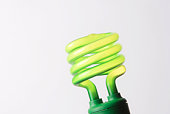
Energy efficient bulbs can save you a surprising amount of money over their lifetime--while also benefitting the environment by reducing pollution from power plants. The most energy efficient bulbs available today are compact fluorescent light bulbs or CFLs. These “curly” bulbs use one-fourth of the energy and last about 10 times longer than a standard incandescent bulb.
According to DOE, an ENERGY STAR qualified CFL bulb can save you an average of $30 over its lifetime. With CFL prices dropping like the stock market of 2008, most energy efficient bulbs should pay for themselves in energy savings within six months to a year.
Lighting expenses typically consists of about 22% of a home electric bill. Like me, many people have saved a significant amount of money each month by converting their entire home to energy efficient bulbs. Once I replaced most of the incandescent bulbs in my home with CFLs, my electric bill began to average $48 per month lower than the previous year.
CFLs do require a spurt of energy when they are first lit, and each time a CFL is switched on it loses a little more of its lighting power. This start-up energy surge, along with the fact that it may take several minutes for a CFL to warm up to its brightest level, means that the best spot for these bulbs may not be in an area where you turn the lights on and off often throughout the day, such as in closets or bathrooms. Instead, consider placing energy efficient bulbs in more high-traffic areas such as in a kitchen, dining room, living room, hallway, etc., where the light is kept on for long intervals.
There are other spots in the home where CFLs might not be the best choice, for example on light switches controlled by dimmers, photocells or electronic timers, or in enclosed light fixtures without proper ventilation. Some CFLs are now made to work in these situations; be sure the package specifically rates them that way.
One concern many people have is the amount of mercury in each CFL bulb. All fluorescent bulbs contain some mercury, which is a potent toxin. In order to minimize any possible health threats, the DOE recommends specific steps to take when cleaning up and disposing of a broken CFL. Many states require CFLs to be recycled or treated as household hazardous waste, which means you can't just toss them in the trash.
For many people, the most compelling reason to switch to energy efficient bulbs is because they reduce air and water pollution by reducing the amount of coal that must be mined and electricity that power plants must supply. Some studies have shown that if everyone in the United States used energy efficient lighting throughout their homes, we could close down 90 average-sized power plants. These plants put out tons of emissions containing mercury, sulfur dioxide, carbon dioxide, and other pollutants, which could be eliminated if more people used energy saving bulbs.
To maximize your savings in money and energy, and minimize your impact on the environment, CFLs are still the best way to go. Now is the time to consider purchasing energy efficient bulbs for your home or small business. Start saving on your monthly utility bills today, while helping to preserve the environment for the generations to come.
Energy Efficient Light Bulbs
Although many Americans are starting to show greater concern for the environment and "going green" has become the "in" thing to do, the greatest motivation for change is still the effect it has on their pocketbook. That is why switching to energy efficient lighting is such an easy change to make—it can show up to a 20% savings on monthly energy bills. Making the switch doesn't requiring remodeling your home or buying expensive parts either; it's as easy as turning a light bulb in some cases. Even better than that is the fact that most energy efficient light bulbs actually last longer than regular bulbs so they create less waste and require less effort as well.
Compact Fluorescent Light Bulbs Could Save Billions
CFLs or compact fluorescent light bulbs are a great source of energy efficient lighting that save quite a bit of energy while creating a well-lit environment. In fact, according to one manufacturer, if every home in America switched just one light bulb in their home to a CFL we would save over $600 billion dollars each year in energy costs. That would be enough to light 3 million homes for a year and it is a great way to preserve natural resources such as petroleum and coal that are burned to create much of America's electricity. That also means a lot less pollution being emitted into the environment. Think of the impact if all the light bulbs were changed over.
Energy Efficient Lighting Fixtures Save, Too
Of course, CFLs aren't the only choice in energy efficient lighting for the home or office. Fluorescent and LED fixtures also help reduce the amount of energy required to light up your home or office. These fixtures can be used to replace your current fixtures and are a must for responsible new construction. While installing new fixtures is an additional up-front expense and requires a little more work than just screwing in a light bulb, the long term savings and benefits make up for it in the end. More than just saving money on your own electric bill, energy efficient lighting is the economically responsible choice for homeowners and businesses alike.
Everyone Can Help
Of all the ways that a person can make a positive impact on the environment, switching to energy efficient lighting is the easiest and least expensive. If every person in America would vow to just make one small change at a time the positive effects would be felt on the economy and the environment significantly as people would save money while using less electricity. Some changes, like eliminating our reliance on fossil fuels, require greater expenses and will take longer to implement, but switching to energy efficient lighting is something that every person can afford to do, will give them an immediate savings on their energy bills. There is so little effort required for something that can have such a dramatic impact. There is just no reason that every household can't make energy efficient lighting a priority.
Both Holly Martin & Gregg- Camp are contributors for EditorialToday. The above articles have been edited for relevancy and timeliness. All write-ups, reviews, tips and guides published by EditorialToday.com and its partners or affiliates are for informational purposes only. They should not be used for any legal or any other type of advice. We do not endorse any author, contributor, writer or article posted by our team.
Holly Martin has sinced written about articles on various topics from Home Management. Holly Martin is the author of the Energy Efficient Light Bulb Buyer's Guide and the founder of Energy Efficiency Explained. She teaches people how to buy the perfect. Holly Martin's top article generates over 22200 views. to your Favourites.
Gregg- Camp has sinced written about articles on various topics from Home Management. Gregg Camp is an experienced who has spent more than 20 years working in the beautiful. Gregg- Camp's top article generates over 22200 views. to your Favourites.
A Student Health Insurance It is a must to be more aware and secured before availing anything which we think is best and may give the right benefit.