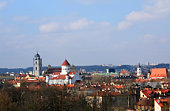
Vilnius, which can look back on a thousand years of Lithuanian history, boasts one of the largest historical town centres in Eastern Europe. Among its almost 1,500 buildings are representatives of nearly every European architectural style and historical period. Vilnius has wonderful examples of architecture from the Gothic, Renaissance, baroque, neoclassical and Jugendstil periods, all of which are located within easy sauntering distance of the city centre. The uniqueness of the Old City of Vilnius led to its inclusion on the UNESCO World Heritage List in 1994.
Heathens and Christians.
After most of Europe had adopted Christianity and prayed to a single Christian God, the inhabitants of Vilnius continued to pay homage to their pantheon of heathen deities. For centuries, it mattered little. Founded in the eleventh century as a walled fortress at the convergence of the Vilnia and Neris Rivers, the city has always been well protected from invaders.
Nevertheless, it wasn't until Vilnius became the capital of the Grand Duchy of Lithuania under Prince Gediminas in 1323 that other nations took an interest in its economic potential. The German confederation, Poland and the Russian czar all cast their greedy eyes on Vilnius, each wanting a portion of its wealth and prosperity. Merchants, businessmen and priests arrived in their hundreds, and with them came Christian missionaries. Soon afterward, most Lithuanians finally became Christian.
The Jesuits in Vilnius.
As a result, unlike many of the other cities in the Baltic region, Vilnius became an eastern outpost of the Roman Catholic Church, and a multitude of glorious baroque churches and buildings greets visitors today. In the wake of the Reformation, a period of industrious building activity was begun under the support of the Jesuit order.
Jesuit activities were also at the heart of Vilnius' intellectual revival, as the first Jesuit University was founded in 1579. Today, the University Quarter is recognized as a one of a kind architectural ensemble. Its buildings were inspired primarily by the styles of the early Italian baroque. Its courtyards, the church of St. John the Baptist, the clock tower, the observatory and the library are unparalleled anti City of churches. Vilnius lost its political significance following the union of Lithuania with Poland in 1569.
From this point onwards, rulers and occupying forces came and went. The city suffered greatly, again and again bowing to the will of more powerful nations. The construction of churches, however, continued unabated and Vilnius became known as "the Rome of the East", a city noted for its abundance of churches and cloisters. Rapid growth continued to attract craftsmen, artists and labourers to the city, and by the beginning of the nineteenth century, Vilnius was the third most populous city in eastern Europe: only Moscow and St. Petersburg were larger.
Vilnius today.
After fifty years of occupation by the USSR, Lithuania gained its independence in 1990, and Vilnius was declared the capital of the modern, democratic state. Lithuanians are busy restoring their city today, in full awareness of the importance of history.
More than buildings need to be restored; the very identity of Vilnius needs to be restored as well. As the Lithuanian government proudly proclaims, "here we are not only repairing the facades, but also the foundations". The president of Lithuania resides in a palace near the towers of the university, in the midst of the lively Old City. An office and business quarter has recently been established nearby, on the opposite bank of the Neris River. Vilnius, already a growing tourist destination, has set its sight on once again becoming the economic centre of the Baltic.
Robert Thomson has sinced written about articles on various topics from Personal Desktop, Finances and Pets. Looking for a low cost Australian airline? Consider .. Robert Thomson's top article generates over 450000 views. to your Favourites.
Beyond The Relaxation Response When a whole magazine is written just for us, it is fair to say ?Weve got the power.? Just ask the advertisers