1. The testing wavelength should always be the same as the working wavelength. Because optical fiber loss varies with light wavelength, you will get incorrect result if your measuring wavelength is different from the actual working wavelength. For example, if a system is designed for 1550nm but you test it with 1310nm light source and power meter, the result will not be correct.
2. The testing light source should be the same as the intended working lightwave equipment light source. If the system is designed for a LED source, you should test it with a LED source. If the system is designed for multimode laser light, you should use a multimode laser light source for testing. This is also true for single mode laser light source.
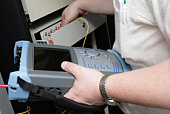
Fiber optic equipment used in a loss testing
In a basic loss testing setup, four types of test equipment are needed. They are the light source, the power meter, the reference patch cables and the adapter (mating sleeve).
Here are some considerations when choosing your equipment.
The light source should have the same wavelength as the operating equipment, proper mode (multimode or single mode, should be same as the operating equipment), type (LED or laser, same as the operating equipment) and proper connector.
The power meter should have the same wavelength as the light source, proper connector and calibrated.
The reference patch cables should be high quality with know loss, proper connectors and be the same type as the fiber plant being tested.
The adapter (mating sleeve) should be with high quality ceramic sleeves and be proper type (FC, SC, LC, etc).
Understanding dB (decibel) in fiber optic loss testing
As in any power measurement, fiber optic light power measurement unit can be expressed in milliwatt (mW), but a more convenient unit is dB(decibel).
Decibel (dB) is most often used in electronics testing. It is the ratio between two levels. One level is the input and the other level is the output. The ratio is calculated in logarithmic as explained below.
For power measurement, dB is defined as: dB = 10 x log(output power/input power)
So for example, after a fiber link, the output light power level becomes 50% of its input, the loss of the link will be 10log(0.5)= -3 dB.
Since dB is actually a ratio, it has no absolute units. So from above measurement sample, we have no idea of the actual power, may it be 0.1 mW or 1 mW.
That is why we have another unit dBm. It is the ratio of the measured power to 1mW of reference power. It is defined as: dBm = 10xlog(measured power/1mW)
So for example, a 0.1mW light power expressed in dBm will be 10xlog(0.1mW/1mW)=-10 dBm.
From above we know that dBm is a absolute unit, we know exactly how many mW it is.
For fiber optic loss testing, decibel is the most often used unit since it is much easier to work with. Why? Because two dB values can be simply added or subtracted. For example, a total fiber link may have three sections, each has loss of 0.5dB, 5dB and 0.5dB. The total loss can then be easily concluded as 0.5dB + 5dB + 0.5dB = 6 dB. You can try to convert it to actual milliwatt and you will see that I am right!
Fiber Optic Cable Testing
There are mandatory tests for every stage of the design, manufacture, and installation of the fiber optic components, link, cable plant, and network.
Most fiber optic test procedures have been thoroughly tested and codified as industry standards. These standards are part of EIA/TIA RS455 and are being adapted into IEC standards.
Most of these standards refer to tests of individual components under a variety of environmental conditions; therefore, only a few related to testing the performance of the installed cable plant.
With data communication networks, we are primarily concerned with three fiber optic test procedures: FOTP-95 for measurements of optical power, FOTP-171 for testing patch cables and OFSTP-14 for testing the loss of the installed cable plant.
Optical Fiber Testing
A great many tests must be performed on optical fibers. A fiber manufacturer must test a fiber to determine the characteristics by which the fiber will be specified. As a quality control measure during manufacture of fibers, the manufacturer must constantly test the fibers to ensure that they meet the specifications. Among the tests are the following: core diameter, cladding diameter, numerical aperture (NA), attenuation, refractive index profile and tensile strength.
Other tests performed on fibers or on fiber optic cables concern their mechanical and environment characteristics. Mechanical tests such as impact resistance, tensile loading, and crush resistance test the cable's ability to withstand physical and mechanical stresses. Environmental tests evaluate the changes in attenuation under extremes of temperature, repeated changes of temperature, and humidity.
Fiber Optic Cable Plant Testing
There are some testing concerns in a premises-cabling application based on the recommendations found in TIA/EIA-568A for generic cabling systems and TSB-67 on testing.
An important concept in testing is distinguishing between the link and the channel. The channel is the end-to-end system, including any patch cables at the equipment or work area. The link is the "behind-the-walls" cabling from the equipment-side patch panel to the work-area-side outlet.
Testing can be done on either a link level or a channel level. Installers of a building cabling system are usually concerned with the link. The link forms the basic infrastructure for the building cabling.
Fiber Optic Component Testing
Fiber optic data links are composed of three components: a transmitter, a receiver and the interconnection cable plant. These components must be compatible with the parameters of the intended application.
The loss budget must be adequate for the expected loss in the cable plant and the dynamic characteristics must meet the bandwidth requirements set by the network data transmission rate.
The loss budget is set by the output power of the transmitter and the sensitivity of the receiver. On a static basis, this is determined by the difference in optical power levels, but in reality the issue is a dynamic one, determined by the performance of the components at the data transmission rate of interest.
Continuity Testing
Simple continuity testing can be achieved by a flashlight: Does the light come through the fiber? Fancy flashlights – called visual continuity testers – are available specifically for fiber optic testing. A read light is easiest to see.
Cherokee Culture And History XanGo Juice is free of saturated and trans fats. Xanthones or catechins, flavonoids, proanthocyanidins are a factor in the maintenance of good health and a factor in normal growth and development