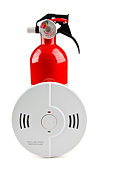
A small fire can grow into a deadly one within minutes. To help prevent a tragedy, closely inspect your home to eliminate potential hazards. Prepare your home for an emergency, and teach your family about the dangers of fire and how to escape. If a child is coached properly ahead of time, he or she will have a better chance of surviving.
1. First, eliminate potential hazards with these eassy tips:
Keep matches, lighters and other heat sources out of children's reach. Playing with matches and lighters is the leading cause of fire deaths for children ages 5 and under.
Keep flammable items such as clothing, furniture, newspapers or magazines away from the fireplace, heater or radiator.
Keep all portable heaters out of children's reach.
Avoid plugging several appliance cords into the same electrical socket.
Replace old or frayed electrical wires and appliance cords, and keep them on top of, not beneath rugs.
Store all flammable liquids such as gasoline outside of the home.
2. Prepare your home with safety and announcement devices with these easy tips:
Install smoke alarms on every level of your home and in every sleeping area. Consider installing both ionization alarms, which are better at sensing flaming fires, and photoelectric alarms, which are better at sensing slow, smoky fires.
Test smoke alarms monthly. Maintain alarms by replacing batteries at least once a year, and replace alarms every 10 years. Plan and practice two escape routes out of each room of the house. It is important to have an alternate escape route in case one is blocked by fire. Fire drills should be practiced spontaneously throughout the year, as home fires and home fire-related deaths are more likely to occur during cold-weather months, December through February.
Keep furniture and other heavy objects out of the way of doors and windows, so they won't block an escape.
Designate an outside meeting place, so all members of the family can be accounted for quickly.
3. Teach your children safety methods:
Children should know the sound of the smoke alarm. When they hear it, teach them to:
Crawl low under smoke. An estimated three-fourths of childhood fire deaths are caused by the smoke and toxic gases produced as a fire develops and spreads.
Touch doors before opening them. If the door is hot, use an alternative exit.
Never go back into a burning building. Children should be reminded not to stop or return for anything, such as a toy or to call 9-1-1. A call to 9-1-1 should be placed after leaving the premises.
"Stop, drop and roll." Upon leaving the burning house or building, children whose clothes have caught on fire should immediately stop, drop to the ground and roll themselves back and forth quickly to extinguish the flames.
Take children to your local fire station for a tour. Children will be able to see a firefighter in full gear and learn that he or she is someone who saves children, not someone to be afraid of or hide from. Also, be sure you're not teaching your children bad habits. Don't let them see you smoke in bed or disconnect smoke alarm batteries!
Fire Safety In The Home
While many of those employed in the emergency services can see the importance of having a fire blanket in the home the same cannot be said for the general public. It is an unfortunate fact most people either ignore the dangers associated with home fires or they just do not realize the dangers that exist.
Most house fires start in the kitchen which accounts for almost 28 percent of all fires in the home. This is a very high number and most fires in the kitchen are caused by either a lack of concentration or because the person was interrupted by an unexpected occurrence. This could be something simple such as the telephone ringing, a caller at the door or maybe one of your children needs your immediate attention.
One of the main causes of fire in the kitchen is when dealing with very hot oil. If not monitored it can reach such high temperatures as to catch alight in an instant. When this happens instant panic will set-in as you try to find a very quick solution while under intense stress and trauma. Most people would dampen a towel under the tap and throw the soaking material over the flames. Smothering the fire does work because it starves the flames of the oxygen they need. But using a small towel to do it causes more danger.
Many people who have tried this method have the burn scars to prove it. The problem is that you feel you have to get very close to the fire to douse the flames. If you miss you may not get a second chance so you get as close as you can get. This is where the severe burning takes place. It may not be the actual flames that cause the skin damage, it could be just the intense heat. Other people have been burned because they may have missed the target and try to retrieve the cloth to try again. This time you may have a partly burning cloth to contend with as well as a fire that is on the verge of getting out of control.
Fire blankets are recommended by all the emergency services and people involved in health and safety. They immediately know the safety benefits that fire blankets can bring when used correctly. They should be made easily accessible near an exit doorway. Never hide them away in draws or cupboards and expect to find them easily when a fire takes hold. Placing them near to an exit ensures that you have away out should the fire blanket not be enough or if things go wrong.
Fire blankets are also ideal for covering someone who has actually caught fire and can also be worn over the head if you need to pass an area that is on fire or where extreme temperatures are causing difficulty. Protecting the vital organs is the most important factor when you are confronted with fire.
Fire blankets can be purchased in many DIY stores and hardware shops and the costs varies with the type and size you need. Many of the fire blankets can be reusable after washing though you will need to check the supporting documents for confirmation of this.
Every home should have a fire blanket located in the kitchen or where cooking takes place. When you consider the minimal cost to purchase one against the protection they provide for your home, your personal effects and of course your loved ones they will be one of the best investments you can ever make.
Both Joyce Jackson & Mark Fynn are contributors for EditorialToday. The above articles have been edited for relevancy and timeliness. All write-ups, reviews, tips and guides published by EditorialToday.com and its partners or affiliates are for informational purposes only. They should not be used for any legal or any other type of advice. We do not endorse any author, contributor, writer or article posted by our team.
Joyce Jackson has sinced written about articles on various topics from Banking, Children and SEO Search Engine Optimization. Joyce Jackson is a safety expert and consultant in northern California. For her latest book and information see .. Joyce Jackson's top article generates over 14800 views. to your Favourites.
Mark Fynn has sinced written about articles on various topics from Property Guide, Home Improvement and Sleep Disorder. Mark Fynn writes many articles for specialist web sites and you can find more information about fire blankets here