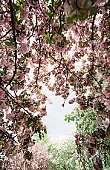
We all know what a commercial orchard looks like - acres of trees planted in regimented rows several metres apart. But not all orchards have to be like this; actually you do not need much space at all to create a small one. Any old wall or fence that gets a bit of sun will do. Apples and Pears, Plums, Damsons and Cherries all grow outstandingly well when trained against flat surfaces. Four or five metres are enough for an orchard with eight varieties of fruit producing enough to feed a family of four.
Choose your fruit carefully. For apples grow an eater that juices well - try James Grieve. Have an eater that keeps through the winter (Winter Gem is delicious and lasts until March) and have a cooker that keeps applesauce, baked apples and apple pies, these are all best in the winter. Go for Lanes Prince Albert. The best pears are Conference, which is an eater that cooks, and Comice, which dribbles down your chin all the way to Christmas. These two will also pollinate one another. Round your orchard off with Victoria plums, Merryweather damsons and Stella cherries that are all self-pollinating. There are your eight varieties.
Grow your fruit trees as cordons. You can buy these ready pruned to shape, or you can prune your own. Cordons are fruit trees that have been shaped to have as many short fruiting shoots as possible. They are planted 2ft (60cms apart) and so can be crammed into a small space. Generally they are grown at a 45% angle which means you get a 3 metre long plant that is only just over 2 metres tall - pickable without a ladder. Because they are so close together, cordon fruit trees make a fantastic screen. Show me a bit of rusty old chainlink fence and I will show you something that flowers its heart out in April and May, is an object of interest in June and July and gives you all the fruit you can eat for the rest of the year.
Cordons are the most versatile of the fruit forms. If you have not got four metres of wall or fence to spare, then try growing them (vertically, not at 45 degrees) on a metal or wood framed arch over a path in the garden. Grow them as a hedge that screens one part of your garden from another. It is probably best not to use fruit trees to separate your garden from someone else's as you might only get half the crop!
Like all fruit trees, cordons like well-prepared ground that drains reasonably well. So dig your soil over thoroughly, removing roots, weeds and large stones. Add a bucket of well-rotted compost or manure per metre run and work it in well. If you are planting them to grow at 45 degrees, it helps to tie them to long bamboo canes at the same angle, which in turn are tied to horizontal straining wires. Always firm the ground around newly planted trees very well and make sure they are watered throughout their first spring and summer.
Once your orchard is established, plant a couple of the less vigorous flowering clematis to ramble over your fruit trees. These can be cut back hard in winter when you prune your trees and then you will have an orchard that flowers in April, May, June, July and September!
Fruit Trees And Bushes
Bird habitat is being destroyed for agriculture, urbanization, gas exploration and hydroelectric development, decreasing their numbers over the years, we are faced with shrinking bird habitat.
Bird habitat plays an important part for our ecosystems providing habitat for our feathered friends but also improving our air quality with the plants filtration process.
Bird habitat is important for breeding, migratory stop overs and migratory destination, the Boreal forest and wetlands are crucial for many bird species survival, for many the shrinking of bird habitat could spell endangered or even extinction for some birds, the Canadian Warbler who's home is the Boreal forest, is notably one of the affected. As bird habitat decreases the billions of birds from around the world that nest in the forest every year will face more problems. There is also a lack of consideration for the natural world, in some coffee plantations, ones that grow their coffee in full sun cutting down all other vegetation causing soil erosion and loss of animal and bird habitat, this is done so that it develops and ripens faster, making for a quicker buck, however there is a solution shade grown coffee takes longer to develop and costs more, the workers get fair pay its most likely organic also the animals and birds keep their habitat.
The Boreal forest covers 2.3 million square miles of Eurasia and Canada, deforestation and climate change is affecting bird habitat and bird populations.
Bird habitat is also struggling with the oil sand project in north Alberta, their homes are being destroyed and they can face death if they try to land there.
Some Birds are very adaptable in bird habitat habits, and can learn to live in urban areas, domestic cats and birds of prey can then pose a threat whilst they visit bird feeders and gardens, others are not as able to adjust to different situations, they are not only wiped out due to lack of their bird habitat but some times migrating birds in the hundreds die because they mistakenly fly into the bright shiny skyscrapers in city areas.
The Borrowing Owl has lost a considerable amount of land to agriculture and urban development, as its habits do consist of actually borrowing they make their nests in the flat treeless prairie lands of North America.
Penguins are one of the most affected by climate change, as higher temperatures destroy their once perfect breeding grounds, lack of snow and ice coverage also diminish their natural food source, warmer climate brings higher water levels also other ocean critters, some predators and others competing for space, taking over their bird habitat.
Both Anna Stenning & Joan Barton are contributors for EditorialToday. The above articles have been edited for relevancy and timeliness. All write-ups, reviews, tips and guides published by EditorialToday.com and its partners or affiliates are for informational purposes only. They should not be used for any legal or any other type of advice. We do not endorse any author, contributor, writer or article posted by our team.
Anna Stenning has sinced written about articles on various topics from computers and the internet, Management and Wedding Gifts. Anna Stenning is a keen gardener and loves to grow her own . To find to out more click on. Anna Stenning's top article generates over 4090000 views. to your Favourites.
Joan Barton has sinced written about articles on various topics from Education, Gardening and Culture and Society. is an important part of our global ecosystem, not only providing essential habitat for our feathered friends, but also helping filter ha. Joan Barton's top article generates over 9900 views. to your Favourites.
Behavior Problems In Schools Express your confidence in the school or day care center and show that youre looking forward to a new beginning ? one where everyone wins. Good luck!