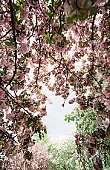
To the untrained eye, there are few things easier than growing fruit. One can all too easily, get the impression that all one has to do is sit back and wait for the fruit to drop into one's lap. Not so. The trees must be planted in a suitable location and properly looked after. If one is to have a supply of fruit for any length of time, the fruit must be thinned and stored properly. Here we will examine the area of locating the fruit tree to your best advantage.
A fruit tree will grow almost anywhere in the garden. However, there are places in your garden that will suit the fruit trees better than others will. The location of your fruit trees is often dictated by the type of garden you already have. Is it an ornamental setting or are you growing the trees in an orchard or vegetable patch to harvest the fruit? You may need to maximise your use of space and grow the fruit trees up against a wall as an espalier or fan or even grow it in a pot. In an ornamental garden, you might grow an apple tree in the centre of your lawn to make the most of the blossom in spring and the beautiful ripening fruit in autumn.
However, some places in the garden will suit you better than others. It would, for instance be better to group fruits with the same nutritional needs together so that you can give them the same treatment at the same time. For example, you would group the gooseberries and red currants near your apple trees, as they all require extra potash and the blackcurrants would go with the pears and plums as they all require extra nitrogen. All fruits need to be protected from birds and it would therefore make sense to have them all in the same general area to make it easier to protect them.
There are some locations that it might be better to avoid. One of these is the vegetable border. Vegetables are generally hungrier than fruit trees and require different soil types so growing trees in this area would make it difficult to maximise the harvest in both. In addition, you may need to spray the fruit trees at a time when there is no fruit. This would be complicated if there were vegetables underneath that would be rendered inedible by toxic sprays at any time of year.
Growing fruit trees against walls is an often-overlooked option. There are many advantages to this for the gardener and the tree. They can be quite decorative when properly trained against a wall but the main advantages are space saving and the ease with which they can be managed there. It is so easy to throw a net over them to keep out birds. It is easier to reach all the branches when pruning. It is easier to know which branches to prune. Growing conditions against a wall suits many of the more delicate varieties of fruit but bear in mind that all fruit need a lot of sun to grow their fruit and therefore if the wall you had in mind is not sunny it might be better not to bother. Check with the garden centre when buying the tree.
Unfortunately, there are some drawbacks. Depending on what direction your wall is facing and what the prevailing weather conditions are where you live, the wall may be a drier situation than you might expect. Therefore, you must keep an eye on the watering. These dry conditions may suit certain pests such as red spider mites. If it is a boundary wall, make sure that you have permission or the right to grow the tree on that wall. In addition, if your tree is likely to grow into or overhang someone else's property you may need to come to some arrangement regarding spraying, pruning and ownership of the fruit and so on.
If you do not use or give away your fruit in the first couple of weeks after picking, you will need to store it properly or you will lose it. But that will be the subject of another article.
Fruit Trees In Containers
Indoor lemon trees are available in several varieties. One of the hardiest is the Meyer lemon tree, which in and of itself is also available in several varieties. The dwarf Meyer lemon tree is one of our favorites, in part because of its bountiful yield of fruit.
While you'll likely be pleased with any indoor lemon tree, the dwarf Meyer lemon tree produces lemons which actually are shaped more like oranges. Their fruit is larger than normally produced by indoor lemon trees, with sweeter juice. They are compact enough to be shipped in one gallon containers, the smallest for any container fruit trees.
Another indoor lemon tree is unique in that it produces fruit almost two pounds in weight. This is the dwarf Ponderosa lemon tree, which is really a cross between a lemon and a citron. Another noticeable aspect of the dwarf Ponderosa lemon tree is the aroma of its blooms - they're very fragrant with a fresh, clean aroma.
Whatever type of indoor lemon tree or container fruit tree you consider, chances are good it will be shipped close to fruiting age. With proper care of your indoor lemon tree, you should expect several pounds of fruit per year, practically eliminating the need to buy lemons at the grocery. Indoor lemon trees are very affordable, ranging from $30 to $50, and are shipped directly from southern state growers.
Indoor lemon trees and other container fruit trees are a perfect way to get someone interested in gardening, speaking from experience. Once you experience success with growing fruit, it becomes a very enjoyable hobby. Best of all, indoor lemon trees and most container fruit trees can be succesfully grown almost anywhere.
Indoor lemon trees are so easy to grow that even someone with no gardening experience whatsoever should be successful. With few exceptions, there isn't much more to growing an indoor lemon tree other than plenty of sunlight and watering every 10 days or so. You can also place your indoor lemon tree outdoors during the warmer months - they'll love it!
The main success factor with an indoor lemon tree is consistent sunlight exposure, usually 8 hours per day. Don't worry if it's rainy or cloudy for a few days. Just try to place your indoor lemon tree in an area where it'll normally receive sunlight, i.e. a southern or western exposure. Nominal care will result in a vibrant addition to your home, not to mention several pounds of fresh fruit per year.
Both Dan Jacobs & Jim Hofman are contributors for EditorialToday. The above articles have been edited for relevancy and timeliness. All write-ups, reviews, tips and guides published by EditorialToday.com and its partners or affiliates are for informational purposes only. They should not be used for any legal or any other type of advice. We do not endorse any author, contributor, writer or article posted by our team.
Dan Jacobs has sinced written about articles on various topics from Landscaping, Management and Forex Trading Forex. Dan Jacobs is an administrator at Gardening With Gerry, a website with information and articles on a wide variety of .. Dan Jacobs's top article generates over 33100 views. to your Favourites.
Jim Hofman has sinced written about articles on various topics from Cardio Training, Modelling and Health. and other container fruit trees are a fragrant, easy care addition to any living space, and perfect for any level of gardener. Visit us fo. Jim Hofman's top article generates over 9900 views. to your Favourites.
Behavioral Pattern That Occurs Therefore, it is quite evident that it is very difficult to demarcate broad-based behavioral patterns for the alpacas as most of them have separate individual traits different form the other.