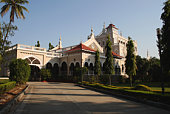
Donning the mantle of Imamate in 1885, Imam Sultan Muhammad Shah had completed 50 years of his spiritual leadership in August, 1935. His devoted followers, long looking forward to the auspicious day, got feverishly busy to pay a memorable tribute to their Imam, who had so happily guided their destinies through all these years, knitted them into a progressive community, and taken them to enviable heights of moral and material glory. Hence, the Ismailis decided that the Golden Jubilee of their beloved Imam should be fitly celebrated by weighing him against gold and making a present of it, as a mark of their love and gratitude. For this grand program, an All-India Golden Jubilee Celebration Committee had been formed, which was inaugurated by Lady Aly Shah on October 16, 1935 at Bombay. Sir Ibrahim Rehmatullah was elected its President and Ghulam Ali Merchant as the Vice-President. Its working committee assigned Pir Sabzali to generate necessary donations through out India. The funds raising campaign started on October 23, 1935 from Kathiawar. He succeeded to collect a sum of five lac rupees in India.
Bombay was the venue for the celebrations in India. Huge crowd in festive and solemn mood had gathered at Hasanabad to attend the unique occasion on January 19, 1936. When the Imam and Begum arrived at 10.35 a.m. to receive one of the most spectacular ovations from a crowd of over 40,000 Ismailis, every inch of space in the Hasanabad ground was taken up. The Imam took his seat on the gadi embroidered in gold with the coat of arms of his family. To his right sat his mother, Lady Aly Shah, and to his left sat the Begum. The Imam was dressed in a purple robe with a great turban, with all the decorations and insignia glittering on his breast.
Mr. Ghulam Ali Merchant, Vice-President of the All India Golden Jubilee Committee made his welcome speech, saying: "Most reverently and respectfully I request that Your Highness will allow yourself to be weighed in gold on this happy and auspicious occasion, and accept the gold so weighed a humble token of our love, devotion and gratitude to Your Highness for all the unbounded bounty and benefits that Your Highness? followers have deriving during Your Highness? Imamate for the last 50 years."
The Imam rose from his gadi amidst great cheers and joy of the followers, and moved towards the weighing scale and took his seat on rich soft cushions placed for him. The weighing scale showed 3200 ounces of gold as his weight, valuing about 3,35,000 rupees.
Replying to the address, the Imam said: "I accept with great pleasure the gold my dear spiritual children have offered me and give them my loving and paternal spiritual blessings. I have decided to use the gold for the uplift of the spiritual children and appoint Mr. Ghulam Ali Merchant, Mr. Rahimtoola M. Chinoy, Mr. Cassamally Manji Nathoo, Mr. Ali Mahomed R. Mecklai and Mr. Ismail M. Jaffer to devise the best means of applying not only the income of this gold but the corpus also for intensive uplift work amongst my spiritual children, particularly by way of all kinds of scholarships, relief by emigration from congested districts, infant welfare and other beneficial works."
A silver casket mounted on four carved tigers standing on rare sandalwood, a replica of the Assembly Hall with the clock tower from which the Imam blessed his followers, was presented to the Imam. The casket contained a commemoration address which emphasized the great Ismaili tradition of learning, linking Al-Azhar University and Aligarh and proudly enumerated the progress of Ismailis in Law, Medicine, Commerce and Industry. Visibly moved, the Imam once more exhorted his followers to ?educate, educate and educate their children.? The communal gifts having been handed over, delegate after delegate stepped forward to present the Imam with other nazrana (valuable presents). The Maharajah of Kutchh offered a gold-bordered robe and one thousand rupees in silver and the Nawab of Lunawada beautiful silver tea-set. Diplomats from many countries brought their governments? good wishes. In sum, it was most impressive and picturesque ceremony, simple in nature but rare novelty in the life of many a man. Besides, 1 Gold Medal with Chevron and Straight Bar, 3 Gold Medals with Chevron Bar, 12 Gold Medals with Straight Bar and 42 Gold Medals were presented to different individuals in view of their outstanding services in the community.
The African Ismailis also expressed their desire to hold a separate Golden Jubilee in their territories. Thus, the next Golden Jubilee celebration at Nairobi, Kenya on March 1, 1937 in presence of over 70,000 Ismailis. Under the chairmanship of Count Abdullah Sharif Kanji, the All African Golden Jubilee Celebration Committee was formed with 18 members.
It was also as grand as those in Bombay. The memory of those who had, with great zeal, taken part in collecting funds for the celebration remained ever engraved. The African Ismailis collected 7 lacs of Shillings. On the occasion, Pir Sabzali had privilege to put the gold bars into his hand and addressed the audience on microphone, and spoke the importance of the occasion. Once again the gold was presented to the Imam by the followers as a token of love, and once more the Imam returned the gift for the welfare of the Ismaili community.
Besides, 2 Gold Medals with Chevron and Straight Bar and 57 Gold Medals were presented to different individuals in view of their unstinted services in the community. The Imam also awarded different titles to the volunteers, scouts, girl guides, over and above various gentlemen and ladies, whose rich services to the community were appreciated, such as 2 Counts, 14 Vazirs, 2 Varas, 2 Itmadi, 5 Rai, 62 Alijah and 101 Huzur Mukhi.
Golden Jubilee Aga Khan
The word jubilee is derived from the Hebrew yobel, meaning ram's horn. In the ancient time, the jubilee was announced by the blowing of the shofar, a trumpet of ram's horn, and as a result, the occasion came to be known as yobel, or jubilee. The Arabic word for jubilee is also yobel, and Turkish ellinci. Jubilee is a momentous occasion, denoting the celebration of a period of time, anniversary or other special occasions.
It was initially pronounced as 'dimund 'joobu`lee, meaning ?an anniversary celebrating the passage of 60 years.? Sixty years of Imam Sultan Muhammad Shah's benevolent rule gave his followers a chance to celebrate the Diamond Jubilee by weighing him against diamonds. On December 31, 1945, the Imam had said to the H.H. The Aga Khan's Legion Central Committee that, ?Sixty years have been passed to the enthronement of the Imamate, which is its unique occasion. It is an incomparable occasion in the world. No occasion ever occurred in the world history like it.? The weighing ceremony was performed in Bombay at the Brabourne Stadium on the after-noon of Sunday, 10th March, 1946.
Over 100,000 Ismailis from various parts of the world had come to see this magnificent spectacle unusual event. The huge multitude present in the ceremony included fourteen ruling princes, among them the Maharajas of Kashmir and Baroda and the Jam Saheb of Nawanagar. The value of the diamonds was 640,000 British pounds.
The second jubilee was celebrated in the sports ground of the Aga Khan Club in at Dar-es-Salaam on 10th August, 1946. It was attended by 70,000 Ismailis, including the Governors of Kenya, Tanganyika and Uganda. This time the value of the diamonds was 684,000 British pounds. The sum value of the diamonds at each place was presented as an absolute gift to the Imam from his jubilant followers. This vast sum was again invested by him in a trust meant to enrich the life of the community in the educational and commercial spheres.
In a message to ?Diamond Jubilee Souvenir Year Book,? the Imam said, ?The Ismailia history has passed through several stages of development. My Diamond Jubilee marks such a stage in the present times. With it a phase of consolidation and cooperation has been achieved among my spiritual children in various countries, and now lies ahead a period of goodwill and expansion. With the Diamond Jubilee dawns a new era, full of hopes and opportunities for economics, educational, social and religious uplift of my beloved spiritual children all over the world. It is a time to go ahead and leave a mark on the world history like the glorious Ismailis of the past. Let the Diamond Jubilee message for my spiritual children be that of doing their best and devoting their best in the best cause of their beloved faith.?
Both Dr. D.s. Merchant & Ibrahim Lodhi are contributors for EditorialToday. The above articles have been edited for relevancy and timeliness. All write-ups, reviews, tips and guides published by EditorialToday.com and its partners or affiliates are for informational purposes only. They should not be used for any legal or any other type of advice. We do not endorse any author, contributor, writer or article posted by our team.
Dr. D.s. Merchant has sinced written about articles on various topics from The Internet, Health Care and Health. Mumtaz Ali Tajddin S. Ali is an He has written many books on history and culture of ismailism, his recent book is on Encyclopedia of Is. Dr. D.s. Merchant's top article generates over 9900 views. to your Favourites.
Ibrahim Lodhi has sinced written about articles on various topics from Religion, Nutrition and Pets. Mumtaz Ali Tajddin S. Ali is an popular author He has written many books on history and culture of ismailism, his recent book is on Encyclopedia of Ismailism, must read about the history of. Ibrahim Lodhi's top article generates over 90500 views. to your Favourites.
Abc Fine Wines & Spirits People even tend to keep the bottle and the labels of the fine wines safe as it may add to their collection of fine wines or have an everlasting experience because of the same