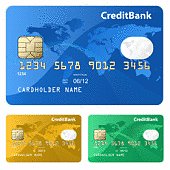
A credit card, as you might know has individual information like your signature and often your photograph as well. The credit card perhaps, is one of the best identification you can offer as it is often on your person always. With a credit card in hand, you can use it to make purchases, pay bills on services and the consumer is charged periodically based on the purchases made. The details of a card, the balance and payment schedules and statements can be viewed over an automated teller machine ? ATM and on Internet computers as well.
According to sources, the credit card was first born in the United States way back in the 1920s. It was issued mainly by hotels, oil companies and certain stand-alone companies. This credit card could then be used at those specific establishments and those connected with them. Post World War II, the credit card found it growing and it was found to be very useful.
The first credit card that could be used at a number of stores was brought to the market by Diners Club in 1950. This enabled the consumers to make their purchases and they only had to pay an annual fee and then pay back the amount purchased on a monthly basis or even a yearly basis. It was in 1958 that the American Express card came into the market, the other big player in the credit card market even to this day. This too worked in a similar fashion.
It was only later that banks got into this business and came out with a bank credit card. This way, the bank would pay the store as and when a consumer would make a purchase, which satisfied the business house totally (credit being their bane) and the consumer would be presented with a bill on a regular basis. The consumer in turn, has the option of paying back the bank the entire amount or even part of it. He returns the rest of the amount with an interest charged to it ? what is called a carrying charge.
Did you know that the first national bank to introduce a credit card was the Bank of America with its BankAmericard in 1959? This could only be used in California initially, though by 1966, it could be used in more states across the country. In 1976 it was renamed Visa ? as it stands today and is now accepted worldwide across establishments. MasterCard too came into being and they tied up with several smaller banks to enable consumers to make purchases at various stores and business houses. Visa and MasterCard, today and big names and are connected with small banks, international banks and large national banks as well as they issue credit cards to consumers worldwide.
History Of Credit Cards
The concept of credit is not new. In ancient Egypt and Babylon ? more than 3,000 years ago ? merchants bartered with currency and services in order to maximize their spending processes, often collecting what we now call ?interest? on payments that were late or past due. Credit cards themselves, however, didn't surface until the early 1950's.
American Express and the Diner's Club were the forerunners in ?plastic money?, and issued their first credit cards to fewer than 200 Americans for use in restaurants and entertainment venues in New York City. More of its kind were issued in New England until the late sixties, but none of these credit cards could be paid off over long periods of time ? their balances were due immediately. Bank of America issued the Bank Americard in California in 1959, and this was the first card to be accepted almost universally.
In the early 1970's, the first magnetic strip was developed, and this was what launched the use of credit cards as we know them today. Although the ?magnetic stripe system? was used in England in the early 1960's, it was not standardized until the 70's in the United States.
The Bank Americard eventually became Visa, and a company called Master Charge (formed in the late 60's) eventually become MasterCard. These were the two most popular credit card issuers, as they remain today. They revolutionized the magnetic strip on credit cards and began to form credit card offers that allowed debts to be paid off incrementally.
As the bankcard industry became more widely spread, financial institutions that were interested in issuing credit cards began to align themselves with either the Visa Association or the MasterCard Association. Using this method, even small banks were able to make credit cards available by sharing program costs and offering universal solutions to consumers. In the late 80's, this was made even easier when bylaws were generated to allow any single financial institution to offer both Visa and MasterCard bankcards.
In the late 80's, processing companies began to emerge, which allowed both Visa and MasterCard to streamline their paper flow processes and to reduce the possibilities of credit card fraud. They offered mediation to credit card association members so that disputes could be resolved quickly and easily, with less cost to the financial institutions.
Until 1987, American Express had remained on the back burner, only offering credit cards that had to be paid immediately. Their target consumers were high-rollers in business industries who used the cars for entertainment purposes, and could then pay off the balances. But in keeping with the new trends exploding across the United States, they altered their business model to accommodate the average consumer, thus becoming another forerunner in the credit card industry.
Discover Card appeared in the early 90's as an alternative for consumers. Originally a division of Sears corporation, now owned by Morgan Stanley, Discover Card sought to change the credit card industry by offering alternatives to the Visa and MasterCard traditions. Discover is now one of the most largely accepted forms of payment worldwide, and rivals only American Express internationally.
Credit cards have changed astronomically over the last forty-or-so years, and will undoubtedly continue to evolve as further technology is developed. In recent years, measures against fraud and identity theft have been implemented, and credit card companies are offering more and more benefits to consumers. The competition between Visa, MasterCard, American Express and Discover has proven a significant benefit to the public, and will likely continue to grow.
Both Jim Glu & Edward Vegliante are contributors for EditorialToday. The above articles have been edited for relevancy and timeliness. All write-ups, reviews, tips and guides published by EditorialToday.com and its partners or affiliates are for informational purposes only. They should not be used for any legal or any other type of advice. We do not endorse any author, contributor, writer or article posted by our team.
Jim Glu has sinced written about articles on various topics from Debts Loans, Credit Cards and Eyelid Surgery. Jim is the owner of , and. Jim Glu's top article generates over 27100 views. to your Favourites.
Edward Vegliante has sinced written about articles on various topics from Credit Cards, American Express Card and Student Credit Cards. Ed Vegliante runs the website , a well organized credit card directory enabling the consumer to compare and apply for a variety. Edward Vegliante's top article generates over 60500 views. to your Favourites.
Big Bass Lake Poconos Lake El Salto is a bass fishing heaven. In fact, in 2002, a fish nearing 20 pounds was landed on the lake. Its reputation as a breeding ground for monsters continues to grow