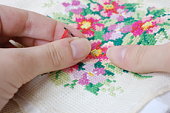
What is this thing called cross stitch? Well...in a way, cross stitch is just like embroidery or needlepoint. But that one statement will often bring many handcrafters to the boiling point. Die hards from each type of craft think that their own craft is the best and they just don't like being compared to the others.
So...to simplify things lets say that cross stitch is mainly stitching with planned x's like this xxx or angles like this ///// or lines like this ----- with loops and controlled knots. Now you just put the stitches together and you can create some of the most beautiful gifts ever given to anyone.
Let's Look at Some Cross Stitch Basics
Cross-Stitch has become such a popular type of handcraft that you often find the crafters no longer use a kit for their projects, they create their own. But, before you can go out on your own and start creating your own art, you will need to know more about the fabrics, thread, needles and frames. That's why most Crafters start out with a kit.
Also, when you buy patterns or kits, you may decide to use different fabrics and threads than what is mentioned in the kit projects. The following will help you to understand and adapt the patterns and materials for your own needs.
Cross-Stitch Fabrics
What is called counted cross-stitch can be stitched on just about anything that will allow you to make consistently even sized stitches. I have even seen people use an iron on pattern and an iron on grid to insure the even stitches they wanted. (Like on T-shirts)
Aida Cloth
Aida cloth is the most common of all the cross-stitch fabrics. Look close at the fabric and you will see that the woven threads are grouped and separated by little tiny spaces. This makes a pattern of squares so that even a beginner will be able to see exactly where their cross-stitches need to be placed. Aida cloth comes in 6,8,11,14,16 and 18 count threads but 14 count is the most often used thread count for the beginner. Aida cloth comes in a variety of colors and threads counts and for the beginner they even have (in the white cloth only) a removable grid of pre-basted threads. Now how about that for being helpful?
Linen
Over all, because of the price, linen is considered to be an excellent fabric to work with by the more experienced cross-stitchers. The threads that they use to weave the linen cause a slightly irregular thickness to work on. And when you buy linen you need to remember that most designs are stitched over two threads so, 28-count linen will work out a 14 stitches per square inch. Linen is made in counts of 14 to 40 count so at 14 you would have 7 stitches per square inch and at 40 you would have 20 stitches per square inch.
Sweaters
Sweaters are an excellent background for cross-stitch. Just by basting a grid onto the sweater you will be able to have the even consistent stitches you want. But don't try cross-stitching on knits without the grid because knit stitches are not square. They are wider than they are tall and your design will appear broader and shorten than the pattern you are working from.
Burlap
Burlap can be counted and stitched as easily as any other traditional cross-stitch fabric. And if you are working a country style pattern it will give you that little extra something we all look for in the work we do.
Evenweave Fabric
The recent popularity of cross-stitching has created a need for specialty fabrics. These fabrics are called evenweave fabrics because they are woven from threads of a consistent diameter. Most of the evenweave fabrics are counted by so many threads by the inch and are worked much like the linen fabrics.
Needlepoint Canvas
Quite often needlepoint canvas is used for cross-stitch, especially on clothing and things that are not suitable alone. In fact waste canvas is designed to unravel when dampened. And the count runs from 6 1/2 to 20 stitches per inch.
Hardanger Fabric
Now hardanger fabric is used for the extra fine cross-stitch. This is the traditional fabric used for the famous Norwegian embroidery of the same name. This weave produces 22 small squares per inch.
Threads for Cross-Stitching
Most threads used for embroidery can be used for cross-stitching, just separate the threads into ones, twos, threes, fours, etc, etc. The more threads you use the richer the work will look, the less threads the more fragile it will look. The rayon or silk floss will give your work a shine or slick look but sometimes they are more difficult to use as they tend to tangle. Pearl cotton is also a high sheen.
Flower Thread and Other Specialty Threads
Flower thread is 100% cotton with a matte finish and is used as a single thread (same as two ply). Over dyed threads are introduced on the market almost everyday. Most of them give that one of a kind appearance because of their irregularly variegated colors. All of the threads I have mentioned so far are available in this form also. They are great for when you want to change colors without having the need to change threads.
Yarn and Ribbon
When working with the large projects you can use yarn, ribbon and even strips of fabric to give your work your own personal touch. The larger the squares the larger ply thread you can use.
Needles
Generally blunt pointed needles are better for working on most cross-stitch fabrics because they slip through the holes and threads without snagging and splitting the fibers. There is one exception to this rule, when working with waste canvas you will need to use the sharp embroidery type needles. And a lot of companies sell the blunt needles labeled "Cross-stitch" but they are identical the the tapestry needles which have a much larger selection to choose from.
The First Pattern
Your first pattern should be something small and simple, so you would be better off starting out with a small kit. It's kind of like using training wheels on your first bike... it will give you a little security. Besides it comes with needles, floss, fabric and anything else you need to complete your first project.
Good luck and happy stitching.
History Of Cross Stitch
The designs of Africa have a totally unique look about them, and are not typical of other designs. Their patterns are not simply "another piece of material with art designed on it", but are made and designed with the love of Africa always in mind. The people of Africa trust in their inner knowledge and fundamental beliefs, and their history is never forgotten as is clearly shown by their fabulous designs.
The material and textiles are designed with their attitudes and behaviors toward all, which is believed to be sacred. Added to their work is the recognition of their country and society, not only by themselves, but also of others. Cloths in other African regions represent their aesthetic quality, symbolism of the regions culture, or individual responsibility.
The quality that is expressed within the African look and feel is demonstrated in their culture and their material, created by their own people. And it is onto this cloth that cross-stitch weaves its powerful communication with those who feel this metaphor.
The warm and vivid colors of Africa's sunrises and sunsets are interwoven with its folklore and customs, and are impossible to separate from one another.
An excellent resource book to use in regard to Africa colors and designs, if you are not using a pre-designed kit, is "The African Cross Stitch Collection" by Trish Burr, which is for embroidery work but the projects in it are bright and vivid, letting you see how the colors work together, with folklore African stories bringing the work to the very heart. The designs vary from easy to more challenging.
An alphabet and motif library is included in the resource book, which costs approximately US$17.95/UK/?10/Canada$2 3.95. The publisher, Powell.com, has some used copies beginning at $9.95 if you are interested in them, or some used copies from Amazon.com, has an average price of $11.95 each.
If you are interested in the African animal cross-stitch designs, Janye Netley Mayhew has designed several cross-stitch hardback books with Africa in mind. One is entitled, "Cross Stitch Animal Collection" which has the Safari Collection in it, plus many other animals.
The book has the basic techniques needed to complete each picture in the book for cross-stitch design, along with many project ideas. Her watercolor illustrations and colored photographs add to the 128 pages of cross-stitch design information. She also has a book entitled, "Cross Stitch Collection Tigers" and "Cross Stitch Collection on Safari". The website Alibris, , has the Safari book in a large range of prices, with the low price of $5.60 from Dave and Charles Publishing as its low bid.
Amazon.com has a price of $9.59 on it. If you plan on having a cross-stitching resource library, such as some of the books listed above, make sure it is the one you want. Check it out, read the reviews and comments. Look at some of the designs if possible. And then purchase the book for your own library.
Another item I ran across in regard to Africa cross-stitch was on one of our favorite websites, good ol' Ebay. The seller, happy_paws_haven, has a beautiful African cross-stitch pattern for $8.00 plus $2.00 shipping. The money from these patterns is for a rescue animal site for Happy Paws Haven, so you may want to check it out online. The pattern is one of a group of African animals in a headshot with beautiful "Africa" lettering below.
It is nice work and comes on a CD, with the pattern being on 16 letter size sheets. Included are a color key, DMC floss usage summary, and a finished color picture of the pattern in virtual stitches. This pattern can be used in 18, 20, 22, 28, etc. size fabric, with a stitch count of 280 x 355.
In summing up this marvelous topic, be assured you can spend a lifetime researching traditional African patterns and being enthralled by the many striking images of that magnificent continent so beautifully captured in its cross-stitch designs without ever tiring of its sheer fascination.
Both Ian Williamson & John are contributors for EditorialToday. The above articles have been edited for relevancy and timeliness. All write-ups, reviews, tips and guides published by EditorialToday.com and its partners or affiliates are for informational purposes only. They should not be used for any legal or any other type of advice. We do not endorse any author, contributor, writer or article posted by our team.
Ian Williamson has sinced written about articles on various topics from Guide Guitar, History and Sports Car. For more by Ian Williamson please visit. Ian Williamson's top article generates over 74000 views. to your Favourites.
John has sinced written about articles on various topics from Parenting, Swimming Pool and Baby Shower. John Wigham has been a professional author and editor for 20 years and is a co-founder of http://www.patternspatch.com an online cross stitch club dedicated to counted cross stitch. The website has a small team of writers who are devoted to our. John's top article generates over 49500 views. to your Favourites.
Big Block Engine Identification It is satisfying to have a hobby around what I love and that is the big blocks! Get you one today!