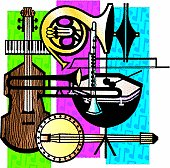
No one is certain when the first musical instruments were made. It's possible that they predate language in human cultural development, but I'll leave that argument to the anthropologists. What is sure is that there is a deep, ancient desire within people to express themselves using sound. Our voices were almost certainly used for more than communication. Somehow that was not enough. Our ancestors pushed creative sound further.
The first instruments were probably percussive because they are the simplest to make. Clapping hands or striking flint on flint, it's easy to imagine that this would be our earliest attempts to make our own rhythm, our own pulse, sent out into the world and echoed back. What likely followed were simple mallets and skins stretched on bowls. What makes these tools so distinct is that were not needed for hunting, food preparation or defense; they had no other purpose than to create a controlled, predictable sound. With advances in metallurgy, gongs and bells developed. Our modern drums are a descendant of this type of early instrument.
Most likely, wind instruments came next. These could have been created relatively easily with a hollowed out plant stem or animal horn to create a simple whistle or horn. The initial benefit was increased amplification. Later, it was discovered that the resonating chamber of the instrument could be manipulated to give differences in pitch. Significantly, many of the wind instruments use breathing to generate and control the sonic effects, which closely resembles our vocal chords. Further technical advancements in smelting and metal working gave us instruments with more sound making precision and exceptional durability. Modern trumpets and saxophones are closely related to these early instruments. Xylophones and organs are special percussive-wind hybrids that gave chording or polyphony in a single instrument.
Stringed instruments likely came last. Egyptian records indicate that instruments using vibrating strings existed at the time of the pharaohs, near the dawn of recorded civilization. Lyres and harps are early examples and their manufacture and required a dedicated craftsman for their manufacture. Strings not only give the instrument a potential for harmony and cording on one device, but also frees the vocal chords of the performer for singing in accompaniment. A later development added a resonating chamber making the instruments potentially louder. Violins and guitars are modern string instruments. Pianos are a special hybrid; it has hammers that strike the strings making it percussive and stringed.
The control and use of electricity took musical instruments to a completely new level with developments like the microphone and amplifier. Guitars had pick-ups added, keyboards had wave form manipulation and the most mind-boggling innovations have come with computers and digital music. Effects technology that alters the sound between the instrument and amplifier keep adding rich tonal qualities that are still being explored. Experiments are being conducted to create plasma instruments and other advances could bring instruments that interface directly with our brains.
Like our ancestors, we still use sound to create and the instruments we use are developed along with our technology. We keep stretching the possibilities toward the horizon and when we arrive, I believe we will find more horizon to explore.
History Of Musical Instruments
It seems that every little boy has dreams of starting their own rock band when they reach junior high school. A guitar has been chosen by your child as their favorite and you want to make sure that all goes well, when he plays it in the home. With these aspirations, parents start choosing music playing areas for their child that won't be too noisy.
When they go musical instruments shopping with their child, you know ahead of time that he has to have an amplifier to ensure that the roof does not cave in from the racket. Many fathers convert old garages into places that their children can set up their amplifiers and mikes, and play to their heart's content. The effort might be very therapeutic for a father who had his own band when he was younger.
Buying musical instruments and shopping with your child can be a learning experience all it's own. These trips are full of wonder, as the child gets to see for himself some of the finer instruments he can own one day, if he learns his craft well. All of the colors and multiple strings available on the guitar he wants to play so much are spread out before him in living color.
It is a hard decision for a boy to make on whether he wants an acoustic guitar or a bass guitar. As parents go musical instruments shopping with their child, they get to open a whole new world of possibilities to their child. As the child develops his talents, parents can spend time at musical concerts and let their child see what a symphony orchestra sounds like.
That night out on the town could be a good starting point to encourage a child to earn a scholarship to college where he can further his education and enjoy the fruits of his labors by becoming part of the university or college symphony orchestra. Through musical instruments shopping with your child, you can learn more about your child, and about yourself.
With each accomplishment that your child attains, it is an achievement for the parent too. A parent that encourages their children to expand their horizons gets to see life through their eyes, and shares in their experiences like they are there by their side, as they grow up at home. Parents can help children appreciate different cultures through their musical experiences.
When shopping for musical instruments with your child explore all of the devices and see which one fits your child's personality. The musical instrument will an extension of his creative inner-self, and if the wrong instrument is forced on them, the bad choice will stand out readily at each day of practice and children will more like fail in their musical endeavors. Even if you think an instrument will be too loud and inconvenient, find a way to create an environment where they can express their thoughts through music. Letting your child learn to play music will offer far more opportunities in life, than a quiet video game machine that has the sound muted.
Both Alan Phillips & Jim Brown are contributors for EditorialToday. The above articles have been edited for relevancy and timeliness. All write-ups, reviews, tips and guides published by EditorialToday.com and its partners or affiliates are for informational purposes only. They should not be used for any legal or any other type of advice. We do not endorse any author, contributor, writer or article posted by our team.
Alan Phillips has sinced written about articles on various topics from Keyboard Synthesizer. Alan Phillips is a freelance writer, he retired from the US Army in 2000 and has spent the last few years in Computer Technology. He currently resides in Texas, USA with his wife and owns and operates. Alan Phillips's top article generates over 1900 views. to your Favourites.
Jim Brown has sinced written about articles on various topics from Flirting Tips, Culture and Society and Soccer. Jim Brown writes about ,. Jim Brown's top article generates over 20400000 views. to your Favourites.
Bladder Pain And Symptoms Knee supports are effective because they can help you to stop future knee injuries from occuring. It can also help prevent a current knee problem from getting worse