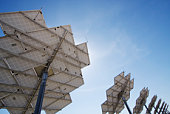
With the recent rise in energy costs many people have been looking to alternative sources of energy. One of the greatest energy sources (our sun) is readily available for the taking. We just need to be able to harness it's power. For those interested, below is a brief history of how solar power came to be.
The history of photovoltaic energy (aka. solar cells) started way back in 1876. William Grylls Adams along with a student of his, Richard Day, discovered that when selenium was exposed to light, it produced electricity. An electricity expert, Werner von Siemens, stated that the discovery was "scientifically of the most far-reaching importance". The selenium cells were not efficient, but it was proved that light, without heat or moving parts, could be converted into electricity.
In 1953, Calvin Fuller, Gerald Pearson, and Daryl Chapin, discovered the silicon solar cell. This cell actually produced enough electricity and was efficient enough to run small electrical devices. The New York Times stated that this discovery was "the beginning of a new era, leading eventually to the realization of harnessing the almost limitless energy of the sun for the uses of civilization."
The year is 1956, and the first solar cells are available commercially. The cost however is far from the reach of everyday people. At $300 for a 1 watt solar cell, the expense was far beyond anyone's means. 1956 started showing us the first solar cells used in toys and radios. These novelty items were the first item to have solar cells available to consumers.
.In the late 1950's and early 1960's satellites in the USA's and Soviet's space program were powered by solar cells and in the late 1960's solar power was basically the standard for powering space bound satellites.
In the early 1970's a way to lower to cost of solar cells was discovered. This brought the price down from $100 per watt to around $20 per watt. This research was spearheaded by Exxon. Most off-shore oil rigs used the solar cells to power the waning lights on the top of the rigs.
The period from the 1970's to the 1990's saw quite a change in the usage of solar cells. They began showing up on railroad crossings, in remote places to power homes, Australia used solar cells in their microwave towers to expand their telecommunication capabilities. Even desert regions saw solar power bring water to the soil where line fed power was not an option!
Today we see solar cells in a wide variety of places. You may see solar powered cars. There is even a solar powered aircraft that has flown higher than any other aircraft with the exception of the Blackbird. With the cost of solar cells well within everyone's budget, solar power has never looked so tempting.
Recently new technology has given us screen printed solar cells, and a solar fabric that can be used to side a house, even solar shingles that install on our roofs. International markets have opened up and solar panel manufacturers are now playing a key role in the solar power industry.
History Of Solar Power
The period that we associate as modern solar power history is a lot longer than many would think. In fact, it's genesis can be traced some 140 years back to the middle of the Victorian age. Just like the scientists and inventors of today look for alternatives to a dependence on fossil fuels so did the scientists of those times. This article will trace the history from 1860 through to the present day.
From 1860 to 1880, the French inventor Auguste Mouchout constructed a solar powered engine. The idea behind the engine was to use the sun's heat to create steam. This steam could power other machinery used in many of the new factories that were being built.
The French Emperor was so impressed with the device that he gave Mouchout a state subsidy to continue developing the engine. The subsidy eventually lapsed without much headway and cheaper coal resources were negotiated putting an end to the solar powered engine in France.
Around this time, William Adams, an Englishman living in India, devised another solution. He built a rack with many small mirrors around a stationary boiler. This allowed him to get 2.5 horsepower out of the engine.
Charles Tellier started working on a solar powered system in 1885. By 1889 he had created one of the first solar collectors that are used today. He installed the collector on the rooftop. The energy generated was used to cool refrigeration units.
In 1903, Aubrey Eneas began investigating solar power. He drew his inspiration from the ideas of Mouchout but increased the scale of Mouchout's work. He created a solar power engine that could be sold to the public. In fact he made a sale of one engine to a doctor in Arizona. For around $2000 it was dispatched to Arizona but became damaged soon after and was never operational. Eneas went on to sell one more engine for around the same sum but this was also never operated because it was damaged soon after set up by a hailstorm.
At the same time, Henry E. Willsie developed 2 solar plants that collected energy during the day for use at night. The plants used flat plate collectors that produced an output of around 15 horsepower.
In 1906, Frank Shuman made improvements of the original Willsie design. This increased the engine output to 33 horsepower. He continued to tweak his designs to the extent that he managed to get the engine up to 55 horsepower.
There were no note worthy developments until around 1954. Bell Laboratories researchers discovered the reaction of sunlight and silicon. This was investigated and lead to the creation of the photo voltaic (PV) cell.
A Photovoltaic (PV) cell is the fundamental element that makes up the solar panels that are generally placed on rooftops. Solar panels create direct current from sunlight.
When the energy crises hit in the 1970's, it caused many people to look at how they got there energy resources. This increased the thinking that alternatives to fossil fuels had to be found so that the energy resources couldn't be used as a political bargaining chip again. This increased the interest in solar power. Research went into improving PV cells.
PV cells are now far more efficient and cheaper than they used to be. Given the numerous government incentives, solar panels are within the reach of the average household. Funding has also been increased to make solar power research more successful.
Both Will Reece & Adrian Fletcher are contributors for EditorialToday. The above articles have been edited for relevancy and timeliness. All write-ups, reviews, tips and guides published by EditorialToday.com and its partners or affiliates are for informational purposes only. They should not be used for any legal or any other type of advice. We do not endorse any author, contributor, writer or article posted by our team.
Adrian Fletcher has sinced written about articles on various topics from Information Technology, Cure Anxiety and Home Improvement. For more visit solarpowerappliances.com. You will find products and features on solar applications, including. Adrian Fletcher's top article generates over 27100 views. to your Favourites.
Boat Loan Payment Calculator Like all good things, a guaranteed boat loan could well take some time and research to become a reality. At the same time they are well worth the effort, and will prove to be beneficial in the long ru...