Does anyone really like buying and giving out Christmas cards? When people talk about the over-commercialization of Christmas, Christmas cards are often named as one of the culprits. When did it ever become trendy to give people folded pieces of paper with cutesy, over-cliched sayings and pictures? It's tough to say. Nevertheless, the Christmas card giving tradition is firmly entrenched and not likely to go away anytime soon. That being the case, one would do well to at least learn how to give cool and interesting ones versus the cheesy, forgettable ones most people give.
Here are some general principles:
1) Send an actual card, not an "e-card"
It has become trendy in recent years to send "e-cards" via e-mail instead of actual cards via actual mail. This is seen as cute, clever, or unique, since it bucks the long-standing tradition of physical cards. While some e-cards are cool, and some people enjoy getting them, it often comes off as tacky. It indicates a lack of effort from the sender. For this reason, it is good practice to not send e-cards, at least not to people you truly care about. Take the time to pick out a unique and interesting physical card.
2) Don't pick out a card with impossible-to-read cursive writing
Nothing is worse than someone handing you a card face-to-face and you having to squint to see what it means. Not because the text is too small, but because it's written in ridiculously over-pretentious, old English style, looks like it was written with a feather pen cursive! This is seen as sophisticated, festive, and formal, but in actuality, often comes off as boring and tacky. The phrase "it's been done" comes to mind. If you want to give a card that conveys a serious meaning, opt for one with printed, easily read text that hits home immediately. Having to squint to understand the words lessens the effect.
3) Funny cards are great, but not cliched funny
In the world of cliched, serious, and pretentious cards, funny cards are a welcome breath of fresh air. But sadly, even humorous cards have been siezed upon by cliches, over-used jokes, and stale punchlines that sound like they were lifted from Hee-Haw reruns. Examples of this include cards that fart when you open them, cards with generic knock-knock jokes, or cards with almost-naked men or women. Don't give people cards like that. Rather, try to select a funn card that is in some way relevant, perhaps one that has to do with an inside joke you have, or a shared memory.
4) Don't write something ultra-sentimental if it's not warranted
Everyone has one of "those relatives" whom you never see or talk to during the year, but who writes out Christmas cards as though you are close. Maybe it's a distant aunt who gushes in the card about how "special" you are or how much they miss you, or an out-of-state grandmother (who you've met all of twice) who still feels compelled to write how she "can't wait to see you again." Try to avoid writing things like that unless you actually mean them. If you write them without meaning them, and it's obvious that you don't mean them, your card will be seen as hoaky and phony.
How To Christmas Cards
Each day during the Christmas season, many businesses and private individuals turn to printers, asking them for personalised calendars and corporate Christmas cards. Writing Christmas cards became a tradition in the XVIII century, when the British royal family started to use them as a form of congratulation for social acquaintances.
So, Christmas cards became the ideal way to congratulate someone during the holiday season, without having to spend a lot of money on the purchase of gifts and wrapping paper. Furthermore, Christmas cards could be sent by mail without any problem; as the XX century advanced, more and more people turned to Christmas cards as a solution to an increasing social ambiance and to lessen the need to provide tokens or gifts of friendship that overwhelms their entire financial income.
Even so, Christmas cards became a great advertising and marketing opportunity since trade cards started to appear. Trade cards are prints on one single sheet or card, with the business simply wishing the customer a Merry Christmas; but the idea of the ‘Christmas card' as we know it started to appear and become more popular in the XX century. In 1961 only 2000 of them were printed, while in 2005 an average of 1.4 million Christmas cards were printed, sent and distributed.
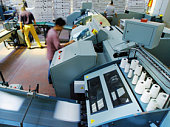
This makes Christmas cards one of the strongest money-makers for the printing industry, not only from the private sector, but also from the commercial sector that seeks to elevate their business higher in the ranking of the target market, in contrast to their competitors.
Frequently, printing workshops linger through the year with a small amount of work, according to the difficulties and economic events that happen in the location where they are found; it might be that all the work they do relates to marketing promotional products. Big printing companies do not worry much about the off season, since they carry on the printing requirements for other companies, however, the small printing business, the one that suffers the changes of the printing business season, suffers the consistent reduction of marketing promoting products.
The Internet, with its online marketing potential, makes it less necessary for advertisers and marketers to use promotional products to enhance the presence of a product, service or business in the target market. Consequently, printing workshops have to subsist as much as possible on alternative means, until the Christmas season. Christmas cards are still popular among private citizens and businesses; however, the appearance of the laser printer and the increasing use of the Internet has modified greatly the way Christmas cards are viewed, printed and even created.
In yester years, Christmas cards were printed on cardboard and decorated with water colours and even glitter; now, even serigraphy is taken off the Christmas cards, making laser printed Christmas cards the new fashion statement; this might end up reducing the printing workshops to a thing of the past.
Despite it all, Christmas cards are still the biggest income source for all printing workshops alongside the printing of catalogues and calendars. Therefore, the effect that Christmas cards have on the printing industry is evident to the naked eye.
Both Wade Knoxville & Bella Harris are contributors for EditorialToday. The above articles have been edited for relevancy and timeliness. All write-ups, reviews, tips and guides published by EditorialToday.com and its partners or affiliates are for informational purposes only. They should not be used for any legal or any other type of advice. We do not endorse any author, contributor, writer or article posted by our team.
Wade Knoxville has sinced written about articles on various topics from Guns, Pets and Fitness. Wade Knoxville. Wade Knoxville's top article generates over 14800 views. to your Favourites.
Bella Harris has sinced written about articles on various topics from Affiliate Programs, Marketing and Business Cards. Solopress is a UK company dedicated to providing you a variety of printing services and products to successfully promote your business.. Bella Harris's top article generates over 14800 views. to your Favourites.
Auto Insurance Homeowners Insurance It does not express the official policy of the American Academy of Actuaries nor does it necessarily reflect the opinions of the Academys individual officers, members, or staff