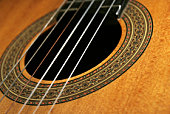
1. The first thing you will need is a book on the subject and I recommend two. The first is Classical Guitar Construction by Irving Sloane. This is a simple and straightforward book that takes you through the process. It also includes a template for all the parts of the guitar. The second book is considered the bible of guitar construction and it is: Guitarmaking: Tradition and Technology: A Complete Reference for the Design & Construction of the Steel-String Folk Guitar & the Classical Guitar (Guitar Reference) by William Cumpiano which is a much more complete reference that will also show you how to make folk guitars.
2. You must purchase, pre-made, some of the basic items for the guitar. These are the tuning pegs and the bridge. You will also need to purchase fret wire, purfling, the mosaic inlay, and a selection of wood both used directly in the guitar and indirectly for the forms and jigs that are used to make the guitar.
3. Tools needed. A half dozen hand tools will be needed to make your guitar and these include a plane, block saw, hand scraper, several chisels, jigsaw wire cutters, several clamps, a power drill, and a 6 inch circle cutter. The books explain all the tools needed.
The Basic Assembly process
? The first step in building a classical guitar entails building the forms and jigs. You can’t just build a guitar out of wood. It has to be shaped in a very particular way and to achieve this shape you have to build forms to shape it around. In particular, the curved sides of the guitar have to have a profile that exactly matches the shape of the soundboard and the backboard. You also create a jig that will hold the whole guitar together when you glue it into a complete whole.
? The second step entails individually making the five major parts of the guitar. They are the neck/head, left side, right side, Soundboard, and backboard. Note that the neck/head assembly can be done in one piece or as two pieces assembled together.
? The third step is where you would assemble and glue the five major pieces of the guitar together.
? The Final Step is the finishing of the guitar. This includes inserting the frets on the neck, the purfling around the edges, and the sanding and varnishing of the guitar.
What is the most difficult part?
When curving the sides of the guitar you have to soak them in water and then heat them so they can be slowly shaped to the correct curvature. This takes some practice but you don’t have to guess at the shape. You make a jig that you use as a guide for a perfect fit. If you want to avoid this step you can purchase kits with the sides already pre-bent.
A little bit about the wood
The wood you use is of the utmost importance when it comes to how your guitar will sound. And Brazilian rosewood is the wood of choice for most classical guitars. But there are variations on this such as Spanish Cypress, which is often used for Spanish guitars. Other woods used are maple, birch, pear and mahogany.
Don’t think you have the skill to do it all yourself?
There are many online dealers that will sell complete kits that have everything pre-cut and shaped correctly. All you have to do is assemble it and finish it. This is a good alternative if you don’t think you want to tackle the whole project. You can also buy kits that have all the selections of wood uncut and raw so you can still do all the crafting.
Making your own classical guitar can be a challenge and it takes patience and some handy skills but it definitely something the average do it yourself person can accomplish. And the reward is a musical instrument that will be your lifetime companion.
How To Classical Guitar
Although the precise origins of the classical guitar are open to debate, there is plenty of evidence of the existence of similar instruments dating back as early as 5000 years ago. The idea of a hollow body with tensed strings anchored between two points is seen in many instruments, including the violin family, sitar, piano and harp; they all use the string's vibrations to resonate the body and produce sounds. However, because the guitar is fretted, it allows pitch-perfect chords to be played over six strings, which differentiates it from the unfretted (and often bowed) violin family. The guitar as we know it today started to take shape during the Renaissance and Baroque period, when it was used mainly as an accompaniment. Cousins of the guitar are the mandolin, balalaika, banjo and lute. There are enough similarities between these instruments to relate them all, but to give a guitar a unique definition, it would be a six-string, fretted instrument tuned between low E (a thirteenth below Middle C) and the E two octaves above. Of course ? these are merely the open-string tunings. Notes approaching two octaves above this are achievable through fretting. This tuning allows the guitar's whole range to be represented on the treble clef, albeit with three ledger lines for the lowest notes.
Playing the classical guitar
The classical guitar is played in the seated position, the curvy shape of the body helping to keep it steady by resting on the thigh. Right-handed players fret with their left hand and pluck with their right, and the highest toned strings are nearest to the ground. If a purely rhythmic sound is required, the guitar can be played using a plectrum strummed across all or some of the strings; the plectrum can also be used to pick out monophonic melodies. More expert players will use their fingers, however. This allows very complex tunes to be played, with bass notes and melodies plating simultaneous. In the hands of a true virtuoso, it can sound to the untrained ear like several musicians are playing at once. Chords can still be played with the fingers, either by simultaneously plucking multiple strings with various fingers or stroking the strings and taking advantage of the instrument's sustain. Playing with the fingernails gives a sharp, almost rasping sound, whereas playing with the soft front of the finger gives a softer tone.
Composers of classical guitar music
The rich history of the guitar and its forebears means that many composers have written music that can be played on a modern guitar with some degree of success. J.S. Bach is perhaps the most well known, and his many pieces written for the lute and even the cello and violin have found their way onto the classical guitarist's repertoire. Bach was predated by Dowland and Narvaez, and his contemporary Scarlatti wrote some enduring music that works well on the guitar. In more modern times, Villa-Lobos, Rodrigo and Segovia have written music specifically to be played on the guitar, and Stanley Myers? classical guitar theme tune to The Deer Hunter proved to be hugely popular.
Both Will Kalif & Charlie Buquette are contributors for EditorialToday. The above articles have been edited for relevancy and timeliness. All write-ups, reviews, tips and guides published by EditorialToday.com and its partners or affiliates are for informational purposes only. They should not be used for any legal or any other type of advice. We do not endorse any author, contributor, writer or article posted by our team.
Charlie Buquette has sinced written about articles on various topics from Education, Keyboard Synthesizer and Guide Guitar. Charlie Buquette wrote this article about . Charlie Buquette's top article generates over 22200 views. to your Favourites.
Auto Parts Online Auction When they come back to you for more, then that means there will be more money in your pocket. More money in your pocket means success for your business