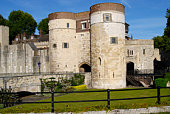
Tradition has it that as long as the ravens remain at the Tower of London, which they have occupied since the fortress first stood along the River Thames, the kingdom will persevere. Today, the huge black birds, sporting names like Hardey, Odin, Gwyllum and Cedric, wander the inner courtyard of the Tower, their wings clipped to ensure their continued residence. As with the ravens, the Tower of London also endures, despite assaults in the 13th and 14th centuries and more recently, aerial bombing raids during the Second World War. The fortress's battlements command international attention, for this majestic World Heritage Site embodies the history and spirit of the land it represents.
The proper title is "Her Majesty's Royal Palace and Fortress of the Tower of London" and it has dutifully served the monarchy since the 11th century. That was when William the Conqueror ordered the construction of stone keep to command his new kingdom. Planting his castle in the corner of the walls that enclosed the Roman city of Londinium, William I began one of the realm's earliest and possibly finest, stone keeps. Later known as The White Tower after the brilliance of its whitewashed walls, the Norman keep retains its classical rectangular design and forms the centrepiece of this great fortress on the Thames.
Altered over time, the 90 foot high tower initially provided accommodation for the king and the castle's constable and even housed important prisoners in its finer upper chambers, for example the Duke of Orleans, who resided there in the 15th century. Meanwhile, with its 15 foot thick walls, the basement was used occasionally to imprison less savoury characters. On the second storey, the Chapel Royal of St. John the Evangelist with its smooth unpainted walls, bestows grace and dignity upon this great keep.
Over time, succeeding monarchs surrounded the White Tower with towered walls, palatial buildings and a military depot but the turreted keep has always remained the castle's most recognizable feature. Both physically and visually, its owners intended the Tower of London to dominate, intimidate and impress onlookers. Every angle reinforced the notion that here stood a royal stronghold with no rival.
In the 13th century, Henry III began an ambitious expansion program at the site, adding a massive curtain wall that had nine sturdy towers and doubled the size of the fortress. He contributed a new Great Hall, a kitchen block and additional accommodations. He flooded the moat with the waters of the River Thames and enclosed the Church of St. Peter ad Vincula within the curtain wall. He also established a royal menagerie inside the castle which housed an elephant, bears, lions and other exotic animals that were presented to him by the crown heads of European nations.
Later in the 13th century, Edward I transformed the Tower of London into a fine concentric fortress like those he built in North Wales. Edward was a castle builder at heart and he undertook the redesign of the castle. First he filled in the moat that Henry III had flooded and enclosed the fortress with yet another - albeit lower - towered curtain that was fitted with heavily defended twin-towered gatehouses. He also added St. Thomas's Tower, which had a water gate for access to and from the River Thames. Now know as Traitor's Gate, this access gained its name from the prisoners who passed through on their way to confinement and execution. Among the most famous of these prisoners under Henry VIII's reign were Anne Boleyn, Catherine Howard and Sir Thomas More, after whom the tower was named.
Edward I also built a royal mint inside the castle and added a treasury to house the Crown Jewels. Now housed in the Jewel House, the Crown Jewels remain one of the Tower's biggest attractions. The Tudor kings expanded the Tower of London's role as a prison and staged scores of political executions on Tower Green and Tower Hill. Today a plaque commemorates the 125 prisoners who lost their lives there.
By the late 17th century, the castle's role as a state prison diminished. The Office of Ordnance began to occupy the site and with them came munitions stores, military workshops, a barracks and gun batteries. In the 1840s the Army constructed the North Bastion, Waterloo Barracks and other structures to counter local civil unrest from the Chartist Movement. Beginning in the 1850s, Queen Victoria and Prince Albert began restoring the castle's medieval appearance.
Visit the Tower of London today and you will be regaled by the Beefeaters with stories of treason, beheadings, torture and ghostly apparitions. Managed by the Historic Royal Palaces, the Tower is open daily throughout the year for an entrance fee.
London The Tower Of London
White Tower
This is the original part of the fortress, built at the behest of William the Conqueror in 1078 to protect the Norman rulers from the inhabitants of the city. It's a magnificent white stone keep, which would have looked incredible when first built as the Norman style was completely unknown in London at the time. It's right at the heart of the complex, surrounded by towers, walls and a moat. From the mid 16th century it was the main arsenal in the fortress and today it houses a fascinating museum of arms and weapons ? the Royal Armouries.
Crown Jewels
Royal treasures have been kept at the Tower since the 1300s, and have been opened to the public as the 'Crown Jewels' collection since the 18th century. The 17th century crown and regalia used for Queen Elizabeth II's coronation in 1953 are on display, as are other sceptres, orbs, crowns, swords, jewels and robes.
Bloody Tower
This building certainly lives up to its gruesome name. It's where most of the Tower's prisoners were held. The two boy princes were thought to have been kept here until their mysterious disappearance when it's popularly believed their uncle, King Richard III, had them killed. Other famous prisoners include Sir Walter Raleigh, who was incarcerated here for 13 years on suspicion of plotting against King James I. Today one of the rooms in the Bloody Tower has been turned into a recreation of Raleigh's study.
Scaffold Site and Tower Green
If Bloody Tower is infamous for the incarceration of prisoners, Tower Green is even more notorious as the site of their execution. It's a large open space in the middle of the complex, with the Chapel Royal of St Peter Ad Vincula at its north end. Most prisoners met their end on a scaffold erected on Tower Hill on the Green, although some were given private executions in the Tower itself. Many of the executed were important or illustrious figures, and were subsequently laid to rest in the Chapel. Three queens are among the incumbents here, all of whom lost their heads on the Green ? Lady Jane Grey and two of Henry VIII's wives, Anne Boleyn and Catherine Howard.
Traitor's Gate
This water gate at the foot of St Thomas' Tower gave access to the River Thames. It's so called because of the number of prisoners accused of treason who are thought to have been brought into the Tower via this entrance.
Medieval Palace
This ancient part of the Tower was built by two medieval Kings, Henry III and his son Edward I, who resided and held court here. The Palace has been reconstructed as a 13th century royal residence, complete with sounds, smells and light. The vaulted halls and elaborate bedchambers are beautifully laid out as they would have been during the reigns of these monarchs.
Beauchamp Tower
Another of the Tower's prison blocks, the Beauchamp Tower was used mainly to hold well known and high-ranking figures. There are some fascinating old inscriptions adoring its walls, which were engraved by the various captives held here over the centuries.
Yeoman Warders
This regiment of Tower guardians, also commonly known as Beefeaters, was established over 500 years ago. The guards' distinctive uniforms consist of a long navy blue tunic with red piping and the Queen's insignia, a matching cape and a box shaped hat with decorative rosette. They are all retired army officers of high rank, but their duties today are mainly ceremonial and they're a popular tourist attraction. They provide informative guided tours of the Tower several times a day. Some of their traditional rituals include the 700-year-old Ceremony of the Keys, the nightly locking up and securing of the fortress, which has never been missed over all these centuries.
Ravens
No visit to the Tower would be complete without seeing some of the famous ravens who live there. According to an old legend, the Royal Astronomer to King Charles II complained that the large black birds were obscuring the views from his observatory and requested that they be killed. However, it's said that the King was told by someone that the Tower would fall and the Kingdom would be destroyed if the ravens ever left, upon which he insisted that a few remain. To this day they wander around the Tower grounds, with their wings clipped to ensure that no catastrophe can befall the Tower. There are currently six ravens, which are housed in the Wakefield Tower and looked after by their own Yeoman Warder who holds the title of Ravenmaster.
Both Michael Russell & Pauline Wapping are contributors for EditorialToday. The above articles have been edited for relevancy and timeliness. All write-ups, reviews, tips and guides published by EditorialToday.com and its partners or affiliates are for informational purposes only. They should not be used for any legal or any other type of advice. We do not endorse any author, contributor, writer or article posted by our team.
Michael Russell has sinced written about articles on various topics from Celebrities, Dieting and Diabetes Treatment. Michael RussellYour Independent guide to . Michael Russell's top article generates over 2240000 views. to your Favourites.
Pauline Wapping has sinced written about articles on various topics from Travel and Leisure, Destinations and Keyboard Synthesizer. Pauline WappingWebsite: Pauline Wapping is a Londoner, having lived in the city all her life. She is a travel. Pauline Wapping's top article generates over 480 views. to your Favourites.
Cooking With Food Storage The expensive seafood, meats, and other ingredients would have been wasted, and if the person chooses to ignore the distaining smell and the cooking advices for food storage, and goes on and eats any...