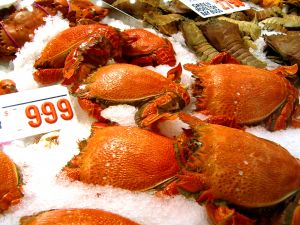
The Australian shopping experience offers a vast range of both imported and locally-made goods.
Local products include the inevitable toy koalas, kangaroos and wombats. But many local fashion designers are making names for themselves. In tune with the laid back 'Down Under' lifestyle, Aussie designs tend to be more casual and comfortable than those from Europe. Notable local brands include Sass and Bide, Carla Zampatti, Jag, and Adele Palmer.
Locally-mined opals are one of the best buys in Australia but you really need to know what you're doing when shopping for any kind of gemstone.
And of course if you're after serious Aboriginal art or just a boomerang or didgeridoo, Australia's the place to go.
Shopping In Sydney
Downtown Sydney is home to the standard retails outlets. For department stores, the two major names are David Jones and Myer. David Jones is the largest, selling goods ranging from the latest fashions to designer furniture.
For more individual wares you have to head to Paddington, Glebe and Newtown, home to distinctive boutiques showcasing the threads of local designers, along with jumble shops and markets for penny-pinchers. Oxford Street is the domain of myriad fashionable clothing outlets featuring the creations of the city's most avant-garde designers.
A must visit is the Queen Victoria Building which houses a delightful Victorian shopping arcade offering four levels of male and female fashion items in 200 boutiques.
Shopping In Melbourne
Melbourne is acknowledged to be Australia's shopping capital. It is home to grand fashion houses, department stores, fascinating souvenir shops, and glorious arcades.
The arcades are one of Melbourne's treasures. The finest is the Block Arcade home to over 30 businesses such as the historic Hopetoun Tearooms. Another gem is the Royal Arcade and don't miss the massive Melbourne Central shopping complex between Latrobe and Lonsdale streets.
Other Melbourne shopping attractions include South Yarra featuring Australian fashions, and Toorak Road for high-priced, brand names such as Gucci.
For the more thrifty shopper, head to one of the thousands of retail shops and factory outlets. They're spread around Melbourne especially on Bridge Road and Swan Street. Here you can pick up designer clothes, perhaps last season's top picks, for just pennies on the dollar.
Shopping In Brisbane
Australia's third-largest city boasts a broad array of shopping outlets gracing its tropical landscape. Brisbane's shopping scene is centered on Queen Street Mall which houses around 500 retail outlets.
Queensland's own fashion creations are on sale at the Brisbane Arcade. The nearby Broadway on the Mall and MacArthur Central offer a wide range of gifts and accessories and designer labels and Swiss watches.
But for an authentic Brisbane shopping scene, you have to head to one of the city's many markets. Valley Markets is the place for alternative and retro fashion. It's open on weekends from 8 am to 4 pm On Friday nights, the South Bank Art and Craft Markets come to life with its stocks of handicrafts.
Men Work Down Under
This lucky country's economy is on a record-breaking 14-year roll. The big question: Will it continue?
Just imagine: From a few convicts dropped ashore in 1788, Australia has developed into a first-class global economy. The reforms enacted by former Prime Minister Bob Hawke and Treasurer Paul Keating during the 1980s set the stage for a remarkable run of prosperity. Specifically, they slashed import tariffs, floated the currency and reduced the power of big labor. The current prime minister, John Howard, who has been elected four times, has continued and expanded these reforms riding a wave of economic growth – 14 years of uninterrupted 4% to 5% growth.
The national debt has been virtually eliminated, the currency is strong, the government has recently signed a free-trade pact with America, and it is starting to negotiate a pact with China. Australia received $42 billion in foreign direct investment in 2004.
This is all great news, and our portfolio allocation in the Australia iShare (AMEX: EWA) has done very well, with a 105% gain over the past two years. The Australian iShare is up 15% so far this year and provides investors with exposure to about 60% of the total stock market.
Some Warning Signs
The question is of course, what should we do now. When things are going this well for so long, investors need to be skeptical and weigh the potential upside with the downside risk.
- A shortage of skilled and semi-skilled workers and relatively high labor costs (minimum $400 a week).
- Complicated and rigid labor rules continue to hamper productivity growth, which seems to be slowing.
- The total tax take by the Australian federal government is 22%, which is higher than the rest of Asian competitors and the U.S. (average of 16%).
- From 2000-2004 housing prices were up 100%, and household debt is now 160% of disposable income.
Australia is taking some measures to address these matters. It recently enacted a $17 billion cut in personal income taxes over three years, and the independent central bank is raising rates. The leadership has also introduced a package of “radical” labor reforms, which if enacted would also be a big plus. The aim is to give employers more flexibility and to bring labor negotiations down to the local level. The measures would increase probationary period for new employees from three to six months, exempt businesses with less than 100 employees from unfair dismissal laws, and favor individual contracts over collective bargaining. All of these measures will be fought by the Labor Party and trade unions.
While much is made of Australia's dependence on China and commodity exports, the Australian economy is well diversified, with 5% of gross domestic product attributed to mining, 5% to tourism and 80% to services. It also has the third-largest stock market in the region and a leading regional financial center.
Taking Profits
After looking closely at the situation, I have decided to keep Australia in our portfolio, but will take some profits by halving our position. Here is my reasoning:
- The decline in housing prices has been incremental and has therefore not affected banking, consumer and construction stocks as expected.
- International fund managers are underweight on Australia.
- The market is not especially expensive. The 12-month forward price-to earnings ratio is about 15, in line with the average over the past three years and below a high of 18. But keep in mind that this low multiple is based on forward and aggressive forecasts of corporate profits.
- Average dividend yield for Australian stocks is around 5%.
One company to keep an eye on is BHP Billiton (NYSE: BBL), the world's biggest mining group, which reported an 85% rise in net profit, compared with a year ago, to $6.5 billion for the year ended June 30, 2005. The Anglo-Australian firm set a new Australian corporate profit record, and after being up sharply in 2003 and 2004, it has confounded skeptics by going up 26% so far this year. The company's good fortune, like that of other mining concerns, comes from rising demand in China.
Another great Australian mining company is Rio Tinto (NYSE: RTP), which has a lower valuation because it doesn't have oil and gas operations, which contribute about 30% of BHP's total revenue.
Last Bit of Advice
The center of gravity for the world's economy is shifting to the Asia-Pacific region, and Australia is in the sweet spot. Keep an eye on housing prices and corporate profit performance, but for now keep some exposure to Australia in your global portfolio.
For more information go to www.chartwellasia.com or call 877-221-1496
Both Alistair White & Carl Delfeld are contributors for EditorialToday. The above articles have been edited for relevancy and timeliness. All write-ups, reviews, tips and guides published by EditorialToday.com and its partners or affiliates are for informational purposes only. They should not be used for any legal or any other type of advice. We do not endorse any author, contributor, writer or article posted by our team.
Alistair White has sinced written about articles on various topics from Argentina Travel, Touring Italy and Recreation and Sports. Alistair White has been in the travel industry for over 20 years and is the founder and CEO of Cheaper Than Hotels. Cheaper Than Hotels offers cheap. Alistair White's top article generates over 201000 views. to your Favourites.
Carl Delfeld has sinced written about articles on various topics from Finances, Family Travel and Fitness. . Carl Delfeld's top article generates over 201000 views. to your Favourites.
Americo Financial Life And Annuity Insurance I am so glad that this is available for all of us.Well that is about all I can do for this introductory article.In the next one, we will dive into the How To of finding homes