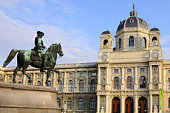
Vienna’s museums, galleries and collections are world-famous. Housed in splendid imperial buildings on the Viennese Ring road the Museum of Fine Arts and the Natural History Museum captivate the visitor with their impressive exhibition objects. The collections in the Museum of Fine Arts were mainly assembled for centuries by the Habsburgers.
Habsburgers loved the Dutchmen Bruegel, Rubens, Van Dyck, the Venetians and Duerer. The surroundings of The “Art and Treasure Chambers" as well as the picture galleries give one the feeling, even today, of visiting a distinguished princely private collection. One becomes acquainted with the art and culture of the former emperors of Austria with a walk round the museums in their former living and function rooms: The Sissi museum, the art collections in the Belvedere castle, castle Schoenbrunn and the Hofburg still radiate the splendor of the Austrian monarchy.
The Museum of Applied Art exhibits fine craftsmanship, art and design from many epochs. Following the traces of the Viennese art nouveau period, the Secession from Otto Wagner is the most important sight of interest in the city. One is impressed not only by the golden domed roof, but also by the Beethoven frieze from Gustav Klimt. The slogan of the “The Association of Visual Artists Austria’s Secession": “the time of their art - the art of their liberty". Art nouveau, which affected not only architecture, but influenced all ranges of daily life, is inseparably connected with names, such as Otto Wagner, Josef Hofmann, Kolo Moser, Gustav Klimt, Egon Schiele and Adolf Loos.
The Albertina collection, the Palace Liechtenstein and the numerous galleries of Vienna are further places to visit for culture-interested Vienna holiday-makers. The KunstHaus Vienna is accommodated in a house built by Friedensreich Hundertwasser. Beside works of the famous painter and architect one can also see drawings of modern art, photography and graphics.
Vienna has built a museum quarter that is one of the ten largest cultural districts in the world. It took a decade to be constructed.
The MuseumsQuartier Wien is a place where 20 autonomous artistic institutions, ranging from a creativity centre for children to a classical art museum, from headquarters for dance, film, architecture and theatre to forums for new media and art theatre. A surfeit of shops and restaurants surround the complex, which has also become the main venue for the Vienna Festival, the city’s foremost annual event.
World-class museums are found in the area which include the Kunsthalle Wien, Vienna’s premier exhibition space for international contemporary and modern art; the Leopold Museum, important for modern Austrian art, including the Secession, Viennese Modernism and Expressionism, as well being home to the largest collection of work by Egon Schiele; and the Museum Moderner Kunst, one of Europe’s largest collections of modern and contemporary art.
The area’s architecture represents a fusion of the original 18th-century buildings with modern work. The former were renovated by Manfred Wehdorn, while a separate team, Laurid Ortner, and were engaged for the latter. The aim is to provide physical and historic links between old and new, art and recreation, audience and architect. Vienna is one of the few European metropolises to have achieved harmony between ancient and modern in its cityscape.
Anil Gupta has sinced written about articles on various topics from Hotels and Hostels, Destinations and Hotels and Hostels. Anil Gupta recommends that you visit for more information on Vienna hotels.. Anil Gupta's top article generates over 49500 views. to your Favourites.
Coral Calcium From Japan They are not designed to treat, cure or mitigate any disease. However, high quality supplements are an excellent way to supplement, but not substitute, the benefits of a good diet