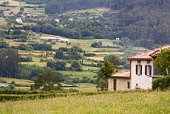
If it is luxury that you are after then the best advice should be to head straight for the exclusive hotels and ?Paradors? but to be honest even the basic family ?casas rurales? are extremely good value for money. The region is dotted with mountain refuges with stunning views not to mention that in the coastal areas you can find quite a few campsites.
The standard of accommodation in the area is extremely high as you would expect from Galicia and Northern Spain. The hotels are awarded between one and five stars and these are allocated by the local tourist Authority. If you need actual visible proof of the standard of your hotel you can find confirmation indicated by a small blue plaque near the hotel front door.
You'll find in hotels that they have at least a shower in each room but more usually en suite bathrooms. Do not expect to find en-suite facilities in the smaller Hostels and ?Pensiones? but you might be surprised in certain cases.
Don't equate the number of stars on the outside door of the hotel to necessarily match the standards of the accommodation that is on offer and this is because in Spain the stars are allocated on the facilities on offer not necessarily the quality of the service. As is usual in most quality hotels the standard facilities on offer include air conditioning, televisions in each room, facilities for the disabled, Internet access and on-site parking.
Two or three star hotels are the most popular in this region and their rates vary on the season or time of year that you stay there. It has been found that in this area quite often the hostels (hostales) and guest houses are actually more popular; the fact that they are cheaper may have something to do with this. Quite often these small establishments are family run and may be limited to just the few beds so yet again it is wise to plan ahead.
It is estimated that there are approximately 92,000 registered beds in this territory, described as ?Green Spain? and there are in excess of 1500 hotels.
The biggest hotel chains in northern Spain are the Grupo Sol-Melia and NH with hotels in the main towns. Their facilities are of a high standard and include internet-access amongst other features. Latterly there have been a growing number of smaller privately run hotels that offer memorable relaxing accommodation available.
In Spain they have dotted throughout the country a series of state run hotels that are known as Paradors. These are classified from between three to five stars. The first Parador opened in 1928 and there is now quite a comprehensive network throughout the country. The theory behind them was that they should never be more than a day's drive from one to another. The Parador de los Reyes Catolicos in Santiago de Compostela, located in a former royal hunting lodge is possibly the best known Parador in the area. Various monasteries, castles and other monuments have been used for Paradors elsewhere. Some Parador's have been purpose built often in spectacular scenery or in towns of historic interest.
You can rely upon the Parador to deliver a consistently high level of comfort but it might not necessarily be the best hotel in town. The bedrooms are usually spacious and comfortable, and all furnished to a standard that varies little from Parador to Parador. Some also offer fine regional cuisine. It might be wise to book in advance if you are planning to visit the area either during the high season or if you wish to stay in one of the smaller Paradors. Paradors can be booked through the Central de Reservas in Madrid or by calling each Parador direct. As with most areas if you travel in the high season you will find accommodation can be quite expensive but if you are able to shop around you can quite often find special deals available.
Northern Spain And France
If it is luxury that you are after then the best advice should be to head straight for the exclusive hotels and ?Paradors? but to be honest even the basic family ?casas rurales? are extremely good value for money. The region is dotted with mountain refuges with stunning views not to mention that in the coastal areas you can find quite a few campsites.
The standard of accommodation in the area is extremely high as you would expect from Galicia and Northern Spain. Hotels are categorized and awarded stars by the regional tourist authorities. The local tourist Authority awards between one and five stars for each hotel and the status of the hotel can be found by looking at a blue plaque near the hotel door.
Hotels usually have en-suite bathrooms or at least a shower in the room. Hostels and ?Pensions? usually do not have en-suite facilities and have fewer comforts than hotels so as to be expected are slightly cheaper.
Don't equate the number of stars on the outside door of the hotel to necessarily match the standards of the accommodation that is on offer and this is because in Spain the stars are allocated on the facilities on offer not necessarily the quality of the service. As is usual in most quality hotels the standard facilities on offer include air conditioning, televisions in each room, facilities for the disabled, Internet access and on-site parking.
Two or three star hotels are the most popular in this region and their rates vary on the season or time of year that you stay there. In some cases the hostels (hostales) and guest houses are more popular in this region primarily because they are cheaper. These are usually small family-run establishments offering just a few beds.
This area of Northern Spain otherwise known as Green Spain claims to have a total of 92,000 beds registered over 1,500 Hotels, Hostels and ?Pensiones?.
The biggest hotel chains in northern Spain are the Grupo Sol-Melia and NH with hotels in the main towns. Their facilities are of a high standard and include internet-access amongst other features. There are a growing number of small privately run hotels that have quite distinctive character and charm and can also provide a quite relaxing and memorable stay.
In Spain you'll find an establishment called a Parador. These have classifications of anything between three to five stars in accommodation standard. There is now quite a wide network of Paradors throughout the country, the first one opened in 1928. The idea behind the hotels when they were setup was that there should never be more than one day's drive from one Parador to another. In Santiago de Compostela you can find possibly the best known Parador in the area and this is the Parador de los Reyes Catolicos. Other Paradors can be found in monasteries, castles and other monuments. You will quite often find that there are a growing number of purpose built Paradors and these can quite often be found in either towns of historic interest or areas of spectacular scenery.
The local Parador might not be best hotel in town but it will usually deliver a predictably consistent standard of comfort. The standard from each Parador to Parador very rarely varies with comfortable spacious bedrooms to be found throughout. Quite often you will find that they offer outstanding samples of regional cuisine. It is usually wise to plan ahead and book your accommodation if you wish to use the network of Paradors. Bookings can be made either using the Central de Reservas which is a centrally based service based in Madrid or you can contact each Parador direct. Rates can be expensive it is worth looking for special deals especially in the high season but to be brutally honest this has to be the same anywhere you go.
Scott James has sinced written about articles on various topics from Information Technology, Health and Social Issues. Scott James writes about a great many Internet Travel based issues and more on the above can be found at
Cheapest Personal Loan Rate If he defaults in his repayments then the lender can take possession of the property offered as security. So, it is advisable to take care of the terms properly to avoid property repossession.