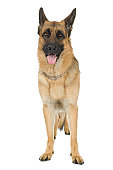
The body that establishes standards of dog breeds in the United States is the American Kennel Club (AKC). The American Kennel Club decides what qualities make a dog a show quality German Shepherd. German Shepherds in dog shows are judged against these standards, and the dog that comes the closest to matching all the standards of the breed wins the dog show. German Shepherds that win certain prizes in American Kennel Club dog shows can earn the rank of American Kennel Club champion, a designation that appears on a dog's pedigree.
The categories that make up the standard of the German Shepherd breed include: appearance, temperament, size and proportion, coat and color and gait, the way the dog moves. A German Shepherd who meets the appearance standard of the breed gives the impression of a strong animal, alert and full of life. A good German Shepherd looks substantial and muscular, with an expression of nobility and quality breeding. The standard of the German Shepherd breed calls for a confident personality, slow to make friends. German Shepherds are alert and eager, ready to be report for duty as guide dogs, guard dogs, police dogs, herding dogs or loyal family companions.
The standards require that German Shepherd males should be twenty four to twenty six inches tall at the shoulder; females should be twenty two to twenty four inches tall. The German Shepherd head is noble, strong, and in proportion to the body. Males should look masculine, and females should look feminine. The face includes dark eyes, moderately pointed ears and a long, strong muzzle. A dog with cropped or hanging ears will be disqualified from competition, as will a dog with a nose that is not predominantly black. The neck should be strong, muscular and relatively long, carrying the head high and forward. The body should be deep with long ribs, a firmly held abdomen and a high, bushy tail. The forequarters are well muscled, with short, compact feet. The upper thigh should run parallel to the shoulder blade. The hindquarters are broad, with dewclaws removed from the hind legs.
The standard for German Shepherds require a double coat, with a thick, short outer coat on the main part of the body and shorter coat on the head, legs, and paws. A slight wave may be acceptable to some judges, but silky, wooly and curly coats are faults that require disqualification from judging. The health of the dog shows in the coat, so a German Shepherd's coat should be glossy and well groomed. The classic German Shepherd is a deep tan with black saddle and facial features. Variations in color are permissible, although a white dog must always be disqualified. The German Shepherd moves in a trademark trot, covering ground quickly and steadily. A good German Shepherd trots effortlessly, as gait faults nearly always result in disqualification.
These are the American Kennel Club standard for breeders and dog show judges. As the saying goes, your mileage may vary. German Shepherd dogs who fall short of these standards make loyal, loving companions, so don't overlook dogs offered for adoption through German Shepherd rescue organizations when selecting a German Shepherd as a companion animal.
Of The German Shepherd Dog
Developmental bone and joint disease is a common problem prevalent in young large breed dogs like German Shepherds. Dogs may not exhibit any symptom or may show pain, lameness and reluctance to exercise. Hip dysphasia is characterized by wasting of hind limb muscle.
German Shepherds can also be affected by hemangiosarcoma. Hemangiosarcoma is a cancer affecting the lining cells of the blood vessels. This mainly targets the skin, heart, liver and spleen. Symptoms may present as weakness, a distended abdomen, sudden collapse and pale gums.
Another German Shepherd dog health problem is weakness in the hind legs, which manifests itself through a lack of coordination, or by a general shakiness of movement. This can be caused by a slipped disc, or by a breakdown of the bones of the spine, or even of the spinal cord itself.
Another problem to look out for is a diseased thyroid gland which will cause either over or under-production of thyroid hormones in some dogs. If your dog is experiencing skin infections, lethargy, hair loss, or cold intolerance it could indicate a thyroid problem.
Keep a keen eye on the eyes of your German Shepherd, especially if you notice apparent squinting, excess tearing or discharge, redness, or rubbing of the eyes. You should also be alert for any growths over the eye, regardless of the color. A condition called Pannus, an inflammation of the dog's cornea, could cause any of these problems and be detrimental to your dog's optical health.
Pyoderma literally means "pus in the skin" is is most commonly referred as bacterial infection of skin that is recurring in nature. Usually there will be pus in the area. The immune system deficiency is thought to be the principal cause. Signs and symptoms of pyoderma include scratching, skin redness, pimples, sores, scaps and alopecia in the area. There may pain in the area and some pets may be sluggish and lose their appetites.
A first step to avoiding these German Shepherd dog health issues is to make sure that your dog does not come from a breeder where other dogs had these issues. Watch your dog carefully, and be sure to consult your Vet if your dog displays any symptoms, or behavior out of the ordinary.
Both Jan A Ryan & Lee Dobbins are contributors for EditorialToday. The above articles have been edited for relevancy and timeliness. All write-ups, reviews, tips and guides published by EditorialToday.com and its partners or affiliates are for informational purposes only. They should not be used for any legal or any other type of advice. We do not endorse any author, contributor, writer or article posted by our team.
Jan A Ryan has sinced written about articles on various topics from Puppies Dogs, German Shepherd Dogs and Puppies Dogs. Jan Ryan is a dog show judge who especially enjoys judging the Working Group. American Kennel Club standards for a cover a dog's appearan. Jan A Ryan's top article generates over 40500 views. to your Favourites.
Conventional Food Vs Organic Food If you need info or more articles on Where to order perennial flowers plants for planting? read more articles from Greenthumbz Bill Wordsworth - Greenthumbz c 2007