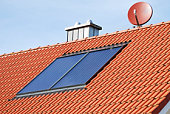
When it comes to heating costs, most of us are not lucky enough to live in a temperate area with a constant year-round climate, and instead have to contend with winter heating bills that can be exceptionally high. When evaluating alternative home heating, an option that is often overlooked is passive solar heating. You not only save money, but energy as well.
Even on those truly frigid days in the dead of winter, the sun still emits a noticeable amount of heat. The only factor that precludes the accumulated snow from melting is the long night and short daylight period. Wouldn't it be nice if you could use the sun's heat when it's available without needing to significantly modify your house?
Passive solar design is a holistic approach integrating the home's architecture, materials and mechanical systems. It will consider the local climate conditions, including temperature, solar radiation and wind, to create energy conserving structures that can be powered with renewable energy sources.
Here is where the Trombe wall comes in. This wall is made of a thermal mass (such as concrete or stone) that can store the heat built up during the day, and then release it slowly throughout both the night and day. On the outside the wall is insulated by a glass pane and an airspace, thus preventing the loss of heat to the outside during the night. A shade rests above the glass that allows direct light exposure during low winter sun, but acts as a protection during prolonged high summer sun heat, this dual action helps keep cooling bills in the summer low also.
The room behind the Trombe wall receives slow, even heating for many hours after the sun sets. Rooms heated by a Trombe wall will often feel more comfortable than those heated by forced-air systems because of the radiantly warm surface of the wall, even at lower air temperatures.
True, short of major renovations, such an addition isn't going to be easy to retrofit to your house, and custom designed homes are expensive. But retrofitting a house for other energy efficient heating techniques, like radiant heating, is also expensive and, unlike the other alternatives, passive solar heating, once implemented, costs nothing to continue using.
Even though it became popular in homes built in the 1960's, the idea behind the Trombe wall actually originated in the 19th century. In shopping for that new, energy efficient home, you should keep in mind that you can still go green by using past, proven design techniques.
Now that the awareness of green issues is commonplace, people are becoming aware of the costs involved in heating our homes, both financial and environmental. Ideas from our ancestors, both ancient and not so ancient, solutions such as passive solar heating, are being looked at as viable because not only do they have a benefit environmentally, but they save us money as well.
Passive Solar Heating Cooling
Mention the phrase solar power and what do you think of? Panel systems comprised of a bunch of solar cells. Maybe they are in the backyard. Maybe on the roof. Regardless, they are bulky, expensive and not much to look at when it comes to the appearance of your home. Fortunately, there is another form of solar power you can take advantage of without using panel systems.
Passive solar is a concept that focuses on using the power in sunlight to heat a home. More importantly, the concept incorporates solar heating both during the day and night. If you are building a new home, you would be wise to give the concept some thought. A new home should last for a long time and passive solar heating can save you a ton of money in heating costs over that time. In many cases, it may eliminate the heating costs entirely.
Passive solar is a theory based on heat retention and heat movement. The classic example of solar heating is parking your car in the sun at a mall on a sunny day. What happens when you come out? The interior of the car is roasting hot. Why? The sun has beat down through the windows and heated up the surfaces in the car. With the windows up, the heat is retained and the surfaces can get painfully hot. This is heat retention.
What is the first thing you do when you want to get in the car? You roll down the windows. Why? The hot air will escape, which cools the car. The heat escapes because hot air always moves away from hot surfaces and towards cooler surfaces. This is known as heat movement.
You can use heat retention and movement to incorporate passive solar heating in your home. The idea is to let as much sun as possible through the south facing wall of your home, typically through large windows. To retain the heat, you want to maximize your thermal mass. This is done by placing absorbing materials and colors on the ground below the windows. During the day, these materials absorb the heat. They will give off some of it, but not as much as you might think since the air in the house is normally fairly warm.
Once the sun goes down, your thermal heat products will start to radiate heat. Why? Well, the cooling air temperature will act to suck the heat out of the materials much like opening your window in the hot car resulted in the hot air getting sucked out the windows. Ah, but how long will the thermal mass heat the home? Well, if you are building your home from scratch, you can incorporate enough of the proper material that it will radiate heat throughout the entire night.
Obviously, this article represents an overview of passive solar heating. If you are building a new home, however, you would be wise to look into the concept. Fuel prices are only expected to rise in the future, so a little proactive planning could save you a bundle in heating costs.
Both Ryan Mccall & Richard Solare are contributors for EditorialToday. The above articles have been edited for relevancy and timeliness. All write-ups, reviews, tips and guides published by EditorialToday.com and its partners or affiliates are for informational purposes only. They should not be used for any legal or any other type of advice. We do not endorse any author, contributor, writer or article posted by our team.
Ryan Mccall has sinced written about articles on various topics from Home Improvement, Swimming Pool and Family. Two important ideas to consider when it comes to eco-friendly home heating is the use of and. Ryan Mccall's top article generates over 40500 views. to your Favourites.
Richard Solare has sinced written about articles on various topics from Family Travel, Home and Home Improvement. Rick Chapo is with SolarCompanies.com - information on .. Richard Solare's top article generates over 246000 views. to your Favourites.
Citifinancial Retail Services Online Payment Dont stop your education about online marketing after you have these five to seven methods because marketing online is always changing and new things are always being added, so your education on mar...