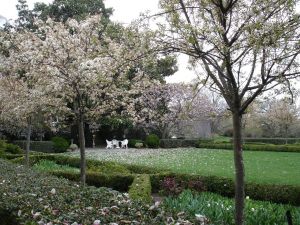
When you look at a rose garden in full bloom, you see all the vibrant colors and smell the heady fragrances. But when you think of starting a rose garden of your own, you think of all the difficulty in maintaining them and how time consuming it all is. But in actuality, starting a rose garden isn't any harder than growing other plant or shrub in your landscape.
Roses have been around a long, long time. Fossilized roses have been discovered that are over 35 million years old. Although mainly a native to Asia, the 150 different wild and cultivated species of roses can be found all across the Northern Hemisphere. Ancient cultures from China to Egypt to Greece to Rome have grown and revered this perennially flowering shrub.
Roses have been symbols for war, love, forgiveness, beauty and clandestine meetings. In fact the Latin expression “sub rosa“ (under the rose) comes from the Romans who would often set out or display roses at gatherings as a signal that whatever was talked about or discussed was to remain “secret”.
How Do You Grow A Rose Garden?
Before starting a rose garden you should visit as many rose gardens as you can. Look in on friends and family's rose beds, ask questions and learn all you can. Ask gardeners about their failures as well as their successes. Pick up a magazine or two or do some searching on the Web.
The next step is to choose the type rose bush or plant you want. Understand that roses come in three main groupings: wild, old garden and modern garden varieties. A wild rose is a plant that remains exactly as Mother Nature created it (it has not been hybridized). An old garden or “antique” roses are plants that were under cultivation before 1867 when the first hybrid tea was developed. Modern roses are hybrid plants introduced after 1867.
Wild roses are the most maintenance free roses but don't have all the colors and aromas of some of the newer hybrids. Vintage or old garden roses have withstood the test of time and hardy and easy to grow. Modern roses have some exciting colors, combinations and shapes.
Rose plants come in pots or containers or as “bare root stock”. Until you get some experience under your belt, you should stick to using potted plants.
How Do I Make a Rose Garden?
Starting a rose garden begins with good soil preparation.
1. Locate an area in your yard that gets a minimum of six to eight hours of sunlight, preferably morning light.
2. Now till or dig a very big hole, at least 2 feet wide by 2 feet deep.
3. Take all the soil and set aside. Mix the soil with one part peat moss and one part compost.
4. Add water into the hole. Shovel a little of the new soil mixture into the bottom.
5. Remove your plant from its pot by gently rolling and squeezing the sides of the pot.
6. Set your plant in the hole and backfill with the soil mixture until the root-ball is covered. Firm the mound with your hands.
7. Give your new rose bush a good soaking to settle the soil and remove any air pockets.
Now that you know more about starting a rose garden, you can start exploring the wide world of this ancient and symbolic flower.
Plant A Rose Garden
Why antiques? They have withstood the test of time. Many are alive and well, living in old grave yards, home sites, and near public buildings that are over 100 years old. Although some get black spot or something, they nevertheless flourish.
Why antiques? Modern day roses, especially the hybrid teas have to be pampered and babysat. Not only do they have to be fertilized, watered, and prune just right to live for any length of time. Hybrid teas are usually grafted on to other root stock. It appears to most horticulturalists they plants are hardier on their own rootstock.
Why antiques? Hybrid teas have been breed for form of flower, how well they do in vases, and repeat bloom. Fragrance, hardiness, and other great qualities have mostly disappeared, although now there are hybridizers experimentally with fragrance. I read recently of petunias being used in experiments to give hybrid teas and other new roses an old flower smell. For the most part, new roses make the ugliest of bushes, whereas the antiques are often graceful in form.
In the late 1700's to early 1800's, visitors to China, specifically botanists, brought back to the west rose that would bloom more than once a year, called remontant. They named these roses "China" Roses and "Tea" Roses. Until then, all roses in the west bloomed only once a year. These were the hardy roses, sports, and varieties grown in the Americas, Europe, and parts of Asia. These roses flourished in the wild, even.
The Chinas and Teas did very well in warm climates. In northern Europe, they could not withstand the cold. So nurserymen and other began crossing the Tea and Chinas with such native species as the dog rose, the Centifolias, Damasks, and Gallicas. The end product of all this hybridizing produced Bourbons, Grandifolias, Hybrid Perpetuals, Noisettes, Portlands, Polyanthas, etc.
Old roses look spectacular in all types of situations. The native species of rose go swell with other natives, especially on rustic, naturalistic sites. Antique roses look well in rustic garden laid out formally or informally. Most old roses look fantastic in abstract modern, baroque, or classical formal or informal gardens. The antiques set off perennials, herbs, and other shrubs in the border. They are at home on either city plots or vast estates.
So the least you can do for your one and only is to give her a rose garden. After all, Napoleon gave Josephine, "Malmaison", outside Paris, reportedly the greatest rose garden since ancient times.
Josephine had a painter who strolled around her garden painting flowers, particularly roses. His name is Redoubte and his works command a high price.
Some of the rose varieties grown at Malmaison can be purchased today, as well as, many others. Petals From the Past in Jemison, Alabama is a great place. So is the Antique Rose Emporium in Tyler, Texas and Suburban Atlanta. In Watsonville, California, there is Roses of Yesterday and Today. You can order old roses from http://www.antiqueroseemporium.com/ and http://www.rosesofyesterday.com/rosenn.htm.
Both Adam Carter & August Holcombe are contributors for EditorialToday. The above articles have been edited for relevancy and timeliness. All write-ups, reviews, tips and guides published by EditorialToday.com and its partners or affiliates are for informational purposes only. They should not be used for any legal or any other type of advice. We do not endorse any author, contributor, writer or article posted by our team.
Adam Carter has sinced written about articles on various topics from Gardening, Rose Gardening. . Adam Carter's top article generates over 590 views. to your Favourites.
August Holcombe has sinced written about articles on various topics from Modelling, Rose Gardening and Gardening. . August Holcombe's top article generates over 720 views. to your Favourites.
Back Shaver For Men Apply a soothing cream to avoid razor burn5. Wear loose undergarments for some time to avoid stubble catching on your clothing