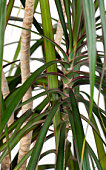
Tempting as are the nursery catalogues, it is necessary to choose carefully, especially on the average lot, because crowding spoils the growth and appearance of trees, particularly specimen trees.
In general, it is wisest and most economical to plant young trees. Planting a mature tree is difficult and, if done professionally, costly.
If, however, a mature tree is badly needed for a terrace or for screening, it may well justify the expense. What you are buying is the time it takes a smaller tree to mature.
Today you can plant trees when in full leaf with the aid of new wilt-proof sprays that seal the leaves against moisture loss until the roots are established.
This, however, costs money and entails greater risks than buying your tree and planting it in early spring (the best time) or late fall or winter. If you are planting a tree over 6 feet tall, it will suffer less setback if moved with a bur-lapped root ball.
The soil preparation described in the previous chapter is helpful for most tree and shrub planting. But since the root system must have fertile soil when it is planted, special steps must be taken. Dig a hole 2 feet deep and at least 1 foot wider each way than the full spread of the roots. The bottom of the hole should be broken up with a pitchfork and thoroughly mixed with peat, leaf mould, loam, etc.
Manure should be used sparingly and only on the top of the hole as it burns the roots. The deeper you can cultivate your hole, the better for your tree. Once it is planted, you can cultivate around it but not under the roots.
If you strike a subsoil of building rubble or clay, which you are very apt to find anywhere near a house and in which a tree cannot grow, this subsoil must be removed and good soil, or better still, garden humus, substituted for it.
If you are planting a seedling that is not balled and bur lapped, you will want to protect it by "heeling in" a vacant flower bed where it may be kept before planting as long as dormant. This means laying it on its side and covering the roots with good soil.
When you take it from the soil, give it a mud bath or "puddle" it. Puddling protects the roots from exposure to air before planting and also from any air pockets which may exist after planting.
Having filled the hole to the depth required by the roots of the plant, flood it with water to settle the soil at the bottom; when this has drained away, place the tree in the position in which it is to grow and settle the soil about it.
Use a stick or shovel handle to work the soil around the roots, and make certain there are no air pockets. Spread the roots out naturally, planting the tree at about the same depth as in the nursery or its former location.
When the hole is two-thirds full, trample it down and again fill with water. Don't firm down the remaining soil, so that the water will drain towards the trunk.
A balled-and-bur lapped tree is one dug with a solid ball of rich, heavy loam in which it has been growing in the nursery for years, its root system thus amply covered and protected.
The ball is firmed and held in place by a secure covering of twine and burlap. To plant it, set the tree in a hole that is a trifle lower than it stood in the nursery. Work the soil beneath this depth, as directed above. Dig the hole about twice the size of your ball and plant at once.
If the ground is dry at planting time, fill the hole with water and let it soak away before planting. Cut the burlap at the top when you put the ball in place, rolling it back 3 or 4 inches. Plant ball, burlap and all?the burlap will soon rot away.
If you are planting a big tree, it is transported in a truck, lowered to the ground by winches, rolled along a plank track on rollers and manoeuvred into the exact centre of the hole on a single board. A holding rope from the truck to the base of the tree trunk helps to position the tree.
After the tree is planted, cutting back is proper. Cut back sharply at least one-third, pruning the branches. It is necessary to brace the tree with wire ropes so that the roots will not be broken by the wind. Use a single wire around the trunk and three guy wires.
For the first year after planting, the more cultivation you can do the better. Keep weeds away, too, with straw or mulch, and straw manure mulch in the spring and fall will help keep the moisture in the ground.
Plant A Tree For
One of the biggest things that companies are finding today is that the world of promotional items isn't like it used to be. There are still the usual promotional items that every company uses, but there are also certain things that have been incorporated into promotions that weren't always such a big part.
Companies want to show their customers and their clients that they don't just care about making money. They care about the world that is around them and what is happening to the earth, so they are starting to plant trees to replenish some of the earth's natural resources.
Here are a couple of tips to follow if you want to incorporate trees into your marketing strategy.
1. Find a tree that goes with your company
There are a lot of species of trees that you can choose from, so it shouldn't be too hard to find a tree to represent your company. For example, if your company has to do with pet supplies, you might plant dogwood trees. If your company makes sweets, you might try something like a cherry tree. These are just examples but you can see what the idea is.
2. Get the whole company involved when planting trees
Nothing gets a company noticed more than working together towards a common goal. The people who see you planting trees are going to be impressed by your community efforts and more than likely will stop to find out more information about your company. Be sure to have some business cards and smaller promotional items to hand out to people who stop. But don't make this the main reason that you are doing this.
There are people who wonder why planting trees is good for business. Well, there are a couple of reasons why people smile on companies who plant trees.
1. It's an ecologically friendly thing to do
There is a lot of talk about how we're depleting the earth's natural resources, and people like it when they see businesses taking an interest in the earth.
2. It's a way to show that a company cares about more than money
A lot of people are under the impression that companies don't care about anything other than the almighty dollar. When you and your employees plant trees, it shows that you care about something more than making money.
In conclusion, when a company gets outside and plants trees they are showing a different side of itself. They are showing that they care about the earth, that they want to put something back into the ground after using so many of the earth's resources, and that they care about something more than just making money.
When a company goes out and plants trees, they and their products are going to get noticed. They are going to be noticed as a company t hat makes a difference - not only as in the business world but in the natural world as well.
Both Jeffrey Seymour & Matt Franks are contributors for EditorialToday. The above articles have been edited for relevancy and timeliness. All write-ups, reviews, tips and guides published by EditorialToday.com and its partners or affiliates are for informational purposes only. They should not be used for any legal or any other type of advice. We do not endorse any author, contributor, writer or article posted by our team.
Jeffrey Seymour has sinced written about articles on various topics from Recreation and Sports, Gardening and Shopping. To learn about and. Jeffrey Seymour's top article generates over 9900 views. to your Favourites.
Matt Franks has sinced written about articles on various topics from Culture, Marketing and Home Accessories. Matt Franks is director of Fluid Branding, the UK's largest supplier of and. Matt Franks's top article generates over 165000 views. to your Favourites.
Back Tax Debt Relief When you finally get income tax debt relief, you can breathe deeply and then exhale with happiness