Mountain climbing locations vary in altitude but many of them are in of sub zero temperatures. There are different techniques required for climbing in ice covered terrain and it's much different than climbing in dry terrain. While it is more challenging than other forms of climbing, ice climbing can be the most rewarding and exhilarating.
Many techniques that are used in other types of climbing are used in ice climbing but the challenge is altogether different. There are definite differences in the equipment used for ice climbing. For example, ice climbing boots require more insulation than for alpine climbing since it's important to keep ice and snow from entering the boot.
Spiked soles that clamp to the soles of your boots, called crampons are required for keeping traction on the ice. There are special techniques used for trekking on ice. Using a large ice pick, you use an overhead swing to penetrate the ice in front of you. When you've determined it's secure, you kick your crampon fitted boot into the ice. Once you are sure you're secure these two steps are repeated.
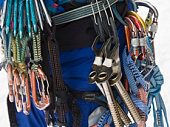
While hiking and climbing, a pro is used much like in traditional climbing but the protective devices used in ice climbing take on a different aspect. Single, twin and double rope ascents are still used but ice screws are commonly used. Ice screws are hollow tubes that have teeth on one end and a hook on the other end. They're placed and secured into the ice and the hook on the ice screw is for attaching to.
The ice itself is sometimes used as a pro. There are two common methods; the V-thread and the Bollard method. In the V-thread method, a pair of holes are drilled diagonally into the ice and their holes connect to make a ?V? shape. A sling is threaded and then attached to a rope and harness. The ice is quite strong and there is little risk of giving way. With the Bollard method a rope hold is carved into the ice and a rope is looped over the piece of ice. The ice is strong enough to hold one or two climbers depending on their weight. There is a risk to using ice as a pro since it is an unpredictable medium but many climbers prefer it.
Ice climbing utilizes many of the same techniques as traditional climbing but with some different equipment. Many climbers find that ice climber is more adventures and provides them with a more rewarding feeling. If you're a climber, you should give ice climbing a try for a true adrenaline rush.
Rock And Ice Climbing
For those of you who just can't get enough of the rush of outdoor extreme sports, ice climbing is something that you may want to look into. It is among the most adventurous and physically taxing of the many extreme sports. If you have any experience with rock climbing, you will be at ease a little bit ahead of the game when it comes to getting started with ice climbing. The same basic principles apply, though the equipment is a little different.
Most ice climbing sessions are planned out long in advance, and taken as a day-long tour. There are many different possibilities for climbing surfaces ? basically, anything frozen and non-horizontal is fair game. Some of the most popular include frozen waterfalls, rock surfaces with frozen water flow, or even icebergs. Some of these are very dangerous, and should only be attempted by the most experienced of ice climbers or professionals.
Ice climbing is a little less accessible due to the fact that most of you won't be able to simply walk outside and find a giant wall of ice to climb. If you are going somewhere up North on vacation, you will definitely find a local ice climbing spot. Usually there are several well-known spots. If you have never climbed ice before, you should be with a guide or an expert as well as your friends.
Most rock climbing takes place in the mountains, since they provide the two necessary components: coldness and steepness. The Rocky Mountains are home to some of the most popular ice climbing areas, with difficulties ranging from beginner to expert. That area is your best bet in the USA, but ice climbing can be done in the Himalayas, the Alps and other mountain ranges all over the world, from Scotland to Nepal.
Safety equipment may seem like a drag, but it is necessary and can be the much needed life savior. Modern ice climbing equipment has been tweaked to the point where it is almost completely unnoticeable while you are climbing. This helps add to the illusion of danger, which is what makes the sport such a rush.
Depending on the surface, you may or may not use tools such as axes and picks. If you are new to the sport, you can start by simply climbing the ice as though it was a rock. Using gloves and stiff boots, you can search around for strategic hand or foot-holds. You will have to strategically plan your ascent so that you don't get stuck hanging from a handhold or you get stuck in a place from where you can't go up or come down.
Once you graduate to vertical climbs, your climb will take much longer. You will have to use your ice pick and axe to pull yourself up. You can bury your pick just a half of an inch into the ice, and that will provide enough strength for you to pull yourself up. You will also have to wear a special kind of footwear known as ?crampons?, which adds spikes to your boots. A swift kick into the ice wall, and you have a custom-made foothold.
Ice climbing can be a long and grueling experience. It requires plenty of physical exertion as you pull your body weight all the way up the side of the ice or glacial cliff. But when you reach the top, nothing can compare to the sense of joy at your accomplishment. So if you have the opportunity to go ice climbing in the future, don't be apprehensive. It may be difficult to get used to, and it may be cold, but it sure is amazing once you reach the top.
Both Greg K. Hansward & Jb Mills are contributors for EditorialToday. The above articles have been edited for relevancy and timeliness. All write-ups, reviews, tips and guides published by EditorialToday.com and its partners or affiliates are for informational purposes only. They should not be used for any legal or any other type of advice. We do not endorse any author, contributor, writer or article posted by our team.
Greg K. Hansward has sinced written about articles on various topics from Home Improvement, Pregnancy and Home Management. Greg Hansward routinely edits reports on areas relating to Denia and Alicante. You might find out more about his abstracts on and Denia on his s. Greg K. Hansward's top article generates over 27100 views. to your Favourites.
Jb Mills has sinced written about articles on various topics from Camping, Recreation and Sports and Forex Guide. For more information please visit .. Jb Mills's top article generates over 6600 views. to your Favourites.
Anti Aging Moisturizing Cream Its ideal as a regular treatment, as a short intensive course during seasonal changes, or when the skin is particularly tired or stressed. The ultimate in pampering and luxury