* Metro - an underground network covering all of Paris
* RER - a network that covers Paris and the residential regions (the banlieu) around Paris. Within Paris the RER is underground, while outside the trains are above ground
* SNCF - the national rail network
The transport networks for the ?le-de-France (region that contains Paris and surrounding area), all fall under a single organisation, the RATP (R'gie Autonome des Transports Parisiens). The RATP control the metro, RER and tram networks, and their website is an excellent source of information for maps, travel information (timetables, delays and ticket information).
For the national train network, the reponsible body is the SNCF (Soci't? Nationale des Chemins de fer Fran?ais - National Society for French Railroads). Through their website you can buy tickets to any where in France, and get information such as timetables and delays. The train in france is called the TGV (Train ? grande vitesse - really fast train, an appropriate name!), although you may see other international trains such as the german ICE (InterCityExpress) or Eurostar (to the UK and Belgium).
Metro
The metro has 16 lines covering all of Paris. The lines are identified by a number, and the direction to travel is indicated by the end destination - for instance, if you travel westerly on line 1, then you're heading in direction 'La Defense'. There are multiple entrances to most metro stations, and inside the station there are street maps showing the local area to help you find the most convenient exit.
The trains are very frequent, often only 5 minutes between stations. Sundays and public holidays have a reduced service, although trains are still fairly frequent. The metro stations are fairly close to one another, so often walking is easier than changing lines to go just one stop.
A ticket will allow a single journey of unlimited distance, and is 1.40?. Rather than buying individual tickets, packets of 10 can be bought for 10.90? - a packet is called a 'carnet' (pronounced 'car-nay'). The tickets also allow travel on the RER, but only within Paris (Zones 1 & 2 on the RER map). Tickets can be bought at the metro stations (be aware that not all entrances have ticket vending machines or tellers), or at newspaper vendors or tabacs (bar/tobacconists) which show the RATP sign outside.
Ticket machines require the ticket to be inserted into a slot, and then you take the ticket before proceeding through the gate. Don't thow the ticket away - even though you don't need the ticket to exit, if you're caught without one it's a 25? on the spot fine.
Travel passes give you a single ticket that allows unlimited travel. The Carte Orange (pronounce Orange as Awe-wronj) is available for either a weekly (Hebdo) or monthly (Mensuel) period. The weekly period is from Monday to Sunday, rather than from the day of purchase. You'll also need to get a ticket pass holder at the metro station, which you sign and stick in a passport photo. For a zone 1 & 2 pass (just Paris) the weekly ticket is 16? and the monthly ticket is 52.50?.
An alternative travel pass is the Paris Visite ticket. This gives unlimited travel for either 1, 2, 3 or 5 days, from the first day of use (not purchase, so you can buy them in advance). The prices for this ticket are;
1 day - 8.35?
2 days - 13.70?
3 days - 18.25?
5 days - 26.65?
Although more expensive than a Hebdo carte orange, you are not fixed to the Monday to Sunday days, and the ticket also gives discounts to museums and department stores. It also covers the Roissybus and Orlybus.
A map to the metro can be found on the RATP site here, but street maps of Paris which include the metro and RER are freely available from almost all hotels, department stores and tourist information offices.
RER
The RER has four lines that cross Paris (A, B, C and D). The lines only stop at a few stations, and generally only useful to the tourist if you rapidly want to cross the whole city, or are travelling to the airports. Line B takes you to the Charles de Gaulle or Orly airports, while line A goes to Eurodisney (Chessy Marne-la-Vall'e station).
The RER is split into zones, with Paris being covered by zones 1 & 2. Metro tickets allow travel within zones 1 & 2. Be aware that some metro stations are in zone 3, such as La Defense. and even though a regular metro ticket will get you to the metro stop, you won't be able to exit the RER station with the same ticket.
Ticket gates to the RER are similar to the metro, and you'll need to insert the ticket to enter. You'll also need the ticket to exit the RER, so don't throw it away, eat it, or screw it into a little ball!
Bus
The bus network in Paris covers a wider range of areas than the metro system (particularly in the outer arrondissements), and being above ground they are also more pleasant to use. However, the maps may be a bit confusing at first glance.
Each bus has a number, and the direction is simply a matter of standing on the appropriate side of the road. The buses stop only at the bus-stops, and you need to wave to stop a bus (although they often stop anyway just in case).
The buses use the same tickets as the metro system, and if using regular tickets they need to be inserted in the stamping machine on each bus. If you have a Carte Orange or Paris Visite ticket, do not stamp the ticket. Tickets have to be already purchased and cannot be bought on the bus.
The buses are fairly frequent - usually 15 minutes apart. Each bus shows the number on the front, back and sides, with the sides also showing the major stops.
Inside the bus will be a map showing the route and each stop. However, there is usually no indication of which stop is being approached, so keep your eyes open and don't be afraid to ask which stop is next. It may be best to ask your neighbour rather than the driver though.
Taxis
Taxis are well organised, and generally easily available. There are illegal taxis operating, but it is not advised to use them.
Official taxis are recognised by the white light on top of the car. The white light has three other lights underneath which show which tariff the taxi is running on - these are for the police to see when a taxi is overcharging it's client.
When the main white light is lit, the taxi is available to pick you up - if it's not lit then it's not for hire. If you've phoned for a taxi don't be surprised if there's already 5 or so euros on clock, as the hire begins the moment the call is received rather than when it picks you up.
You can wave a taxi down from the street, unless you are within 50 meters of an official taxi rank.
Taxis have three rates, Paris daytime (tariff A), Paris nighttime (tariff B), and outside Paris (tariff C). The driver should switch the rate when he drives across the boundary around Paris - that boundary is the p'riph?rique motorway, and the motorway is classed as part of the Paris zone (tariffs A & B).
There is a minimum charge of 5.20?. The rates are fairly reasonable, and to cross the entire city would cost about 20?.
Taxis to the airports are typically 50 to 60?.
Summer In Paris France
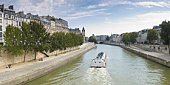
Dating back to when the Parisii tribe first established fishing villages along its banks, the waters of the River Seine have always been the heart and soul of Paris and although this river is not used much today as a commercial waterway, it is used extensively for cruising.
Yet ocean going vessels can still get down the river Seine from The Havre down to Rouen, which is about 120km, although river boats which cruise up and down the Seine can navigate approximately 560km and the river extends right through to Dijon in the Alps. But because the river is slow flowing it makes it easy to navigate and a very pleasant trip for those on a cruise.
When Paris prospered through its river trading back in the days of the Romans, canals were put in place to link other major rivers such as the River Loire and the River Rhine. Then in the eighteen hundreds locks were installed to make life a lot easier as the water levels varied quite dramatically, especially around the Paris area, which are now very tightly controlled today.
When you are cruising down the river Seine you cannot help but notice the many bridges that span this river, with some of them being centuries old, one in particular called the Pont-Neuf had its first stone laid by King Henri III in 1578. However the newest addition was built in 1996 to accommodate more traffic, especially for the new football stadium built for the FIFA world cup.
Did you realise that the River Seine actually forks and cuts Paris in half? Well, that has now become a great advantage for the tourists who travel here from all over the world, as you can get to see many famous monuments such as the Eiffel Tower, The Louvre, and Notre Dame to name but a few.
And going on a mini tourist cruise on the Seine around Paris on what are known as bateaux-mouches is one of the most relaxing ways to get to see some of the most famous historical buildings and other monuments that the romantic city has to offer.
It was actually after World War II that sight seeing vessels really flourished in Paris on the original longboats called bateaux-mouches that were converted into tourist boats. And today, there are now more and more tour operators that also have similar boats, yet the name bateaux-mouches has become synonymous with a tour around Paris on the Seine.
The choice of short cruises available is absolutely incredible from a one hour short jaunt, to having a pleasant lunch, or a full dinner cruise for a romantic gourmet French meal, while drifting past the sites all lit up by glowing lights in the evening.
Some of the cruise operators even offer complete packages so that you can disembark to physically visit some major attractions, or even go to a cabaret such as the Moulin Rouge, before getting back on board to finish the tour.
However, we would strongly recommend that you thoroughly check on what type of cruise you are booking as the costs can vary immensely. In fact, on particular cruises there may even be a dress code of cocktail dresses or dinner suits and evening wear, so of course these do tend to have a price tag to match!
But rather than a short cruise, you could even book to travel from Paris through to Normandy or other areas, where you can glide past storybook chateaux and medieval towns and discover the character, soul and people of France.
So as part of your holiday to France, a trip on the River Seine is always an unforgettable experience and you will be able to find many travel agents who can help you book your perfect River Seine Cruise.
Both Nikwriter & Martyn Davis are contributors for EditorialToday. The above articles have been edited for relevancy and timeliness. All write-ups, reviews, tips and guides published by EditorialToday.com and its partners or affiliates are for informational purposes only. They should not be used for any legal or any other type of advice. We do not endorse any author, contributor, writer or article posted by our team.
Nikwriter has sinced written about articles on various topics from French Vacation, Hotels and Hostels. Nicholas manages Trips Europe which is an , providing a comfortable and luxurious alternative to hotels.. Nikwriter's top article generates over 720 views. to your Favourites.
Martyn Davis has sinced written about articles on various topics from Food And Drink, French Vacation and French Vacation. Martyn Davis European Traveller, Author, Photographer and Business Development Manager, For all your French holiday needs and travel guide. Martyn Davis's top article generates over 8100 views. to your Favourites.
Buying Vs Renting A House Call a OneSource Exhibits Consultant today to learn more about our wide variety of rental displays