For most people, a trip into the wilderness is not a solitary experience. Safety experts recommend that you travel in groups with a minimum size of two to four. The individual wilderness education of the travelers can be different, there should always be an expert or experienced person to serve as a leader. If you travel alone, you increase the risk of injury or death in the wilderness.
Even though you may start a trip into the wilderness in a group, there are always possibilities that lead to separation and/or injury. Injured members of a group may have to stay in a safe camp while some, or all, of the others return to civilization to bring help. It is important to plan for the worst on any wilderness excursion.
Trip Planning for Safety
When preparing for a trip into the wilderness each member of the party should be familiar with the group's general plan for the excursion. This will include the locations and designs of shelters located throughout your scheduled trip. Research ahead to have knowledge of the availability of fire rings, sites, and combustible piles of wood. Each proposed stopping point should include locations for safe drinking water as well as fire protection water. There should be a plan for signaling the outside world if you are in trouble. This may include such high tech concepts as mobile or satellite communications, or GPS guidance, and mapping data to find the nearest help.
Make yourself familiar with the route you will be taking through the wilderness. Whenever possible, take trails rather than planning adventures across country. Carry a marked map with you which includes your itinerary. Be sure to make notations of the points where you can get assistance should it be necessary.
Validate your Navigation Methods
There are several ways to navigate through a wilderness. Some are only feasible if weather and visibility conditions prevail. Try to have two methods of navigation available for any trip into the wilderness. One of the newest and best methods uses the Global Positioning Satellites (GPS) to find your exact position relative to other desired destinations. There are handheld units that you can pre-load with the maps of your chosen area so the GPS system can point out visually where you are on the screen's map. It is a good idea to have a light and hardened laptop. This would provide precise directions and choices should weather, or unexpected events cause you to vary from your arranged trail.
GPS systems not only need a sensor that can capture three satellites' signals in the sky and triangulate your position, but they require enough memory to hold a detailed topographic map. The latest handheld GPS trail systems have the ability to add memory cards. These memory cards will allow you to store a wider geographic map of the wilderness area you are visiting.
Back-up Navigation Systems
If you don't have GPS navigation, you can use topographic maps, the stars, and a compass. If you know how to use one, a sexton can also be used to locate your position relative to your surroundings. The sexton will tell you the direction that you are facing in degrees of the compass. Using the map along with a good map compass, you should be able to find the latitude and longitude of your position on the topographic map.
Survive In The Wild
Many people think they know what to do if they get lost while camping or hiking yet hundreds each year wander off into the woods unprepared, finding that they do not have the tools that they need to survive in the wild. When you are going to be going off into the woods for a camping or hiking trip, even if you are only going a little ways away to gather firewood or explore a new trail, make sure that you have your survival kit on you in case you get lost.
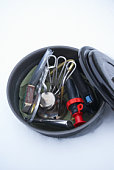
Even the most attentive adult can find that they have wandered off the beaten trail, and finding your way back can be more difficult than you anticipate. Before you set off into the woods, make sure that you have a pack prepared with food like energy bars or trail mix to keep you moving, plenty of water, dry, protected matches, a space blanket to keep you warm and to signal for help during the day, an LED flashlight or LED lantern for use at night, a compass, and the best survival knife that you can find or afford.
You will want an LED flashlight instead of a regular flashlight for several reasons. For one thing, the LED flashlight, even a mini LED flashlight, will burn brighter than a traditional light, making you easier to spot. The LED light will also use less battery power, so that your flashlight lasts longer, and your bulb will burn for many times longer than a traditional bulb, meaning that you won't have to remember to change bulbs out between trips.
You will need to start out with food and water, however if you are stuck in the wilds for very long, you will need to know how to catch and eat animals for food or how to find food naturally in your area. Local guides will be able to tell you which plants are good to eat and which are not, and will even be able to tell you what kinds of animals are prevalent in your area, increasing your chances of setting the right traps or of hunting the right spots. For these pursuits, you will need a survival knife or a folding pocket knife.
Survival knives are supposed to be able to handle just about anything that you need them to do, from sawing through branches that can be used to make a shelter to catching and cleaning animals for food or digging for roots. These knives can be simple small pocket knives as long as they get the job done, but keep in mind that skimping on your knife could mean skimping on the tool best suited to ensure your survival.
Once you realize that you are lost, it is time to stop moving. Rescuers will begin to look for you where you were last known to be, so wandering farther away could delay a successful rescue. If you know where civilization is, however, then take out your compass and make your way back to the road or the trail.
If you are waiting for help to arrive, lay out colorful clothing or your space blanket in an area that is easy to see from above so that rescuers can find you from the air. You will need to keep your food and water as long as possible, so start looking for food and water sources right away, and do not be shy about setting up camp by making a shelter and covering it with your bright clothing. You need to keep warm and dry in order to preserve your energy. Above all remember to stay calm, and you will find yourself safe in no time.
Both Cory Doggett & Ben Anton are contributors for EditorialToday. The above articles have been edited for relevancy and timeliness. All write-ups, reviews, tips and guides published by EditorialToday.com and its partners or affiliates are for informational purposes only. They should not be used for any legal or any other type of advice. We do not endorse any author, contributor, writer or article posted by our team.
Cory Doggett has sinced written about articles on various topics from Education, Environment. Cory Doggett owns and operates several websites specializing in survival and wilderness skills. Visit the .. Cory Doggett's top article generates over 9900 views. to your Favourites.
Ben Anton has sinced written about articles on various topics from Software, Home and Writing. Ben Anton lives in Portland, OR and writes for Discount Lights and Knives. Get what you need for your survival kit, including long-lasting. Ben Anton's top article generates over 1220000 views. to your Favourites.
Causes Of Diabetes Insipidus Staying informed and living a healthy lifestyle with diet and exercise is the best thing you can do to prevent the onset of diabetes, and to battle it once you are diagnosed