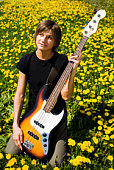
Although the concept of a bass guitar was first developed in the 1930s, it wasn't until the 1950s that mass production met with popularity and the concept of an electric bass guitar became mainstream. Once the idea of an electric bass guitar took hold, and was used widely in groups and bands performing across the world, many companies began developing new styles and methods to create some fantastic ideas for the instrument, and help its popularity grow. Today the electric bass guitar has stepped forwards from the dark shadows of the back of the stage to take a much more prominent position at the front - and has become known as a very popular and stylish instrument to play. Not forgetting, of course, that the quality of sound and versatility have come a long way too.
Since it took about twenty years for the idea of an electric bass guitar to become a mainstream popular idea, it is unsurprising perhaps that it took another twenty years for the next big jump in design and innovation. It was in the 1970s that the company known as Music Man was founded by Leo Fender. It was this company that designed and created the StingRay, which was the first bass guitar to include active electronics. Although these active electronics can sound quite complex, the simple effect was to increase the range of high and low notes, and enhance the crispness of each.
In the early seventies a company called Alembic created the basic design for the high end bass guitars, known as boutique guitars. These were crafted using the highest degree of expertise, with the most highly skilled craftsmen using the finest quality materials. With unique, custom designs, the most premium woods available and some of the most innovative electronic gadgetry included, these boutique bass guitars became well known as the top guitar to have - and brought bass guitars from the back of the stage to the very front - an equal to the standard electric guitar.
Over the next thirty years the designs of electric bass guitars have varied, with new innovations, odd and unusual features and designs, including a headless bass by Ned Steinberger, who also introduced the Trans-Trem tremolo bar. A few years later the Guild Guitar Corporation introduced the astonishing fretless bass, known as the Ashbory. Quite how a guitar would work without frets would challenge any sane thinker - but the Ashbory used silicone rubber strings, with a piezoelectric pickup. The result of this was a sound more like a double bass than an electric guitar.
It was in the nineties that five string basses became popular, and prices began to reduce quite significantly, seeing pre-amplifiers built in to most bass guitars - previously something reserved for the higher end guitar. Today we see electric bass guitars include digital modelling circuits actually built in to the guitar - almost like having a computer built in to the body of the guitar, and able to enhance, distort, amplify and altar the voice of the guitar in such a way that it is possible to program the guitar to sound like any of the well known types of guitar available previously.
The Electric Bass Guitar
Many bass instruments are played upright, as a direct result of the fact that the bass strings are usually the longest, and therefore the instrument is naturally much longer than standard ones. However, electric bass guitars are played in exactly the same way as a standard guitar, and the length of the instrument is roughly the same. This is of course an advantage achieved through the fact that the actual sound heard is produced electronically, and the overall tone, pitch and frequency of the note can be altered digitally.
The typical method used to play the electric bass guitar differs slightly from that used in the playing of a standard electric guitar, since the main method used is pizzicato, or the plucking of strings. Obviously those players who perform on standard electric guitars may also pluck the strings, but this is only one of a range of techniques that can be used. Electric bass guitarists almost solely use the plucking or pizzicato technique throughout their performance.
Plucking can be achieved quite happily through using the index and middle finger, or in some cases the thumb and ring finger too, but since the strings are steel, some players prefer to use plectrums or picks. Using a pick can help to increase both the speed at which a performer can hit the notes, and also the hardness with which the string is plucked. Usually the sound produced by an electric bass guitarist using a plectrum or pick is much sharper and harder, than the equivalent sound produced by a performer using just his or her fingers.
Of course, it is also true to say that the nature of the pick itself makes a huge difference to the quality and sharpness of the sound, and thicker, firmer picks will produce a harder, heavier sound, whereas the more flexible lightweight picks will produce a softer and more gentle tone. For a pick which sounds very similar in tone to using fingers would be one typically made from felt.
In some types of music it is preferable to create a sound using an electric bass guitar which evokes an impression more similar to a double bass. This double bass sound is achieved not by using a pick or a plectrum, but by actually plucking the strings. This on its own tends to create a note which is distinctly longer than that produced by a double bass, and so the typical technique is to pluck the string, and then use the flat of the hand to mute the note. This produces quite a thumpy sound, and is used quite frequently in various styles of music.
Yet another method used by some electric bass guitarists is to either slap or pop the strings, creating a sound which is reminiscent of funk music. This technique literally involves slapping a string with the index finger or middle fingers, creating a flatter sound, or by popping the strings with the same fingers. This slap technique has been popularised in such other styles of music as rock and fusion.
Victor Epand has sinced written about articles on various topics from Shopping, Trucks and Interest. Victor Epand is an expert consultant for guitars, drums, keyboards, sheet music, guitar tab, and home theater audio. You can find the best marketplace at these sites for
Cargo Carriers For Cars Now, whether you are looking to ship something by air cargo, gain a position at a cargo airline or perhaps answer trivia game questions, you will have some of the answers