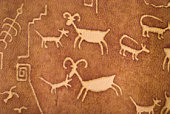
The Eohippus was a type of horse that is believed to have lived around 60 Million years ago in the North American regions. The Eohippus is known as the oldest relation of Equus caballus, considered the true horse. This would be a Cro-Magnon portrayal of this unique and fascinating animal. It has been known from drawings in the Caverns of Font-De-Gaume, Dordogne, France. (There are also ancient drawings of archery in these same caverns)
The Little Eohippus, this creature was approximately the size of what we know today as the fox terrier dog. This is the oldest known ancestor of the of the modern day horse, this chain is what descended from the Eocene mammal to the Equus caballus. Fossil remains can be traced back almost 6 million years, with minor gaps between sections of its development. The Eohippus can be described as having a head like a sheep, hindquarters like a jackrabbit, and toes of multiple proportion, four toes on each forefoot and three on each of there hind feet. All of there fourteen toes were equipped with pads and of a heavy cuticle shaped almost like miniature hooves. The Eohippus was very prolific and was known across the Northern Hemisphere and throughout Asia and Europe, Even to the British Isles, here it was known as Hyracotherium because to them it resembled a Hare.
In our western plains of America, Say over an extended period of thirty million years, The descendants of Eohippus came about and evolved through many stages into whats known as Mesohippus, a much larger animal. The height of this animal increased to an astounding 24 inches, of course the head became more horselike, the legs lengthened, as well as increasing the animals speed. Through this evolutionary period, each foot had three hoofed and padded toes. There teeth were still short, very low crowned, comparatively soft, these were adequately placed for there diet of new bark, leaves and tubers, still not suited to the grazing of grass and such.
Twenty million years later, great geological upheavals occurred in these western mountains, this of course made for many changes in this climate and ecology of the plains to the east. Forests became open plains covered with lush grass, this presented many new problems for Mesohippus genre. Silica in the stems and seeds of this grass and amounts of sand and dirt caused rapid wear to there soft teeth, This in turn meant rapid adaption of the animal to these new conditions, if Mesohippus was to survive. From here the Mesohippus evolved into Merychippus, these had high crowned teeth, these were covered in a much heavier harder outer layer. This new horse ancestor was much larger, approximately 42 inches, about the size of a small pony. After Merychippus, there seems to be a huge gap in the fossil records, this gap goes between 6 Million years to about 600,000 B.C. There are no fossils of the evolving horse in North America through this epic time period, this is around the time of the Great Ice Age, at that time ice covered much of North America and Northern Europe with great glaciers.
When these ice glaciers melted, there were resulting floods that washed away the surface deposits that would have contained the prolific fossil remains for other species in this time period. The story's we have always heard, was that all the horses that are in North America are of European designation. Obviously this is not the case, or of likely prudence. Some believe that the absence of those said fossils, also means the absence of horses in North America all together, Others still expect that we will find these remains by further digging.
During this period of missing records, and those only in Eurasia, we know that Merychippus evolved into Equus caballus, what we know as the true horse, with a single toe to each foot and equipped with one single hoof. From what we know of the Ice Age, There was a land bridge between Alaska and Siberia, This would have furnished an easy passage from one place to the other for various animal species.
In this we see that it is more than possible that horses crossed over into Asia during this time, Hence they could have crossed back over to North America again. This theory is greatly debated, But it is the theory I choose to believe.
If its only to read and study about the history and love of things Equestrian.
It still holds a lot of information and learning potential for your mind to develop on something new.
See the potential and learn about things that are Equestrian today.
The North American Indians
Get out your kilts, folks. The Glasgow based Brit-pop band Travis is going to tour throughout North America come the end of March, and you surely don't want to miss these Scottish lads offering up a bit of heart-to-heart on the stage. Their live performances have been heralded as lively, impassioned and deeply emotional, often leaving their audience members pondering the meaning of life, love, music and plaid kilts. Just joking…no kilts. But get out your pen and jot down a few dates as these boys will blast back to the U.K. before you know it. They are scheduled to kick off the excursion with a few warm-up shows in Mexico, where they will open for Peter Gabriel March 27, 29 and 31. Then they will head way up north to Vancouver where they will jam on April 4, then slowly wind their way down to Seattle, San Francisco, Anaheim and Los Angeles. Then it's outward into the greater U.S. of A. They are touring in support of their most recent album, Ode to J. Smith, which was released in early fall 2008. Get ready for Brit-pop with a modern edge by getting your Travis tickets at http://www.stubhub.com/travis-tickets.
Travis formed in Glasgow, Scotland around 1990, comprised of band members Francis Healy, Andy Dunlop, Neil Primrose and Dougie Payne. At first it was just a side-project, a way of letting off steam and enjoying afternoons together, but then the foursome decided that they might actually be sort of good. They opted to try their luck by packing up and shipping off to London. Their self-released debut EP, All I Wanna Do Is Rock, made headlines in 1996, capturing the lost essence of British rock/pop with an artsy, yet back-to-basics sound.
A year later, they issued their much anticipated, critically acclaimed debut full-length album, Good Feeling. Everyone held similar sentiments about the content of the record: it was all good. Hit singles that emerged from the effort included: “Happy” and “Tied to the ‘90s.” Produced by top producer Steve Lilywhite, the album showed that Travis wanted to emphasize classicism. They drew from the traditional Britpop influences like the Beatles, the Kinks and the Small Faces, but combined that with more modern influences that can be traced to the Stone Roses and Oasis. Most critics and many fans embraced this early effort as a re-writing of the Britpop genre and welcomed Travis with open arms.
After Good Feeling managed impressive marks on just about everyone's charts, Travis pioneered forward with The Man Who, which went six times platinum in the U.K. and spawned hit singles like “Why Does It Always Rain on Me?” and “Writing to Reach You.” Other follow-up albums included: The Invisible Band, 12 Memories and The Boy with No Name, all of which continued getting rave reviews. Their most recent album, Ode to J. Smith, offers up some more gritty sounds with a clearly edgy style, but the content of their material is still the same, which should please their large and devoted fanbase.
Both Shawn Burgy & Alexa Evans are contributors for EditorialToday. The above articles have been edited for relevancy and timeliness. All write-ups, reviews, tips and guides published by EditorialToday.com and its partners or affiliates are for informational purposes only. They should not be used for any legal or any other type of advice. We do not endorse any author, contributor, writer or article posted by our team.
Activities For Esl Efl The demand for these programs is not likely to decrease any time in the near future, so teachers who can teach English to speakers of other languages are going to have job security for many years