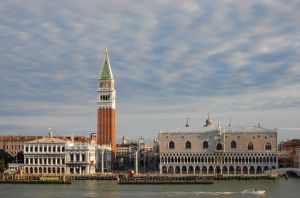
It all began for the Piazza as early as the 9th century when it was a much smaller space than it is today. In 1177, changes and additions were made to the square before the meeting of Pope Alexander III and Emperor Frederick Barbarossa. Additional buildings were added in 1640 and the newest buildings in 1810 were specially made at the request of Napoleon. Although named as a square, according to its shape this square is actually a trapezoid and the length of the Piazza is 175 meters.
There is no shortage of archaeological delights in Venice and there is plenty to see at Piazza San Marco. From this unique plaza, one may tour the St. Mark's basilica that is a famous cathedral adorned with domes and attractive mosaics. One may visit the Palazzo Ducale di Venezia which is a gothic palace that was the place of residence of the Doge of Venice. Among other special features and attractions, one may also view the Torre dell'Orologico, the Clock Tower that has become a part of Venetian culture as it has been striking the hour for over 500 years.
The Piazza San Marco has always been known as a place of central importance to the people of Venice. This is rather like an extraordinary museum out in the open air, filled with enchantment and architectural masterpieces. It is reported that Napoleon referred to the Piazza San Marco as the "finest drawing room in Europe". Today, the Piazza continues to attract guests and has proved to be a very popular venue for tourists.
The Piazza hosts cafes and souvenir shops even bags of food for the pigeons can be purchased. It is probably true that a majority if not all of the tourists visiting Venice have their photographs taken with pigeons in the background at the Piazza San Marco.
Hotel accommodation can be found within walking distance of the Piazza San Marco. It probably should be noted that the price of vacation rooms close to the Pizza itself will be higher than accommodation that is situated a bit further away in a quieter area. Various levels of holiday accommodation may be found west of the Piazza, east of the Piazza, north of the Piazza and along the waterfront.
Many people would recommend that the best time to visit the Piazza San Marco is during the early evening. At this time, the square is lit up and [takes on] a lively, unique and even romantic atmosphere. Musicians begin to play and sometimes people begin to dance. This special square seems to have a character and personality all of its own.
Today the Piazza San Marco continues to be a very popular gathering place in Italy. This site hosts historical buildings steeped in tradition and culture, indoor and outdoor cafes, buildings of architectural interest, stones, monuments, artistic structures, traders, pigeons, people, bustle and perhaps best of all no cars.
The Piazza San Marco
If you face the basilica from in front of the Correr Museum, you'll notice that rather than being a strict rectangle, this square opens wider at the basilica end, creating the illusion that it's even larger than it is.
The Piazza was paved in the late 13th century with bricks laid in a herringbone pattern. Bands of light stone ran parallel to the long axis of the main piazza. These lines were probably used to help set up market stalls and in organizing frequent ceremonial processions. This original pavement design can be seen in paintings of the late Middle Ages and through the Renaissance, such as Gentile Bellini's Procession in Piazza San Marco of 1496.
On your left, the long, arcaded building is the Procuratie Vecchie, built in the early 16th century as offices and residences for the powerful magistrates of San Marco. On your right is the Procuratie Nuove, built half a century later in a more grandiose classical style.
It was originally planned by Venice's great Renaissance architect, Sansovino, to carry on the look of his Libreria Sansoviniana (Sansovinian Library), but he died before construction on the Nuove had begun. Vincenzo Scamozzi (circa 1552-1616), a neoclassicist pupil of Andrea Palladio (1508-80), completed the design and construction. Still later, the Procuratie Nuove was modified by architect Baldassare Longhena (1598-1682), one of Venice's baroque masters.
When Napoleon entered Venice with his soldiers in 1797, he called Piazza San Marco "the world's most beautiful drawing room" and promptly gave orders to redecorate it. His architects levelled a 16th-century church with a Sansovino facade in order to build the Ala Napoleonica (Napoleonic Wing), or Fabbrica Nuova (New Building), which linked the two 16th-century procuratie and effectively enclosed the piazza.
Piazzetta San Marco, the "little square" leading from Piazza San Marco to the waters of Bacino San Marco (St. Mark's Basin), is a landing that was once the grand entryway to the Republic. It's distinguished by two columns towering above the waterfront.
One is topped by the winged lion, a traditional emblem of St. Mark that became the symbol of Venice itself; the other supports St. Theodore, the city's first patron, along with his dragon. Between these columns the Republic traditionally executed convicts.
It takes a full day to take in everything on the piazza thoroughly; so if time is limited you'll have to prioritize. Plan on one to two hours for the Basilica and its Pala d'Oro, Galleria, and Museo Marciano. You'll want at least two hours to appreciate the Palazzo Ducale. Do take time to enjoy the piazza itself from a cafe table, or on a clear day, from atop the Campanile.
Both Gaizka Pujana & Robert Thomson are contributors for EditorialToday. The above articles have been edited for relevancy and timeliness. All write-ups, reviews, tips and guides published by EditorialToday.com and its partners or affiliates are for informational purposes only. They should not be used for any legal or any other type of advice. We do not endorse any author, contributor, writer or article posted by our team.
Gaizka Pujana has sinced written about articles on various topics from Barcelona Holidays, Family Travel and Culture and Society. Gaizka Pujana has a few websitespecialized in providing short term tenancy solutions in a few cities in Europe.. Gaizka Pujana's top article generates over 135000 views. to your Favourites.
Robert Thomson has sinced written about articles on various topics from Personal Desktop, Finances and Pets. If you are looking for great value visit escapetravel.com.au. Escape travel has an exciting range of. Robert Thomson's top article generates over 450000 views. to your Favourites.
All I Need Is The Air I Breathe Living with a smoker would also help you eliminate the odor in the air with the help of a purifier. Those suffering from respiratory ailments or asthma could also benefit as well