In the Bible, persons with military rank were generally mounted on horses - those without rank very seldom; and the association of horses with war is frequent.
A white horse signified conquest and victory and was a good omen. In medieval days (chivalry) a white horse also signified innocence and chastity.
The ancients attributed special sanctity to a vow taken on horseback - one that could not be violated.
The horse was frequently the emblem of the sun, symbolizing creative life and giving solemnity and fruitfulness to the marriage vows. The Ruler of the Day - the Sun - was drawn in his chariot by celestial horses in his daily journey across the skies. The Dawn (The Goddess Aurora) was called the "White Horse" and had Pegasus as her steed after he had disposed of his earthly rider.
To the ancient Norsemen and the Romans (Diana) the horse was also similarly associated with the moon - drawing that god's chariot across the skies.
The horseshoe in mythology represented the crescent moon. Nailed on doorways it was deemed to ward off witchcraft, the evil eye and Satan. It is still, today, a symbol of good luck. Attached to a wall or doorway, the open end should be up, otherwise "the luck will run out".
Horses disturbed and restless in the morning and with their manes and tails tangled and twisted are supposed, according to old English legend, to have been ridden in the night by the pixies.
Superstitions about color include these: A good horse is never a bad color.
ONE white leg, buy him.
TWO white legs, try him.
THREE white legs, send him far away. (Sell him to your foes)
FOUR white legs, keep him not a day. (Feed him to the crows)
(He's sure to cause you woes) The Hungarians and Spanish believe all black horses are lucky - the French think the reverse.
There is an Irish superstition that a pure white horse - when ridden by the owner - confers upon him the special gift of advising how to cure physical ailments.
The White Horse - The Saxon King Alfred in the ninth century had carved in a precipitous chalk cliff on the Berkshire Downs in England an enormous white horse, 374 feet long and 120 feet high, to commemorate his victory over the Danes at Ashdown. It is still visible today. The "Tale Horse of the Saxons", in varied forms, is found in the coat of arms of several British Regiments, of noble houses descended from the Saxons and in the ensign of Kent.
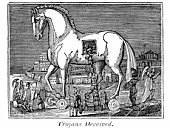
The Trojan Horse - The Trojan Horse is well known to all who have read Greek history. This was the tremendous image of a mare, built of wooden planks, concealing a group of Greek soldiers. The Trojans were led to believe that this was a peace offering to the goddess Minerva by the Greeks as they ostensibly abandoned their ten year siege of Troy and sailed home.
The stratagem worked. The Trojans opened their gates and widened the gap in their walls to take in the wooden mare (and its soldiers). The Greeks, under Ulysses, returned from their nearby island hideout - and Troy fell!
According to legend, Troy - built by Neptune who was the god of horses as well as the sea - was taken three times and each time a horse was the cause of its downfall. First, when the Trojan king refused a promised reward of six sacred horses to Hercules for the rescue of his daughter; second, the Greek's wooden mare (The Trojan Horse) and third, when a Greek horse stood in the gates, preventing the Trojans from shutting them against their enemies!
The horse has indeed figured in many superstitions and fables!
The Trojan Horse Myth
We have all heard the term Trojan Horse, but what exactly is it? A Trojan Horse is a destructive program that masquerades as a harmless application. Unlike viruses, Trojan Horses do not replicate themselves, but they can be just as destructive. One of the most dangerous examples of a Trojan is a program that promises to rid your computer of viruses, but instead, introduces viruses into your computer.
The Trojan can be tricky. Who hasn't been online and had an advertisement pop up claiming to be able to rid your computer of some nasty virus? Or, even more frightening, you receive an email that claims to be alerting you to a new virus that can threaten your computer. The sender promises to quickly eradicate, or protect, your computer from viruses if you simply download their "free", attached software into your computer. You may be skeptical, but the software looks legitimate and the company sounds reputable. You proceed to take them up on their offer and download the software. In doing so, you have just potentially exposed yourself to a massive headache and your computer to a laundry list of ailments.
When a Trojan is activated, numerous things can happen. Some Trojans are more annoying than malicious. Some of the less annoying Trojans may choose to change your desktop settings or add silly desktop icons. The more serious Trojans can erase or overwrite data on your computer, corrupt files, spread other malware such as viruses, spy on the user of a computer and secretly report data like browsing habits to other people, log keystrokes to steal information, such as passwords and credit card numbers, phish for bank account details (which can be used for criminal activities), and even install a backdoor into your computer system so that they can come and go as they please.
To increase your odds of not encountering a Trojan, follow these guidelines:
Remain diligent. Trojans can infect your computer through rogue websites, instant messaging, and emails with attachments.
Do not download anything into your computer unless you are 100 percent sure of its sender or source.
Ensure that your operating system is always up-to-date. If you are running a Microsoft Windows operating system, this is essential. Install reliable spyware removal software. It is also important that you download any updates frequently to catch all new Trojan Horses, spyware, viruses, and worms.
Be sure that the spyware removal program that you choose can also scan e-mails and files downloaded through the internet.
Consider installing a firewall. A firewall is a system that prevents unauthorized use and access to your computer. A firewall is not going to eliminate your computer spyware problems, but when used in conjunction with regular operating system updates and reliable anti spyware software, it can provide additional security and protection for your computer.
Nothing can guarantee the security of your computer 100 percent. However, you can continue to improve your computer's security and decrease the possibility of infection by consistently following these guidelines.
Both Jimmy Cox & Andrew Saari are contributors for EditorialToday. The above articles have been edited for relevancy and timeliness. All write-ups, reviews, tips and guides published by EditorialToday.com and its partners or affiliates are for informational purposes only. They should not be used for any legal or any other type of advice. We do not endorse any author, contributor, writer or article posted by our team.
Jimmy Cox has sinced written about articles on various topics from Web Development, Horse Racing and Investments. Discover Everything You've Ever Wanted to Know About Horse Training - You'll Be An Overnight Expert!Click here for FREE online ebook!
Bill Collectors Calling At They will also check postal and other public records for the same purpose. Bill collectors are aided in this by advanced computer applications