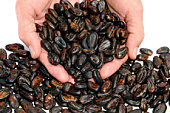
For a food that seems so familiar, most of us know surprisingly little about the real origins and history of chocolate. I counted myself in this group until very recently when I picked up a copy of a book titled ?The True History of Chocolate?, by Sophie D. Coe and Michael D. Coe. Published in 1996, it's 268 pages of meticulously researched, fascinating facts and ?speculation? about the origin and development of the food we call chocolate.
I wonder how many of us would even recognize a cacao pod if one happened to fall on our head? Of course, such an event is highly unlikely unless one happens to be in a very small number of places in certain regions of the world. The cacao tree simply refuses to grow outside of a very narrow range of latitudes and weather conditions. Another crucial factor in the successful cultivation of the tree is making sure that the right insects are around to pollinate the flowers, a fact that wasn't known when some early attempts were made to transplant the trees.
As the authors mention, if you hold a cacao pod in one hand and a piece of chocolate in any form in the other, you would never suspect that the one was made from the other. In fact, for nine-tenths of its long history, chocolate was drunk, not eaten. Consumption of solid chocolate by the masses is a relatively recent development. So how did chocolate get from the forests of Central America, where it began as drink for the royal courts of the Maya in the Yucatan Peninsula, to your pantry in the form of a Hershey Bar? Seems like a long trip, doesn't it? Furthermore, why is chocolate thought of a product of Switzerland? How did the Swiss manage to dominate the chocolate world? Can you think of two more different environments than the jungles of the Yucatan and the Swiss Alps?
The story is more fascinating than you can imagine and involves Columbus, the Conquistadors, the fall of the Aztec Empire, the French Revolution and the Industrial Revolution, and last but not least, Milton Snavely Hershey.
When first introduced to Europe, chocolate was only for the nobles, who endlessly debated it nutritional and medicinal properties. In fact, because of the dominance of the Catholic Church, long debates were held as to whether or not chocolate was actually a food and whether, as such, eating it broke the fasting rules in place at the time.
The generally accepted first meeting between Europeans and the cacao bean took place in 1502 when Columbus anchored off the island of Guanaja, north of mainland Honduras. It was his fourth voyage, and he unfortunately died without ever tasting chocolate.
What followed was the Spanish conquest of Central America and the eventual return of cacao to Europe where it did not actually receive rave reviews. But the story is long one, and to get all the details, pick up a copy of the book. It's a wonderful story, a great history lesson, and may leave you with the desire to sample not just Hershey Bars, but some of the other more ?exotic? chocolate products that are available these days.
Note: You may freely publish the above article in any way you wish, as long as the author's name and links are left intact.
The True History Of Chocolate
The history of chocolate is one that goes back centuries through many cultures. Chocolate is known for its cultivation, processing, taste, presentation and psychology. The history of chocolate is in many ways the history of the Americas, from the ancient Mayans to the theft of "the secret", and has made its way through Europe eventually returning to the Americas. The history of chocolate is almost as interesting as the confection itself, and as interesting as the tastes that cocoa can produce when crafted by experts into fine chocolates and chocolate is as unique as the options available to the chocolate consumer.
The Aztec emperor Montezuma drank over 50 cups a day of chocolate which is one of the more interesting aspects of the history of chocolate. Cocoa beans served as a form of currency, and was considered a luxury commodity. The history of chocolate is more fascinating than the tales of the Arabian nights. The History of Chocolate is a Record with Centuries of Appreciation.
Ancient cultures who brew the seeds of the cacao tree into a delicious beverage was the start of a wide assortment of chocolates that everybody enjoys today.
Chocolate became a treat only the wealthiest could aquire when it was discovered by European conquests. One of the reasons, chocolate was expensive, but also bitter. Spices and sugar were used to sweeten chocolate, but they were also expensive and out of the common man's reach. What made chocolate candy affordable for everybody was at the beginning of the industrial age and mass production.
The chocolate candy bar became a big hit in stores, and took its place proudly on the general store shelfs next to hard candy, gum drop, and candy canes. From that meager beginning, the varieties available today are mind boggling. With limitless ingredients, chocolate candy is available in many different flavors and shapes today. There are some ingredients like fruits and nuts which are complimentary to the flavor and texture of the chocolate and can be left diced or whole inside the chocolate candy bar. Other flavorings and spices are also added to enhance the chocolate. Some people when they taste chocolate a story is told in their chocolate candy. Travel by chocolate and the chocolate flavor medley tells them through their tongue what region of the world each ingredient came from.
With the Internet, everyone can enjoy exotic chocolate candy delicacies made from anywhere in the world. Innovations in chocolate recipes and shipping ensures everyone will receive their chocolate candy in perfect condition.
Today, to make chocolate candy there is a wide variety of chocolate molds and candy making accessories. Making chocolate personalized gifts to making chocolates, the possibilities are endless in the flavors and ingredients to incorporate. Very successful candy companies begin this way with an idea right from their own home kitchen.
Chocolate is the delicacy of kings, and today everyone's favorite treat. Chocolate is a revered and sacred food of the people, and a modern scientific wonder, the history of chocolate is varied, rich, and exciting.
Both Peter Cullen & James Murray are contributors for EditorialToday. The above articles have been edited for relevancy and timeliness. All write-ups, reviews, tips and guides published by EditorialToday.com and its partners or affiliates are for informational purposes only. They should not be used for any legal or any other type of advice. We do not endorse any author, contributor, writer or article posted by our team.
Peter Cullen has sinced written about articles on various topics from Finances, History. Pete Cullen runs the website Visit. Peter Cullen's top article generates over 2400 views. to your Favourites.
Bio Diesel In India You contribute to pollution by driving you reduce the pollution by planting trees! You are carbon neutral! Save energy by using renewable products available via companies listed in the green direc...