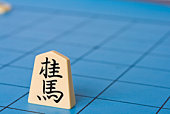
The first couple of things Chess players are likely to notice about Shogi are the size of the board and the number of pieces. Chess players who are used to playing with sixteen pieces each on an 8 x 8 board may be surprised to find that Shogi is played on a 9x9 board and that each player starts with twenty pieces.
Also, typical Chess pieces are representations of soldiers, knights, bishops and so forth and consequently they are designed to stand upright, whereas Shogi pieces are made to lie flat on the board and are wedge-shaped, with a pointed edge facing forwards to enable the players to tell at a glance whose pieces are whose!
The rank of a piece is indicated by its size and by one or two Japanese characters painted on its upper face.
Depending on which piece is being played, when it advances to one of the back three rows it may be promoted. This is done by turning the piece over to reveal a different character that indicates its new status.
Chess players will be surprised to learn that in Shogi captured pieces may be "dropped" back on the board and used by the player who captured them! The "drop" rule is a unique development of the Japanese game. After capturing a piece the player sets it aside (or place it on a tray especially designed for captured pieces). A player who has one or more captured pieces in hand may choose on his turn to move a piece that is on the board, or to bring a captured piece into play by "dropping" it onto one of the empty spaces on the board. Because of this innovation the pieces are not distinguished by colour as they are in Chess, Igo, or other games.
As a game, Chess develops more swiftly than Shogi because the board is smaller and the pieces are less restricted in their movments. Also, in Shogi it is considered prudent to build a strong defensive position for the King before moving onto the offensive.
Even so, Shogi, like Chess, can be divided into three developmental stages: the opening, middle game and end game.
Perhaps the drop rule developed from the understanding that many an enemy may be turned into a friend, especially after he has been captured. A Shogi piece dropped deep inside enemy territory can cause major disruption. It is rather like having a hostile Ninja fighter suddenly appear armed to the teeth in the Daimyo's bedchamber!
Shogi offers an early example of how a foreign invention is introduced into Japan and modified and refined to become something unique to the Japanese.
In recent years Shogi has begun to attract a following outside of Japan, in China, Europe and America. If you enjoy playing Chess, I recommend that you try playing Shogi and experience something of the unique spirit the Japanese have imparted to this ancient family of games.
David Hurley has sinced written about articles on various topics from Business Loans, Email Advertising and Internet Marketing. David Hurley lives in Japan and runs a supplying Japanese games and goods including Shogi sets, exclusive hand crafted Shogi pieces, Shogi boards and koma tra. David Hurley's top article generates over 27100 views. to your Favourites.
Calorie Counter And Exercise Losing weight is all about energy intake, which means managing calories in and calories out of your body.