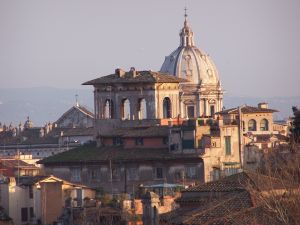
Rome's history as a city spans over two and a half thousand years, as one of the founding cities of Western Civilization. Rome has a considerable place in Christianity and is the present day home of the Roman Catholic Church and the site of the Vatican City, an sovereign city-state run by the Catholic Church within as an enclave of Rome.
These are the 10 top places to visit while in Rome:
The Colosseum
The oval building is immense, measuring 188m by 156m and reaching a height of more than 48 meter (159 ft). The Colosseum could contain some 55,000 spectators who could enter the building through no less than 80 entrances.
Above the ground are four stories, the upper storey contained seating for lower classes and women. The lowest story was preserved for prominent citizens. Below the ground were rooms and cages containing wild animals and mechanical devices. The cages could be hoisted, enabling the animals to appear in the middle of the arena.
The Forum
The forum was the centre of political, commercial and judicial life in ancient Rome. The principal buildings were the basilicas, where legal cases were heard. For many it was the center of the universe.
The Pantheon
The Pantheon is the oldest standing domed structure in Rome, originally built as a temple to all the gods of Ancient Rome. It is the best preserved of all Roman buildings, and perhaps the best conserved building of its age in the world. It has been in continuous use throughout its history, since the 7th century, the Pantheon has been used as a Roman Catholic church.
St. Peter's Basilica, Vatican City
St. Peter's Basilica (Italian San Pietro in Vaticano) is a major basilica in Vatican City, an enclave of Rome. St. Peter's was until recent times the largest church ever. Emperor Constantine, the first Christian emperor of Rome, ordered to build a basilica on Vatican Hill. The site was symbolic: this was the place where Saint Peter, the chief apostle, was buried in 64 A.D. Other popes are also buried in and below the basilica.
The Trevi Fountain
The Trevi Fountain, certainly the most famous and spectacular fountain in Rome. The fountain is the terminal part of the Vergine aqueduct built by Agrippa, a general of Augustus, in 19 B.C. to bring the water coming from the Salone springs, 19 km away, to Rome. Around 3,000 euros are thrown into the fountain each day. The money has been used to fund a supermarket for Rome's needy. However, there are regular attempts to steal coins from the fountain.
Villa Borghese
Villa Borghese is considered the city's most significant green space. Painted by famous artists, the muse and inspiration of writers and celebrated musicians, Villa Borghese is perhaps Rome's best known ?villa?, or park. Exclusive in the world for its concentration of cultural institutions, the park contains five museums and is ringed by a string of overseas academies representing Romania, Egypt, Sweden, Denmark, Austria and Britain.
Piazza di Spagna
The Piazza di Spagna or Square of Spain is famous for its numerous stairs (135) covered with flowers during Spring and Summer. It was conceived by the architects Francesco De Sanctis and Alessandro Specchi in 1723. It was inaugurated for the 1725 jubilee by pope Benedict XIII. The stairs were to link the Spanish embassy to the church of the Trinity of the Mounts to celebrate the peace between the French and Spanish crowns.
Capitoline Museums
The Capitoline Museums are composed of three main buildings; Palazzo Senatorio, Palazzo dei Conservatori and Palazzo Nuovo, surrounding the Piazza del Campidoglio and interlinked by an underground gallery beneath the piazza. they were built on the Campidoglio as part of the design of the Square drawn up by Michelangelo.
Vatican Museums
The Vatican Museums are among the greatest museums in the world, since they display works from the immense collection built up by the Roman Catholic Church throughout the centuries, originated as a group of sculptures collected by Pope Julius II and placed in what today is the ?Cortile Ottagono? within the museum complex
Arco di Costantino
The Arch was built at the beginning of the fourth century in honor of Constantine, following the victory over Maxentius. It is considered one of the last great monuments to be constructed by the Romans. It stands beside the Colosseum in the huge square which in summer is the site for one of the proceedings of the Estate Romana.
Tours Of Rome Italy
No matter which direction you go, you will pretty soon end up in a square, in front of a church or a palace and be amazed. Your gaze meets the Church of St Peter, the Forum Romanum, the Capitol, the Spanish Steps, Piazza Navona, Colosseum and Fontana di Trevi. All of these are major sights which remain great milestones in human history. The rest ? the local trattorias, the best cappuccino, the good ice cream, colorful markets, and even football - is a pure love story of the kind that last a lifetime.
The city of Rome is over two thousand seven hundred sixty years old. That is if you choose to believe the old legend that tells that the city was founded on April twenty first in the year seven hundred and fifty three BC, when Romulus on the Palatine drew up the first city, roma quad rata, while he murdered his twin brother Remus. Since then, many different people have come and gone. The Etruscans have disappeared and the Roman Empire was passed over. The eternal city of Rome has been ruled by kings, emperors and popes.
Today Rome is a capital of a republic led by a president, trying to appear as a modern European country with the functioning of social security, pensions and medical care as well as having a regulated traffic. Somewhat behind most of the other European Union member states, however, one must say. The ancient is never far away even in the modern city. The city's seven hills (Palatine, the Capitol, Esquilinen, Quirinale, Viminale, Aventinen and Celio) are still clearly seen in the city. The municipality of Rome is wide ? farther so than even Paris - and also includes the ancient port city of Ostia, which during the summer is a popular seaside resort. The base for the city's road network is an antique construction. The road exits still carry the same names as they did two thousand years ago: Flaminia, Cassia, Prenestina, Salaria and Appia.
In contrast to all the antiques a visit to Mussolini exhibition city EUR (Esposizione Universale Roma) is recommended, the construction of which was finished after the Second World War. Fascism's eminent architects Marcello Piacentini and others have created a modern city here with wide streets, not forgetting the antique ideals of old with columns and white marble. EUR is largely reminiscent of a metaphysical town in a big dream landscape, much like in Giorgio de Chirico's paintings.
As one often says ? a lifetime is not long enough to really see and experience everything that Rome has to offer. The best thing is to take it easy and first and foremost try to enjoy the city. Plan to return on more visits and do not try to squeeze in hundreds of churches, museums, palaces and other antique and modern sites in only one week.
Both Frank Benitez & Robb Stark are contributors for EditorialToday. The above articles have been edited for relevancy and timeliness. All write-ups, reviews, tips and guides published by EditorialToday.com and its partners or affiliates are for informational purposes only. They should not be used for any legal or any other type of advice. We do not endorse any author, contributor, writer or article posted by our team.
Frank Benitez has sinced written about articles on various topics from French Vacation, Travel and Leisure. If you want to know more about the author please visit his website. . For more info about Italy and other destinations visited by him please. Frank Benitez's top article generates over 5400 views. to your Favourites.
Robb Stark has sinced written about articles on various topics from Hair Care, Travel and Leisure and Modelling. Robb Stark is writing about his favorite destinations all over the world. This time it is about Rome, Italy. See
Bags Of Coffee Beans The most famous coffee is the Blue Mountain know for its flavor and resistance against many diseases and they have the ability to grow in higher altitudes.