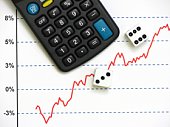
When buyers and sellers meet to exchange shares of a company, then they do it at the stock exchange. Stock exchanges are virtual or physical market places which offer standardized procedures for stock trading. This is of benefit for both parties, buyers and sellers, because only an efficient and liquid stock market is a secure place to trade shares.
Stock markets play an important role in today's economy. For a company it's the best place to raise much money quickly. Companies sell shares to have more money for investments. They can achieve their business goals faster. Private investors can buy shares to become a partial owner of the company with voting rights at the shareholder meeting and the right of shared profits. For an investor it's the only way to become part of a business and enjoy the chances for high profits without founding an own company. Stocks also limit the risks and liability. In the worst case, you loose the purchase price when the shares go worthless.
There are various different stock exchanges. The most important ones in the United States are the New York Stock Exchange (NYSE) and the NASDAQ. The NYSE is a physical market place while the NASDAQ is a virtual exchange. The NYSE, also known as the “Wall Street”, executes the orders to buy or sell shares through so called specialists in an “open outcry” system. Each specialist is responsible for a specific company. When an order to buy or sell stocks comes in then the specialist tries to match orders to receive an execution. Since all orders for the same stock come to the same specialist, he usually has enough shares to match the orders.
The NASDAQ works different because there is no specialist. There are several market makers per stock who are obligated to provide a current bid and ask price at all times. There are also electronic communication networks (ECN) which work 100% electronically. All orders are matched that way. Since there is no physical location of the NASDAQ like the NYSE trading floor, it's a virtual stock exchange.
Today's stock markets work very efficiently and fast. Advances in technology, especially the Internet, allowed the stock exchanges to grow rapidly the last years. Today everybody with a computer and Internet can trade stocks online with low transaction costs. Years ago stock trading was expensive and made sense only when you bought a large amount of shares. Now you can trade stocks in seconds and so inexpensively that so called day traders execute hundreds of trades per day from their home computer.
You still need a broker to get connected to the stock market. A broker is the intermediate between the investor and the stock exchange. He takes care that your orders are executed properly and timely. Discount brokers offer only order execution while full service brokers offer more services at a higher fee like research, advice and financial planning.
No matter which broker you choose, the stock market is an exciting place offering you the choice between thousands of companies. There are new opportunities every day.
About The Stock Market
The stock market can be a heaven or hell for investors.It is the arena to make serious money. Whether you are a newbie or an experience stock investor, you need to be well familiar with the stock market trading terms and terminologies. Here are a few terms that you may need to familiarize,especially if you are not familiar with the many terms and tactics used for negotiations.
Basket Trades - Large transactions made up of a number of different stocks.
Bear Market - Bear markets mainly characterize significant losses and declines in a particular market. With this type of behavior among stocks, most investors would generally want to sell more of their stocks and may be pessimistic about investing.
Bid and Ask - Highest price and lowest price that an investor will pay for a tradable.
Broker - A stockbroker is the person who handles the actual trading of stocks. He or she does the negotiations to buy and sell the stocks in behalf of the investors and the companies involved. The many various types of brokers may include full-service, online, auto-trade and discount brokers.
Bull Market - A bull market is a market that manifests a continuous increase in the value of its stocks as well as a steady growth. Generally, with this type of market, investors gain an optimistic attitude and may want to buy more rather than sell stocks.
Buy and Hold - The acquisition of a tradable for the long term rather than quick turnover.
Capital Losses - Losses resulting from selling at a loss.
Consumer Price Index - The gauge of US inflation.
Day Trader - A day trader is the person who buys and sells stocks aggressively in one day. Usually, he or she does this for several times each day in order to make quite a few small profits within the day.
Dividends - Dividends are added or bonus payments given to stockholders after a profitable quarter. With this sum of money, many people may often reinvest on more shares of stock, which allows individuals to earn so much.
Futures - Futures, just like stocks, are also traded in the market. However, these are purchased against future costs of commodities. You can earn from these, if in time, the actual price of commodities become higher than what you paid for the futures. On the other hand, you can also lose money if the price becomes lower that what you paid for.
Stocks - Stocks are probably the most important and common items traded in the stock market. These are actually shares of certain companies, which are publicly sold and traded.Whenever people buy a portion of stock in a particular company, this means that they acquire a share of ownership and investing in that specific business. Through this, a stockholder is given certain rights towards the company such as a vote in stockholder meetings as well as his or her financial share from the company's earnings.
Trading on Margin - Trading on margin may be similar to trading stocks with the use of borrowed money. Through this, you can purchase shares of stock for only a portion of the actual price. The remainder of the cost can be paid upon the actual sale of the particular stock, or on a later date.
These terms are only a few of the most commonly used language in stock trading. And upon encountering them, you may certainly have the impression of how intimidating the stock market can get. With the many complicated terminologies and tactics, you may easily get backtracked if you do not know enough about what you are dealing with.
Remember that if you are new at doing business in this arena, make sure that you take the extra mile to learn more about more terms as well as strategies on how you can best maximize profit. A little hard work will certainly get you far, and one of these days you will realize how all of this can pay off.
Both David A. Sorenger & are contributors for EditorialToday. The above articles have been edited for relevancy and timeliness. All write-ups, reviews, tips and guides published by EditorialToday.com and its partners or affiliates are for informational purposes only. They should not be used for any legal or any other type of advice. We do not endorse any author, contributor, writer or article posted by our team.
David A. Sorenger has sinced written about articles on various topics from Finances, Stock Exchange and Finances. David A. Sorenger is a stock exchange expert and provides detailed information on the , stocks, options and online brokers at his web site. David A. Sorenger's top article generates over 8100 views. to your Favourites.
has sinced written about articles on various topics from . . 's top article . to your Favourites.
British Take Over India There are memories which a traveler will take with him and the appetite inside him will cause him back here again and again. No doubts, India is termed a magical land