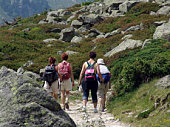
Effective mountain walking may mean relearning how to walk, and includes the correct technique reinforced by experience. There are several techniques which may be used, but they all have the same goal. Safe movement over difficult terrain, with the least expenditure of energy to arrive at a destination in good condition. Let's go over a few of the principles to be borne in mind.
You should centre your weight directly over your feet at all times (whenever practically possible). Place you foot flat on the ground to obtain as much sole-ground contact as possible. Place your foot on the uphill side of grass tussocks and other level spots to avoid twisting the ankle and straining the achilles tendon ( something to be avoided in my personal experience, achilles injuries are very painfull and can take weeks to heal). You should rest between steps by straightening the knee after each step. Take small steps at a slow pace. Try to avoid steep angles of ascent or descent, taking advantage of any indentation in the ground.
When in a group a tempo (number of steps a minute) should be set according to the pace at which the group is moving. Since physical differences will mean that the tempos of two people moving at the same speed will not be the same, an interval of three to five paces should be kept between individuals. This allows each person to adjust their stride for changes of slope or terrain, enhancing their tempo, pace, and rhythm. Those at the end of the file will benefit from this interval, since the accordian effect will be lessened.
Terrain, weather, and light conditions affect the rate of climb. The more adverse the conditions, the slower the pace. Moving too fast, even under ideal conditions, results in early fatigue, requiring more rest halts, resulting in loss of climbing time. You can only move as fast as your legs will allow. The key is rest, good nutrition, proper conditioning and acclimatization, as well as the will to climb.
Breaks, though necessary, should be kept to a mimimum. When taking a rest, boot laces should be loosened and the body ventilated (through layer dressing). At the end of a days climb, a good rest will revive tired muscles.
The rest step, as described above, is used for steep climbing, though not exactly elegant, this slow, steady, halting rest step keeps the pace slow and rhythmic. This is much more efficient than bursts of speed, which are rapidly exhausting and require longer recovery.
There is much to cover in mountain walking, and for that reason I intend to make it a short series of articles. Look out for part two with more techniques for different terrain.
The Art Of Mountain
Hard ground. This is firmly packed dirt that does not give way under the weight of a climber's step. When ascending, your knees must be locked on every step to rest the muscles of the legs. Steep slopes can be traversed rather than climbing straight up. Turning at the end of each traverse should be done by stepping off in the new direction with the uphill foot. This prevents crossing the feet and possible loss of balance. In traversing, the full sole principle is used by rolling the ankle away from the hill on each step. For small stretches, the herringbone step may be used, ascending straight up a slope with the toes pointed out. A normal progression as the slope steepens would be from walking straight up the slope, to a herringbone step, and then to a traverse on the steeper areas.
When descending you should move straight down the slope without traversing. Your back must be straight and knees bent so they take up the shock of each step. Walking with a slight forward lean and with feet in a normal position makes the descent easier.
Grassy slopes. They are usually composed of small tussocks of growth rather than one continuous field. In ascending, the upper side of each hummock, or tussock, is stepped on where the ground is more level than on the loer side.
When descending a grassy slope, a climber should traverse because of the uneven nature of the ground. You can easily build up too much speed and fall if a direct descent is tried. The hop-skip step can be useful on this type of slope. In this technique the lower leg takes all of the weight, and the upper leg is used for balance.
When traversing, the climber's uphill foot points in the direction of travel. The downhill foot points about 45 degrees off the direction of travel. This maintains maximum sole contact and prevents possible downhill ankle roll-out.
Scree slopes. These consist of small rocks and gravel that have collected below rock ridges and cliffs. Scree varies in size from grains of sand to the size of a fist. Sometimes it occurs in mixtures of all sizes, but normally scree slopes consist of the same size particles.
If possible you should avoid ascending scree slopes since they are difficult and tiring. All principles of ascending hard ground apply, but each step is chosen carefully so that the foot does not slide down when weight is placed on it. This is done by kicking in with the toe of the upper foot so that a step is formed in the scree. After determining that the step is stable, weight is transferred from the lower to the upper foot. This process is repeated.
The best method for descending scree slopes is to come straight down the slope using a short shuffling step with the knees bent, back straight, feet pointed downhill, and heels dug in. When several climbers descend a scree slope together, they should be as close together as possible, one behind the other, about an arms length apart. To prevent injury from dislodged rock. Scree slopes can be traversed using the ice axe as a third point of contact. Always keep the axe on the uphill side.
When the herring bone step is used to ascend scree, the axe can be used by placing both hands on top of it. The bottom, or point, of the axe is sunk into the scree, and the axe is used for balance. The climber uses the herringbone step up to the axe. The tendency to run down a scree slope is to be avoided so control is not lost. When the bottom of the route cannot be seen, caution should be used since dropoffs may be encountered.
Talus slopes. Talus is a slope formed by an accumulation of rock debris much larger than a man's fist. When walking in talus, wether ascending or descending, always step on the top of and on the uphill side of rocks. This requires the least amount of movement into the slope. Always use caution when moving in talus. Large rocks can be held in place by smaller keystones, disturbing them can cause rockslides. Climbers must stay in close columns whilst traversing. To prevent injuries, no member of the group traverses below another member. All other basics apply.
These techniques are valuable precautions to learn in order to reduce the risk of the most common mountaineering hazard - rockfall. Learnt and practised to the point where they become second nature will make you a confident, and much safer, climber.
Chris Haycock has sinced written about articles on various topics from Internet Marketing, Email Advertising and Investments. Chris Haycock is an information publisher, one of whose many hobbies is climbing. With recurring knee problems, including one replacement, making it no longer possible to physically climb, he spends a lot of time researching resources to help other climbe. Chris Haycock's top article generates over 33100 views. to your Favourites.
Benefits Of Art Therapy You will find that art therapy has become more accepted as a form of treatment by many specialists