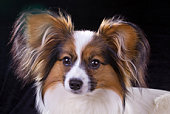
The word Papillon is French for 'butterfly.' The Papillon was named for its erect butterflylike ears that frame its face. Apparently the Papillon was developed in France during the sixteenth century from a small, long-eared dog called the Belgian Spaniel or Dwarf Spaniel. At the time the spaniels were popular in Spain, Italy and France. Down-ear and erect-ear types exist today and are judged by the same breed standards in AKC shows.
The diminutive breed was popular with European landed gentry and royal courts' ladies for many years before the mutation created the Papillon known today. The petite Papillon was designed to be a decorative lapdog. It has been reported that Madame Pompadour and Marie Antoinette owned Papillons. Ownership today is not limited to the upper class.
Papillons are excellent companions. They are hardier than they appear and are comfortable in all climates. They love the outdoors. The Papillon probably prefers to romp in the yard or take a leashed walk and rather would not be picked up and held. The Papillon can socialize with other small pets and children who have been properly instructed in small dog care.
Personality
A Papillon is lively, intelligent and loves to learn. It is loving and loveable, but is sometimes suspicious of strangers and prefers the company of its family. The Papillon is best trained with gentleness and consistency. He wants to please his owners and will look to you for rewards both verbal and edible. The Papillon is usually well represented in obedience classes and often surpasses larger dogs in learning ability. The Papillon also makes an excellent therapy or visitation dog after minimal obedience training.
Appearance
The Papillon stands 8 to 11 inches tall and weighs about 9 to 10 pounds. The Papillon is has a dainty and refined appearance with a fine bone structure. His legs are straight and feet are elongated. Its eyes are dark and not bulgy. The lip margins, nose rubber and eyelid rims are black. The tail is long, high set, and arched over the body.
Grooming
The coat is long, fine, silky and requires regular brushing. The Papillon does not have an undercoat. The coat falls flat on the back and sides with a profuse frill on the chest. It is short and close on the skull, muzzle and front legs. The rear of the forelegs, tail and thighs are covered with long hair. The Papillon's coat is easy to maintain with weekly brushing. You will need a plastic pin brush or bristle brush and comb. You can use a special whitening shampoo to make the coat shine.
Brush through the coat with a pin brush, then comb with a medium-toothed comb.
The Best Dog Breed For Me
While ranked as one of the ten most popular breeds, Poodles also have their share of Poodle health problems just like any other dog breed. Problems that affect the eyes are the most common for Poodles. Progressive retinal atrophy or PRA is the most common eye problem for Poodles. This condition destroys the photoreceptors found on the retina in the eye. Basically it causes the retina to shrivel up as the disease progresses until the dog goes completely blind. As the dog ages the condition will get progressively worse, but it can appear in dogs anywhere between two years of age to eight years of age.
A sudden appearance of being afraid of the dark is the most common symptom for a dog with this condition. PRA is also caused by a recessive gene that can remain dormant in a line of dogs for several generations before showing up in a dog. It is very difficult to predict which dogs will get PRA and currently there is no cure.
There are many more Poodle health problems that you should be aware and not just the eyes. Your dog can be affected by other Poodle health problems such as a bleeding disorder known as Von Willebrand's Disease, which affects the proteins in the platelets. As a result the dog's platelets don't have their normal adhesive properties and then they can't stick together in order to stop a dog from bleeding. The blood will not clot normally with any injury. Typically this condition is unnoticed in the dog until they have surgery or experience a traumatic injury, usually causing the dog to bleed out before treatment can be done.
If you have a miniature Poodle then there is achondroplasia, which is a condition where the long bone cartilage in the leg hardens because of their abnormally short legs. For the larger standard Poodle the common bone problem is hip dysphasia, which is a malformation of the hip socket and femoral head. Then there are allergies that can cause skin conditions on the face and feet. Some can result in itching, others in moist and smelly skin and still others that cause pustules to appear.
Poodle health problems include bloat, which can occur in standard Poodles. This is a condition that can happen in any breed that is large and deep chested. While the exact cause is not known the results of this condition are always and quickly fatal. With this condition the stomach fills with an excessive amount of gas and stomach fluids and cause the stomach to blow up like a balloon.
The buildup is the result of the stomach flipping itself over causing both ends to twist close. The only cure for a dog with this condition is to receive surgical care from a veterinarian within a few hours. Without the care of a veterinarian the dog will die and it will be painful for the dog. However, the bad news is that even with surgery the dog's chances of survival are not that high, but successful surgeries often correct the problem for the life of the dog.
has sinced written about articles on various topics from . . 's top article . to your Favourites.
Best Way To Exchange Money It is, I believe, the best way to succeed and make money with affiliate programs. I recommend these programs for anyone looking to start up an online business