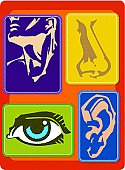
However, keep in mind that there are three dominating senses we gravitate toward. They are sight, hearing and feeling, or, visual, auditory and kinesthetic. When we learn, 75 percent of knowledge comes to us visually, 13 percent comes through hearing and 12 percent comes through smell, taste and touch. Most people tend to favor one of these perceptions over the others. As a Master Persuader, you need to identify and use your prospect's dominant perspective on the world. Granted, we generally make use of all five senses, but the point is to find the dominant perception. As you determine the dominant learning mode, consider the size of your audience. If you were speaking to one person, for example, you would want to pinpoint her/his one dominant perception. If you have an audience of one hundred, on the other hand, you would need to employ all three learning styles.
If you were to ask an auditory person to be an eyewitness to a robbery, he would describe the situation in this manner: “I was walking down First Avenue, listening to the singing birds, when I heard a scream for help. The yelling got louder. There was another scream, and then the thief ran off.” A visual person might describe the same situation this way: “I was walking down First Avenue, watching the birds playing in the air, when I noticed a large man coming around the corner. I saw him attack the other man, take his wallet and run from the scene.” The kinesthetic person would use this description: “I was walking down First Avenue and I felt a lump in my throat because I had a feeling something bad was going to happen. There was a scream then there was tension, and I knew that a man was getting robbed. I felt helpless to do anything.”
The most commonly prevalent of the senses is sight, or visual perception. One study showed that those who used visual presentation tools (slides, overheads, etc.) were 43 percent more persuasive than subjects who didn't. Also, those using a computer to present their visual aids were considered more professional, interesting and effective. Visually oriented people understand the world according to how it looks to them. They notice the details, like an object's shape, color, size and texture. They say things like, “I see what you mean,” “From your point of view …,” “How does that look to you?” “I can't picture it,” and “Do you see what I mean?” They tend to use words like “see,” “show,” “view,” “look,” “watch” and “observe.”
Auditory people perceive everything according to sound and rhythm. Phrases you would commonly hear would be, “I hear you,” “That sounds good to me,” “Can you hear what I'm saying?” “It doesn't ring a bell” and “Let's talk about it.” They use words such as “hear,” “listen,” “sounds,” “debate,” “silence,” “harmony,” “rings,” “say,” “speak,” “discuss” and “verbalize.”
Kinesthetic people go with what they feel, not only in a tactile way, but also internally. They are very into feelings and emotions. A kinesthetic person would say things like, “That feels right to me,” “I will be in touch with you,” “Do you feel that?” “I understand how you feel” and “I can sense it.” They use words such as “feel,” “touch,” “hold,” “connect,” “reach,” “unite,” “grasp,” “tension,” “sense,” “lift” and “understand.”
One last word on visual, auditory and kinesthetic sensations: A general way to tell which type describes a particular person is to watch the movement of her/ his eyes when s/he has to think about a question. Ask her/him a question, watch her/his eyes and make sure the question is difficult enough that s/he has to ponder for a moment. Generally, but not 100 percent of the time, if the person looks up when s/he thinks, s/he is visual. When s/he looks to either side, s/he is usually auditory. When s/he looks down, s/he is kinesthetic. I am simplifying a complicated science, but if you try it, you will be amazed at the accuracy of this technique.
Using The Five Senses
Creative thinking can work wonders to human mind and activities. People have been looking out for various methods and measures to boost creativity. Experts believe that creative thinking is directly related to the energy level of human brain. The article below offers you methods to boost your creative side of the brain via utilizing five vital senses.
Sight, hearing, tastes, smell and touch are the five vital senses that provide the brain with several pieces of information each second. The reason that we do not realize this is because we get familiar with the environment we live in and fail to pick up the details of what is available to us. Hence we usually fail to get creative ideas.
The basic idea is to break the barrier and start noticing the details of things around you. Here is an exercise to put your five senses in action. Try thinking of a book that you thoroughly enjoyed reading and would like to read again and again. Now, close your eyes and keeping the book in mind work on your five senses. Here are some points to help you enjoy this experience.
1)Sight:
Think about what appeals your eye as you have a vision of this book. Come in to a conclusion clearly and sum up whether it is the size, color, title or the art work of this book that appeals you.
2)Hearing:
What do you hear as you turn the pages of this book? Does it sound stiff, fine or confusing? Concentrate and think about how does it feel when you proceed with the book with an intention to read in further towards the end of it.
3)Smell:
Does your favorite book have a peculiar smell? Does it remind you of some place?
4)Touch:
Try to recollect the feeling you had when you first touched this book. Then think of what you felt each time you touched it. Think of what the texture of the cover made you feel like. Does it feel smooth, grainy or rough?
5)Taste:
This may sound bizarre! However, taste has an important role to play here. You need to imagine the taste your tongue provides you when you think of this book. Yes, think of the flavor of your favorite book.
Once you are through with working out on your five senses, your brain is left with certain images and these pictures would enhance your power of concentration.
Remember, that you require putting in a lot of sensations into your creative thinking activity. The exercise for creative thinking mentioned in this article will storm your brain with excellent ideas.
In case, you feel that you are not getting good ideas and pictures in your mind, you may be suffering from a state called "stuckness". You need to work out with your five senses again. Just think about the color that is associated with this feeling. Also think about the kind of sound you want to provide this feeling. Creativity can be enhanced with the help of using five senses. The more you practice, the more you enhance your creativity.
Both Kurt Mortensen & Khoon Eng are contributors for EditorialToday. The above articles have been edited for relevancy and timeliness. All write-ups, reviews, tips and guides published by EditorialToday.com and its partners or affiliates are for informational purposes only. They should not be used for any legal or any other type of advice. We do not endorse any author, contributor, writer or article posted by our team.
Kurt Mortensen has sinced written about articles on various topics from Leadership, Sales and Negotiation and Web Development. Kurt Mortensen's trademark is Magnetic Persuasion; you should attract customers, like a magnet. Claim your success and learn what the ultra-prosperous know by going to. Kurt Mortensen's top article generates over 12100 views. to your Favourites.
Khoon Eng has sinced written about articles on various topics from Web Development, Marketing and Communications and Web Development. Download a That Will Change Your Life Forever!To Learn How to Unleash the Power of Law of Attraction, visit. Khoon Eng's top article generates over 2400 views. to your Favourites.
A World Of Knowledge So, stop running yourself ragged doing those endless web searches and check out the endless supply of ebooks available to you.