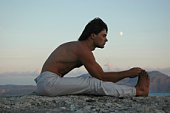
Yoga teachers should have good working knowledge of Yoga posture alignment and know how to assist a Yoga student who is holding an asana. When you are about to give an assist - ask for permission first; as this might be considered an invasion of privacy by some of your Yoga students. Yoga teachers should not take for granted that all students want a physical assist and should respect their space.
Yogic philosophy: Yamas and Niyamas are the ethical principles of Yoga. Most of us read Patanjali's guidelines from the Yoga Sutras. If you want to become a Yoga teacher, you should get your own copy of the Yoga Sutras. The Yamas contain the following five self restraints.
Ahimsa: A Yoga teacher should be a living example of how to avoid violence, harming, and especially killing. This principle can be carried further, as you should avoid purposely injuring yourself in any way. To avoid harming animals could also be included within this principle of Yoga. It is one more reason to consider vegetarianism or, at least, to cut back on meat consumption.
Satya: To be true and honest in every way. This is a very simplistic principle and includes avoiding deception of any kind, shape, or form. However, the truth can sometimes hurt people deeply, so you must use your best judgment when you want to avoid harming someone, but do not lie.
Asteya: This is to avoid stealing in any way. This is a simple principle, but throughout history, laws were sometimes modified to justify stealing. The problem is the desire of something - to the point of jealousy, and finally outright theft. The elimination of the Cathars, Africans, and Native Americans are just three examples of people who suffered from modified laws that took away their land.
Brahmacharya: To be free from sensual imprisonment and to live in moderation. At first we might think of lust, and correct this by seeing another person as more than a sexual object. However, most obesity can be found within industrialized nations, where the lust that may kill most people, is over consumption of food.
Therefore, we should strive to be moderate in eating, drinking, sex, Internet use, consumerism, computer games, television, and our behavior. With that said, the use of any illegal drugs is very far from moderate or responsible behavior.
Aparigraha: To be free from greed, wanting, hoarding, and to avoid being selfish. This is one more good reason to give to charity, and help those in need.
Yoga teachers should not only know these principles, but should live by them.
Copyright 2007 - Paul Jerard / Aura Publications
What Every Teacher Should Know
Since Yama literally means "control," you could say that Pranayama is control of "vital energy." When teaching Yoga classes, the four stages of Pranayama should be thoroughly explained. If you think in terms of a pendulum, it is much similar to the four stages of Pranayama. The pendulum moves in one direction, pauses, then moves in the opposite direction, and pauses again. This is the same action that occurs in the lungs, when a Yoga student practices Pranayama.
The following are the four stages of Pranayama. Puraka is the inhalation stage. Antar Kumbaka is the pause that happens when we retain the inhalation. Rechaka is the exhalation stage of a breath. Bahir Kumbaka is external breath retention and occurs after the exhalation stage.
Why should we get so technical about Pranayama techniques in the average Yoga class? Many Yoga students will come to your classes for a variety of pain relieving methods, and some Pranayama techniques usually help alleviate pain.
When a person has pain, he or she can think of nothing else. Pain is the companion you wish you never met. Pranayama can help us say goodbye to pain, but it must be performed technically and safely.
Here are some of the many forms of Pranayama a Yoga teacher should know. There are more, but this is a good foundation. It should also be noted that Yoga students are advised to seek guidance from a competent Yoga teacher.
Pranayama methods deserve much more respect and should not be taken lightly. One Pranayama session of 20 minutes, would make any Yoga beginner realize the hard work that goes into this practice. The value of Pranayama, and quality of life it can bring, cannot be overstated.
Ujjayi Pranayama: Also known as victorious breath is often seen in Vinyasa style Hatha Yoga, Power Yoga, and Ashtanga Yoga classes, but can be found in other Yoga styles, as well. This technique allows the Yoga student to concentrate deeper on his or her practice. However, this is also a calming form of Pranayama that can be performed before bedtime, relaxation, or meditation.
The glottis is gently contracted to draw the length of your breath out. Yoga students should seek guidance from a certified Yoga teacher when integrating bandhas with Ujjayi Pranayama.
Natural Breath: This is the breath of a new born baby. It is a full breath in the upper, middle, and lower compartments of the lungs. The stomach, intercostals, and chest should expand equally during an inhale. If a student is naturally short of breath and nervous, he or she may have difficulty learning this technique, even with the guidance of a certified Yoga teacher.
However, this same student is relieved to master natural breath, as this Pranayama will also calm those who feel anxiety, nervousness, and hypertension. This Pranayama technique is not a cure for nervousness, but some Yoga students have had amazing relief from natural breath.
Dhirga Pranayama: Is a three part breath, where awareness is developed through all three lung compartments from the bottom up on an inhale and from the top down on an exhale. This is a very common practice within a Hatha Yoga class.
Kapalabhati Pranayama, Sitali Pranayama, and Bhastrika Pranayama are also essential techniques. As stated earlier; there are many more Pranayama techniques that can be taught by Hatha yoga teachers, as quality of life can be rediscovered through their practice.
Jackie has sinced written about articles on various topics from Yoga Practice, Anger Control and Yoga Practice. Paul Jerard, E-RYT 500, is a co-owner and the director of Yoga teacher training at: Aura Wellness Center in, Attleboro, MA. He has been a certified Master Yoga teacher since 1995.http://www.yoga-teacher-training.org. Jackie's top article generates over 74000 views. to your Favourites.
Below Invoice New Car Visit several dealerships and see who offers the best price. Once your salesperson realizes you are armed with all the inside info, youll get the best deal possible