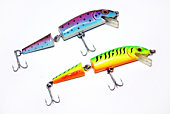
The key concept you need to remember is that Smallmouth Bass live and feed towards the bottom. Top running baits like spinnerbaits or poppers will not be effective.
In my opinion the crankbait is the most effective lure for Smallmouth Bass. They key thing to remember is choosing the correct crankbait. For this artificial lure to work effectively it needs to have a retrieve depth at or near the bottom of the area you are fishing. Optimally the bait will occasionally bounce off the bottom while retrieved.
When you buy a crankbait you will notice that they are generally classified as shallow runners or deep runners. The running depth is determined by the body shape and the size and angle of the plastic lip located near the eye hole.
Shallow running baits generally run at three to five feet, deep running baits between ten to fifteen feet. The speed of your retrieve will alter the bait somewhat as well, a faster retrieve equates to a deeper running depth.
Your other primary concern in selecting a crankbait is matching the forage of the fish. When fishing a river you will want to keep your bait small, in lakes you can use larger baits.
If the primary forage is crayfish you should select a crankbait that compares to a crayfish in both color and shape. In lakes where the primary forage is shad you should select a fat crankbait that is silver.
Match the bait to the forage fish.
Smallmouth Bass are a predator that likes to use rocks as an ambush point. You need to position your casts so the crankbaits will swim directly near the rocks you have chosen as a likely ambush point.
The thing to remember when fishing a crankbait is that it is a lure designed for active fish. Crankbaits work best in early morning and near dusk. They are also more effective lures in the spring and fall than they are during the dog days of summer.
You need to keep your retrieve fast when using this lure. You should move you rod tip up and down slightly during your retrieve to alter the depth and direction of the lure. Remember fish do not often swim in a direct straight line, nor should your lure.
If you are fishing a known spot to hold Smallmouth Bass and are having little success you can assume the fish are not very active.
In this situation you will need to change your approach by switching lures. The jig and pig combination is excellent for these situations.
A jig and pig is simply a weighted jig head with a piece of colored pork rind attached to it. You can also use a plastic twister tail or other plastic attachment with equal effectiveness. I do however like contrast when using this bait.
If I am using a light colored jig head I prefer a dark colored attachment and vice versa.
Smallmouth Bass Fishing Lures
Bass fishing has evolved to a near cult popularity with so many anglers through the years that there have been so many products made, clubs formed, and articles written about it. Here you will read about the types of Bass fishing lures you can use to catch them. Also, there is also a list on the necessary equipments to have when going bass fishing.
The type of bass that will bite almost anything is the largemouth bass. Minnows, worms, or other live bait, plus poppers or streamers presented with a fly rod, or plugs thrown from a casting or spinning rod are ways where they can be caught. Since bass is usually associated with weeds, a weedless bait will often be necessary. Morning and evening are the best fishing times when warm months come. They usually like to stay in warm water and warm weather. There is only little bite during winters.
Smallmouth bass pound for pound are the scrappiest fish of all fresh water bass. They are usually associated with a rocky stream or lake environment where its favorite food, the crayfish, is plentiful. The best lake fishing takes place in the month in June and just after, the spawning season, and in early fall. Natural lure like hellgrammites, dragonfly larvae and crayfish are especially useful during early morning or late evening. Most likely, the best artificial lures are those who are used on the surface. Light tackle is ideal. Fish quietly, casting toward rocks or logs, keeping the rod tip up and the line tight. Many fishermen debate on the colors used for their lures. This may vary on the bass fish that is to be caught.
Fishing requires more than just a simple fishing rod and some lure for serious fisherman. People who fish for leisure are those who fish because it's their hobby, they can have some tools and accessories that will help them make it easier and be able to catch more fish. Here are some suggested tools for starters that will help them improve in catching fish:
- Fishing Rod. The most important piece of equipment and should be chosen with care. A basic rod-and-reel set is enough for beginners. It is necessarily important to have more featured materials. The most important is that you should learn how to use the rod and be comfortable to it before moving into another difficult type of equipment. Professional fisherman can experiment different types of rod for them to know what works best for them.
When buying a fishing rod, know before you enter the store what kind of fishing you'll be doing, and under what conditions. Rods come from different varieties of materials, from wood laminates to fiberglass to carbon fiber. Rod handles should fit securely in your palm, and practice casting with the rod, to test how flexible and easy to use it is. In addition have the proper length of the rod. For using lighter lure, or catching tiny fish, a 4 inch to 6 inch rod is advisable to use. For using larger lure, which gets larger fishes or casting longer distances, a rod of at least 6 inches may be required.
- Waders. It is a water- resistant covering you wear over your pants to keep them dry so you can wade out into the water. A lot of are made like overalls, covering the chest and the legs, and with boots attached, for ultimate defense. Make sure the boots are warm and secure, to supply better balance while walking on wet rocks.
- Fishing Vest. Contains several pockets for storing fish equipments and your hands are free to manage the fishing rod. Also, should you have to wade out into the water, wearing a vest will let you to have all of your gear with you at all times. Make a decision beforehand which gear is necessary; if you store too much in the vest, it may make it too heavy to wear, which could bring you down.
- Tackle Box or Fly Box. In fishing it requires a lot of supplies and you need a something big to store all your gears. Spend in a durable tackle box, in which you can store your entire lure, keeping it easily to get to. Styles are classified into simple and inexpensive, and large and costly. Fishermen may only need something small, but the more advanced fishermen may want something handier. Furthermore, you should consider a fly box. Small enough to fit a vest pocket and allows you to keep them with you as needed.
Jack Mitchell has sinced written about articles on various topics from Fishing, Puerto Vallarta and Fishing. For a free course on finding the best bass fishing guides and the best , visit. Jack Mitchell's top article generates over 8100 views. to your Favourites.
Business Plans Executive Summary When you develop your executive summary, create an ?elevator pitch.? This is a three minute summary of your executive summary, with the purpose of creating interest in your idea from potential lenders or partners